
Kirjojen hintavertailu – 12 903 725 kirjaa ja 27 kauppaa

Kirjailija

Jane Dixon

Kirjat ja teokset yhdessä paikassa: 3 kirjaa, julkaisuja vuosilta 2002–2015, suosituimpiin kuuluu The Changing Chicken. Vertaile teosten hintoja ja tarkista saatavuus suomalaisista kirjakaupoista.

3 kirjaa

Kirjojen julkaisuvuodet: 2002–2015.

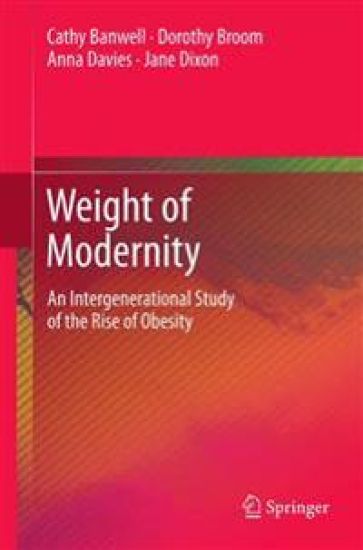
Weight of Modernity

Weight of Modernity

Cathy Banwell; Dorothy Broom; Anna Davies; Jane Dixon

Springer
2015
nidottu
Over a half of adults in the US, Canada, Australia and numerous European countries are now overweight or obese, a proportion that has risen sharply in the past two decades. Dominant biomedical explanations focus on the energy equation – an imbalance between energy intake and expenditure - and remedies focus on motivating individuals to restore the balance by eating better and being more active, or – in extreme cases – surgical intervention. This book offers a perspective that sees increasing obesity as a social phenomenon as well as a public health problem. It contains detailed accounts of three generations of Australians’ experiences of changing environments and the emergence of social trends such as increasing availability of convenience foods, the individualisation and commercialisation of leisure, car reliance, and busyness. Participants' narratives are interwoven with sociological and historical analyses of changes to show how contemporary Australians are experiencing and adapting to dramatic socio-cultural and environmental changes that are reshaping their lives and, in many cases, their bodies. The book demonstrates that obesity is an unintended consequence of economic development accompanied by profound socio-cultural changes, and by identifying the key developments the authors propose leverage points. While the research was conducted in Australia, the fundamental drivers of rapid weight gain are equally present in other modern, secular societies.
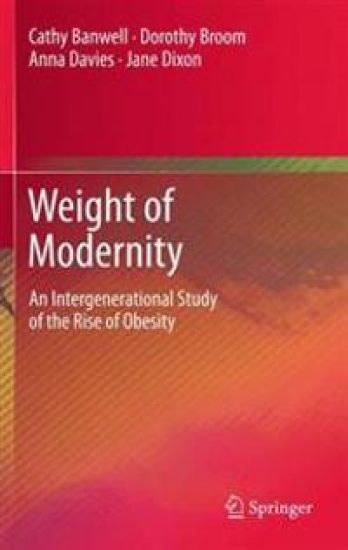
Weight of Modernity

Weight of Modernity

Cathy Banwell; Dorothy Broom; Anna Davies; Jane Dixon

Springer
2012
sidottu
Over a half of adults in the US, Canada, Australia and numerous European countries are now overweight or obese, a proportion that has risen sharply in the past two decades. Dominant biomedical explanations focus on the energy equation – an imbalance between energy intake and expenditure - and remedies focus on motivating individuals to restore the balance by eating better and being more active, or – in extreme cases – surgical intervention. This book offers a perspective that sees increasing obesity as a social phenomenon as well as a public health problem. It contains detailed accounts of three generations of Australians’ experiences of changing environments and the emergence of social trends such as increasing availability of convenience foods, the individualisation and commercialisation of leisure, car reliance, and busyness. Participants' narratives are interwoven with sociological and historical analyses of changes to show how contemporary Australians are experiencing and adapting to dramatic socio-cultural and environmental changes that are reshaping their lives and, in many cases, their bodies. The book demonstrates that obesity is an unintended consequence of economic development accompanied by profound socio-cultural changes, and by identifying the key developments the authors propose leverage points. While the research was conducted in Australia, the fundamental drivers of rapid weight gain are equally present in other modern, secular societies.

The Changing Chicken

The Changing Chicken

Jane Dixon

UNSW Press
2002
nidottu
Chicken meat is one of Australia's most popular and affordable foods, but it was not ever thus. The Changing Chicken provides a unique view of food systems and culture through an examination of our changing attitudes to chicken meat. Colourful descriptions are provided of the activities conducted in hatcheries, on chicken farms, in processing plants, in supermarket delicatessens and in household kitchens. Power, in its many forms, provides the unifying thread, and the concepts of authority and the cultural economy are used to explain how food systems are evolving. The humble table chicken challenges dominant assumptions about how foods become esteemed, or are judged good to eat. By building on insights from the sociology of consumption, retail geography and political economy, the author builds a new framework for studying the shifting balance of power in food systems. The analysis is intentionally multi-disciplinary and, by comparing the Australian situation with international trends in chicken meat production and consumption, the book sheds light on the complex issue of global food systems and national culinary cultures.