Kirjojen hintavertailu – 12 903 737 kirjaa ja 27 kauppaa

Kirjailija

Janet Holmes

Kirjat ja teokset yhdessä paikassa: 17 kirjaa, julkaisuja vuosilta 1998–2022, suosituimpiin kuuluu An Introduction to Sociolinguistics. Vertaile teosten hintoja ja tarkista saatavuus suomalaisista kirjakaupoista.

17 kirjaa

Kirjojen julkaisuvuodet: 1998–2022.

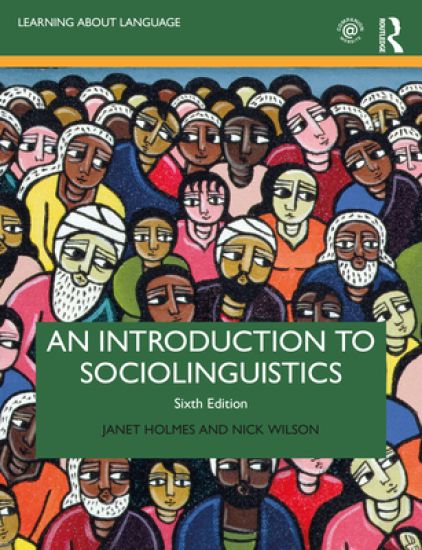
An Introduction to Sociolinguistics

An Introduction to Sociolinguistics

Janet Holmes; Nick Wilson

TAYLOR FRANCIS LTD
2022
nidottu

Halvin toimitettuna 52,80 €

Sociolinguistics is the study of the interaction between language and society. In this classic introductory work, Janet Holmes and Nick Wilson examine the role of language in a variety of social contexts, considering both how language works and how it can be used to signal and interpret various aspects of social identity. Divided into three parts, this book explains basic sociolinguistic concepts in the light of classic approaches, as well as introducing more recent research. This sixth edition has been revised and updated throughout, using key concepts and examples to guide the reader through this fascinating area, including:• New material on gender, social media and online use of language, codeswitching, and language policy• An updated companion website that is fully cross- referenced within this book and features video and audio materials and links to useful websites• Revised examples and exercises that include new material from Asia and South America• Fully updated further reading and references sectionsAn Introduction to Sociolinguistics is an essential introductory text for all students of sociolinguistics and a splendid point of reference for students of English language studies, linguistics, and applied linguistics.

An Introduction to Sociolinguistics

An Introduction to Sociolinguistics

Janet Holmes; Nick Wilson

TAYLOR FRANCIS LTD
2022
sidottu
Sociolinguistics is the study of the interaction between language and society. In this classic introductory work, Janet Holmes and Nick Wilson examine the role of language in a variety of social contexts, considering both how language works and how it can be used to signal and interpret various aspects of social identity. Divided into three parts, this book explains basic sociolinguistic concepts in the light of classic approaches, as well as introducing more recent research. This sixth edition has been revised and updated throughout, using key concepts and examples to guide the reader through this fascinating area, including:• New material on gender, social media and online use of language, codeswitching, and language policy• An updated companion website that is fully cross- referenced within this book and features video and audio materials and links to useful websites• Revised examples and exercises that include new material from Asia and South America• Fully updated further reading and references sectionsAn Introduction to Sociolinguistics is an essential introductory text for all students of sociolinguistics and a splendid point of reference for students of English language studies, linguistics, and applied linguistics.

Power and Politeness in the Workplace

Power and Politeness in the Workplace

Janet Holmes; Maria Stubbe

Routledge
2015
sidottu
Power and Politeness in the Workplace has become established as a seminal text for courses in language and professional communication. Co-authored by bestselling author Janet Holmes, this text provides insights into the way we all talk at work, including a wealth of material illustrating the way people communicate with each other in their ordinary everyday encounters in their workplaces. The analysis focuses, in particular, on how and why people "do" power and politeness in the workplace, and examines the discourse strategies involved in balancing the competing demands of meeting workplace objectives and getting things done on time with maintaining good collegial workplace relationships. Drawing on a large and very varied corpus of data collected in a wide range of workplaces, the authors explore specific types of workplace talk, such as giving advice and instructions, solving problems, running meetings and making decisions. Attention is also paid to the important contribution of less obviously relevant types of workplace talk such as humour and small talk, to the construction of effective workplace relationships. In the final chapter some of the practical implications of the analyses are identified. This Routledge Linguistics Classic is here reissued with a new preface from the authors, covering the methods of analysis, an update on the Language in the Workplace project and a look at the work in the context of recent research. Power and Politeness in the Workplace continues to be a vital read for researchers and postgraduate students in the fields of applied linguistics and communication studies.
Women, Men and Politeness

Women, Men and Politeness

Janet Holmes

Routledge
2015
sidottu
Women, Men and Politeness focuses on the specific issue of the ways in which women and men express politeness verbally. Using a range of evidence and a corpus of data collected largely from New Zealand, Janet Holmes examines the distribution and functions of a range of specific verbal politeness strategies in women's and men's speech and discusses the possible reasons for gender differences in this area. Data provided on interactional strategies, 'hedges and boosters', compliments and apologies, demonstrates ways in which women's politeness patterns differ from men's, with the implications of these different patterns explored, for women in particular, in the areas of education and professional careers.
Power and Politeness in the Workplace

Power and Politeness in the Workplace

Janet Holmes; Maria Stubbe

Routledge
2015
nidottu
Power and Politeness in the Workplace has become established as a seminal text for courses in language and professional communication. Co-authored by bestselling author Janet Holmes, this text provides insights into the way we all talk at work, including a wealth of material illustrating the way people communicate with each other in their ordinary everyday encounters in their workplaces. The analysis focuses, in particular, on how and why people "do" power and politeness in the workplace, and examines the discourse strategies involved in balancing the competing demands of meeting workplace objectives and getting things done on time with maintaining good collegial workplace relationships. Drawing on a large and very varied corpus of data collected in a wide range of workplaces, the authors explore specific types of workplace talk, such as giving advice and instructions, solving problems, running meetings and making decisions. Attention is also paid to the important contribution of less obviously relevant types of workplace talk such as humour and small talk, to the construction of effective workplace relationships. In the final chapter some of the practical implications of the analyses are identified. This Routledge Linguistics Classic is here reissued with a new preface from the authors, covering the methods of analysis, an update on the Language in the Workplace project and a look at the work in the context of recent research. Power and Politeness in the Workplace continues to be a vital read for researchers and postgraduate students in the fields of applied linguistics and communication studies.
Leadership, Discourse, and Ethnicity

Leadership, Discourse, and Ethnicity

Janet Holmes; Meredith Marra; Bernadette Vine

Oxford University Press Inc
2012
sidottu
This is the first book in the field of workplace discourse to examine the relationships among leadership, ethnicity, and language use. Taking a social constructionist approach to the ways in which leadership is enacted through discourse, Leadership, Discourse, and Ethnicity problematizes the concept of ethnicity and demonstrates the importance of context-particularly the community of practice-in determining what counts as relevant in the analysis of ethnicity. The authors analyse everyday workplace interactions supplemented by interview data to examine the ways in which workplace leaders use language to achieve their transactional and relational goals in contrasting "ethnicized" contexts, two of which are Maori and two European/Pakeha. Their analysis pays special attention to the roles of ethnic values, beliefs and orientations in talk.
Leadership, Discourse, and Ethnicity

Leadership, Discourse, and Ethnicity

Janet Holmes; Meredith Marra; Bernadette Vine

Oxford University Press Inc
2012
nidottu
This is the first book in the field of workplace discourse to examine the relationships among leadership, ethnicity, and language use. Taking a social constructionist approach to the ways in which leadership is enacted through discourse, Leadership, Discourse, and Ethnicity problematizes the concept of ethnicity and demonstrates the importance of context-particularly the community of practice-in determining what counts as relevant in the analysis of ethnicity. The authors analyse everyday workplace interactions supplemented by interview data to examine the ways in which workplace leaders use language to achieve their transactional and relational goals in contrasting "ethnicized" contexts, two of which are Maori and two European/Pakeha. Their analysis pays special attention to the roles of ethnic values, beliefs and orientations in talk.
The Ms of  M  y  Kin

The Ms of M y Kin

Janet Holmes

Shearsman Books
2009
pokkari
If you write out "The Poems of Emily Dickinson" and erase some of the letters very neatly and precisely, you can get to The ms of m y kin - the manuscript of my kin, as it were; the manuscript of my family. It might also be said to be the manuscript of my kind. The practice of erasure was most famously accomplished (and perhaps invented) by the British artist Tom Phillips in his book A Humument (an erasure of a Victorian novel titled A Human Document) and later, by the American poet Ronald Johnson, who erased Milton's Paradise Lost into a book called Radi os. In Phillips's books-he did more than one version of A Humument-the artist created paintings over each page of the novel, reserving only certain words that told a different story than did the original work. (A new character, called "Toge," emerged from the word "together," for example.) Johnson, a poet, simply removed the words he did not wish to use as if whiting them out-the remaining words stood in the same relationship to each other as they did in the original poem. (Janet Holmes)
Gendered Talk at Work

Gendered Talk at Work

Janet Holmes

Wiley-Blackwell (an imprint of John Wiley Sons Ltd)
2007
sidottu
Gendered Talk at Work examines how women and men negotiate their gender identities as well as their professional roles in everyday workplace communication. written accessibly by one of the field’s foremost researchersexplores the ways in which gender contributes to the interpretation of meaning in workplace interactionuses original and insightfully analyzed data to focus on the ways in which both women and men draw on gendered discourse resources to enact a range of workplace rolesillustrates how a qualitative analysis of workplace discourse can throw light on the many ways in which workplace discourse provides a resource for constructing gender identity as one component of our complex socio-cultural identity
F2F

F2F

Janet Holmes

University of Notre Dame Press
2006
nidottu
f2f: Shorthand for "face-to-face," as in meeting someone in real life, flesh-to-flesh, as opposed to in the electronic world of cyberspace. Used in chat rooms and while instant messaging on the Internet. At the core of this challenging new collection from Janet Holmes is the conceit of the sense of sight and the complex role it plays in women's self-identities and relationships. Emily Dickinson is introduced as the iconic female writer who, unread in her time, is frequently misinterpreted and unheard. Holmes relates Dickinson's self-isolation to the writer's isolation from the reader and the intimacy of the act of reading. Echo, Eurydice, and Eros—other "E" figures, these mythological, their stories relying on seeing and being seen—are related by Holmes to twentieth-century counterparts manifesting as an anorexic, a flamboyant dresser, and a love god, respectively. Holmes intersperses her meditation with the language of online text-messaging, employing it as a vehicle for probing the dual limitations and liberties afforded on-line correspondents. Through her correspondents' postings, we chart their relationship evolving without benefit of ever meeting or exchanging photographs, the participants deeply affected by the absence of the sense of sight. By turns provocative and timid, lyrical and terse, the voices in f2f exhibit myriad human reactions to how seeing each other influences how we behave.
Gendered Talk at Work

Gendered Talk at Work

Janet Holmes

Wiley-Blackwell (an imprint of John Wiley Sons Ltd)
2006
nidottu
Gendered Talk at Work examines how women and men negotiate their gender identities as well as their professional roles in everyday workplace communication. written accessibly by one of the field’s foremost researchersexplores the ways in which gender contributes to the interpretation of meaning in workplace interactionuses original and insightfully analyzed data to focus on the ways in which both women and men draw on gendered discourse resources to enact a range of workplace rolesillustrates how a qualitative analysis of workplace discourse can throw light on the many ways in which workplace discourse provides a resource for constructing gender identity as one component of our complex socio-cultural identity
Language Matters

Language Matters

Laurie Bauer; Janet Holmes; Paul Warren

Red Globe Press
2006
sidottu
This book provides a non-technical introduction to the study of language by focusing on questions such as: Where does language come from? Why don't we all talk the same? Who needs grammar? Suitable for students with no experience of linguistics, this lively introduction to language approaches will encourage students to think.
A Heritage of Light

A Heritage of Light

Loris Russell; Janet Holmes

University of Toronto Press
2003
pokkari
The nineteenth century opened in the flicker of tallow candles and closed in the glare of Edison's electric lamp. Between those two events inventors and manufacturers developed a wonderful assortment of progressively more efficient lighting devices, burning a variety of fuels. Loris Russell records with scientific attention to detail – backed up by more than 200 illustrations – how these lamps were made and used. His text is interspersed with accounts of his own experiments with the fuels and mechanisms of earlier generations. Russell drew on his own large collection of lighting devices and on the collections of museums and of other individuals for his study, and documented his research with Canadian and United States patent papers, trade catalogues, newspapers, magazines, memoirs, and books. This is the first detailed story of that technological revolution in North America, and while told in the setting of the Canadian home, the developing technology of lighting was common to both sides of the border. A Heritage of Light is of equal importance to collectors and historians in the United States and Canada. This newly reprinted edition of Russell's classic 1968 study has a new introduction by Janet Holmes.
A Heritage of Light

A Heritage of Light

Loris Russell; Janet Holmes

University of Toronto Press
2003
sidottu
The nineteenth century opened in the flicker of tallow candles and closed in the glare of Edison's electric lamp. Between those two events inventors and manufacturers developed a wonderful assortment of progressively more efficient lighting devices, burning a variety of fuels. Loris Russell records with scientific attention to detail – backed up by more than 200 illustrations – how these lamps were made and used. His text is interspersed with accounts of his own experiments with the fuels and mechanisms of earlier generations. Russell drew on his own large collection of lighting devices and on the collections of museums and of other individuals for his study, and documented his research with Canadian and United States patent papers, trade catalogues, newspapers, magazines, memoirs, and books. This is the first detailed story of that technological revolution in North America, and while told in the setting of the Canadian home, the developing technology of lighting was common to both sides of the border. A Heritage of Light is of equal importance to collectors and historians in the United States and Canada. This newly reprinted edition of Russell's classic 1968 study has a new introduction by Janet Holmes.
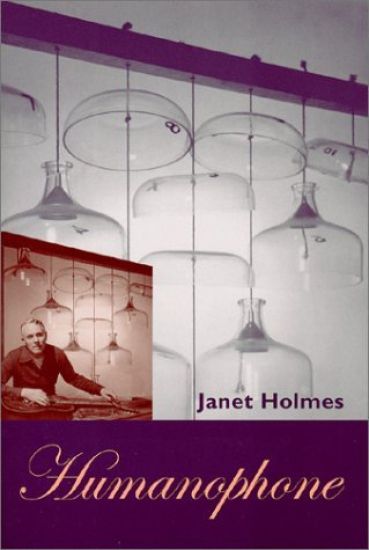
Humanophone

Humanophone

Janet Holmes

University of Notre Dame Press
2001
sidottu
The poetry in Humanophone, the third volume from award-winning poet Janet Holmes, celebrates composers and creators such as Harry Partch, Raymond Scott, Leon Theremin, and George Ives, who had to invent new instruments to capture the music heard in their "mind's ear." Taking its title from a George Ives invention—an instrument made from a group of humans, each of whom sings a single note, arrayed like a xylophone—Humanophone appears on its surface to be about music. But its real subject is the artist's creative dilemma—how to deliver a new idea, whether it be a song or a poem, through existing media. Holmes works language into a variety of forms both familiar—syllabics, couplets, villanelles, sonnets—and engagingly new. With everything from kumquats to abandoned wedding pictures, Clara Bow to Bill Robinson, Keats's belle dame to Dante's Francesca, feng shui to a recipe for octopus, Humanophone celebrates how the body shapes art from the world it is given. In Humanophone, Holmes not only chronicles events such as Harry Partch's transformation of glass chemical containers from the Berkeley Radiation Lab into the melodious and beautiful Cloud-Chamber Bowls, but also traces a playful path through the familiar, as a trombone's upwards glissando becomes "a backwards pratfall/in brass." Engaging a broad array of subjects, Holmes's poetry is as delightful as it is thoughtful, as simple as it is complex.
Humanophone

Humanophone

Janet Holmes

University of Notre Dame Press
2001
nidottu
The poetry in Humanophone, the third volume from award-winning poet Janet Holmes, celebrates composers and creators such as Harry Partch, Raymond Scott, Leon Theremin, and George Ives, who had to invent new instruments to capture the music heard in their "mind's ear." Taking its title from a George Ives invention—an instrument made from a group of humans, each of whom sings a single note, arrayed like a xylophone—Humanophone appears on its surface to be about music. But its real subject is the artist's creative dilemma—how to deliver a new idea, whether it be a song or a poem, through existing media. Holmes works language into a variety of forms both familiar—syllabics, couplets, villanelles, sonnets—and engagingly new. With everything from kumquats to abandoned wedding pictures, Clara Bow to Bill Robinson, Keats's belle dame to Dante's Francesca, feng shui to a recipe for octopus, Humanophone celebrates how the body shapes art from the world it is given. In Humanophone, Holmes not only chronicles events such as Harry Partch's transformation of glass chemical containers from the Berkeley Radiation Lab into the melodious and beautiful Cloud-Chamber Bowls, but also traces a playful path through the familiar, as a trombone's upwards glissando becomes "a backwards pratfall/in brass." Engaging a broad array of subjects, Holmes's poetry is as delightful as it is thoughtful, as simple as it is complex.
The Green Tuxedo

The Green Tuxedo

Janet Holmes

University of Notre Dame Press
1998
nidottu
Janet Holmes's second book of poems explores and interrogates the quotidian life of the late twentieth century for what exists behind its often seductive appearance. In these poems we see beneath acceptable, sleek surfaces into the turbulence they often conceal, as the splendid green tuxedo of the title may disguise a heart that harbors racism, fear, and violence. Holmes exhorts us to look beyond the face value of what presents itself, to resist literal interpretations, and to plumb the many depths afforded by each encounter with the world outside ourselves. In the second half of The Green Tuxedo, Holmes draws on recently discovered diaries kept by her journalist father nearly fifty years before her birth. Sifting through evidence and memory, she entwines actual diary entries (such as a seventy-seven-name list of "Wild Women I Have Known") with speculation and invention to generate a portrait that discovers him- re-invents him-as a young man. This sequence, searching and elegiac, affords closure to a book whose questionings suggest less a need for absolute answers than a declaration of the need to explore. Holmes leads us through a world of appearances, celebrating the necessary examination of what is concealed.