Kirjojen hintavertailu – 12 903 735 kirjaa ja 27 kauppaa

Kirjailija

János Kornai

Kirjat ja teokset yhdessä paikassa: 13 kirjaa, julkaisuja vuosilta 1992–2023, suosituimpiin kuuluu Kraft Des Gedankens: Ungewohnliche Erinnerungen an Eine Intellektuelle Reise. Vertaile teosten hintoja ja tarkista saatavuus suomalaisista kirjakaupoista.

Nimi esiintyy myös muodoissa: Janos Kornai

13 kirjaa

Kirjojen julkaisuvuodet: 1992–2023.

Overcentralization in Economic Administration

Overcentralization in Economic Administration

János Kornai

Oxford University Press
2023
nidottu
Overcentralization in Economic Administration (Oxford, 1959) was the first book written by an Eastern European and published in the West that openly criticized socialist central planning. In this work the distinguished economist János Kornai begins a lifelong study of the economic organization of centrally planned economies. Professor Kornai's aim in this book was to observe the reality of the working socialist system, and to draw conclusions that were not distorted by the laws of Marxist political economy. He provided a lucid and coherent account of conditions, along with normative recommendations which influenced the Hungarian reform process, culminating in the economic changes of 1968. Professor Kornai identified several systematic failures of the centrally planned economy and gave a prescient account of weak economic performance and eventual disintegration. His argument for radical rather than partial change makes this book essential reading for those interested in the economics of transition in Eastern Europe.

From Socialism to Capitalism

From Socialism to Capitalism

Janos Kornai

CENTRAL EUROPEAN UNIVERSITY PRESS
2023
nidottu
Eight essays connected by various common strands. The most important one is the community of the main subject-matter: socialism, capitalism, democracy, change of system. These four expressions cover four phenomena of great and comprehensive importance. Each piece in the book deals with these and the connections between them. One of the Leitmotifs is the “capitalism/socialism” pair of opposites. Capitalism has a history of several hundred years, while the socialist regime existed only for a few decades. But this pair of opposites was central to the history of the twentieth century. This antagonism put its stamp on political thinking, on the foreign policy and military preparedness of every country, and on some appallingly destructive armed conflicts. All these had great secondary influence on each country’s economic development and the standard of living and disposition of its inhabitants. None of the studies is confined to one country—not to Hungary or to any other. Each tries to embrace the problems common to greater units. However, the greater unit comprehended is not the same in each study. One may deal with the capitalist or socialist system in general, another will all the post-socialist countries, and a third the Central East European region. But all extend the analysis beyond the borders of one country.
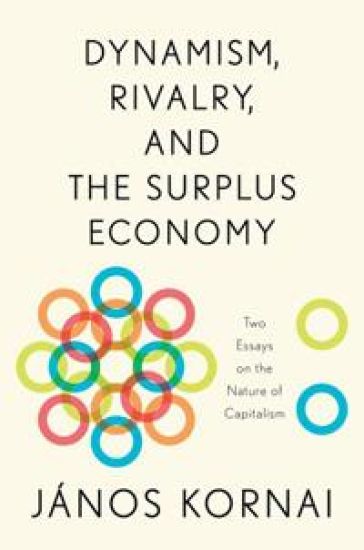
Dynamism, Rivalry, and the Surplus Economy

Dynamism, Rivalry, and the Surplus Economy

János Kornai

Oxford University Press Inc
2013
sidottu
In Dynamism, Rivalry, and the Surplus Economy, János Kornai examines capitalism as an economic system and in comparison to socialism. Kornai explains his view of capitalism as an economy of surplus--a chronic excess of supply of goods and labor. This environment breeds rivalry among producers, which in turn encourages innovation. Socialism, on the other hand, is defined by a shortage of goods and labor and excess of demand. Whereas socialism is slothful and imitative, capitalism is dynamic and progressive. The two essays of this book will explore these differing ideologies on macro and micro levels, ending with definitive explanations of how the systems work and how they develop.
Kraft Des Gedankens: Ungewohnliche Erinnerungen an Eine Intellektuelle Reise
Vom uberzeugten Marxisten zum kompetenten Kritiker des sozialistischen Wirtschaftssystems hat Janos Kornai die Nachkriegsgeschichte Ungarns miterlebt und miterlitten. An der ideologischen Vorbereitung der ungarischen Revolution von 1956 beteiligt, wurde er zu einem einflussreichen Theoretiker der Planwirtschaft, ihrer Reformunfahigkeit und der post-sozialistischen Transformation. Kornai arbeitete als Journalist und als Wirtschaftswissenschaftler. An der Budapester Universitat durfte er nicht lehren, doch wurde er ordentlicher Professor an der Harvard Universitat. Im halbjahrlichen Rhythmus pendelte er viele Jahre zwischen Budapest und Harvard und vermittelte zwischen ostlichem Sachwissen und westlichem Fachwissen. "Kraft des Gedankens" ist der Bericht seiner lebenslangen intellektuellen Reise - eine subjektive Erganzung zu seinem akademischen Werk.
Welfare, Choice and Solidarity in Transition

Welfare, Choice and Solidarity in Transition

János Kornai; Karen Eggleston

Cambridge University Press
2010
pokkari
Reform of the welfare sector is an important yet difficult challenge for all countries in transition from socialist central planning to market-oriented democracies. Here a scholar of the economics of socialism and post-socialist transition and a health economist take on this challenge. This 2001 book offers health sector reform recommendations for ten countries of Eastern Europe, drawn consistently from a set of explicit guiding principles. After discussing sector-specific characteristics, lessons of international experience, and the main set of initial conditions, the authors advocate reforms based on organized public financing for basic care, private financing for supplementary care, pluralistic delivery of services, and managed competition. Policymakers need to achieve a balance, both assuring social solidarity through universal access to basic health services and expanding individual choice and responsibility through voluntary supplemental insurance. The authors also consider the problems that undermine effectiveness of market-based competition in the health sector.
From Socialism to Capitalism

From Socialism to Capitalism

Janos Kornai

Central European University Press
2008
sidottu
Eight essays connected by various common strands. The most important one is the community of the main subject-matter: socialism, capitalism, democracy, change of system. These four expressions cover four phenomena of great and comprehensive importance. Each piece in the book deals with these and the connections between them. One of the Leitmotifs is the “capitalism/socialism” pair of opposites. Capitalism has a history of several hundred years, while the socialist regime existed only for a few decades. But this pair of opposites was central to the history of the twentieth century. This antagonism put its stamp on political thinking, on the foreign policy and military preparedness of every country, and on some appallingly destructive armed conflicts. All these had great secondary influence on each country’s economic development and the standard of living and disposition of its inhabitants. None of the studies is confined to one country—not to Hungary or to any other. Each tries to embrace the problems common to greater units. However, the greater unit comprehended is not the same in each study. One may deal with the capitalist or socialist system in general, another will all the post-socialist countries, and a third the Central East European region. But all extend the analysis beyond the borders of one country.
Evolution of the Hungarian Economy 1848–1998 – One–and–a–Half Centuries of Semi–Successful Modernization, 1848–1989, vol 1
This volume is a major contribution to Hungarian economic history since the middle of the nineteenth century. In this first volume of three on the evolution of that economy, the authors focus on the beginnings of the modern capitalist economy (1848-1914), on economic nationalism (1918-1944) and on the socialist attempt at modernization (1945-1989).
Welfare, Choice and Solidarity in Transition

Welfare, Choice and Solidarity in Transition

János Kornai; Karen Eggleston

Cambridge University Press
2001
sidottu
Reform of the welfare sector is an important yet difficult challenge for all countries in transition from socialist central planning to market-oriented democracies. Here a scholar of the economics of socialism and post-socialist transition and a health economist take on this challenge. This 2001 book offers health sector reform recommendations for ten countries of Eastern Europe, drawn consistently from a set of explicit guiding principles. After discussing sector-specific characteristics, lessons of international experience, and the main set of initial conditions, the authors advocate reforms based on organized public financing for basic care, private financing for supplementary care, pluralistic delivery of services, and managed competition. Policymakers need to achieve a balance, both assuring social solidarity through universal access to basic health services and expanding individual choice and responsibility through voluntary supplemental insurance. The authors also consider the problems that undermine effectiveness of market-based competition in the health sector.
Evolution of the Hungarian Economy, 1848–1998 – One–and–a–Half Centuries of Semi–Successful Modernization, 1848–1989 vol.2
Kornai presents an assessment of Hungary's transition from a socialist to a market economy. In a comprehensive critique of socialist economy reform, Kornai explains how the system's ideological and political attributes deny the idea of "market socialism". Kornai provides examples of Hungary's economoc stabilization and conditions for its sustainable growth.
Struggle and Hope

Struggle and Hope

János Kornai

Edward Elgar Publishing Ltd
1999
nidottu
This major book presents an objective and penetrating economic analysis of stabilization and reform in Eastern Europe, combined with a compassionate plea for individual rights and solidarity. Janos Kornai - one of the most famous Hungarian economists of his generation - focuses on two main issues: first, the problems of stabilization and adjustment, which are painful but necessary conditions of sustainable growth and second, the reform of the 'premature welfare state' of Eastern European countries, which is disproportionately large in relation to the resources available and which was hitherto managed in a highly centralized, bureaucratic and paternalistic way. Struggle and Hope goes beyond most other books on the transition process by placing considerable emphasis on the understanding of the ethical implications and the historical roots of each problem, and also the political conditions and consequences of change. Although economic efficiency is extremely important, it is not the exclusive criterion; ethical principles of individual sovereignty and solidarity must also receive particular attention. Professor Kornai's insightful analysis will become required reading for all those concerned with the process of post-socialist transition.
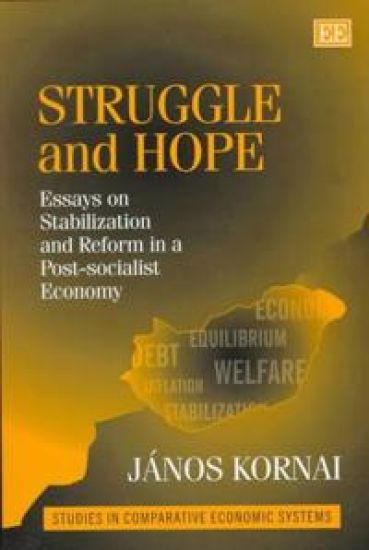
Struggle and Hope

Struggle and Hope

János Kornai

Edward Elgar Publishing Ltd
1997
sidottu
This major book presents an objective and penetrating economic analysis of stabilization and reform in Eastern Europe, combined with a compassionate plea for individual rights and solidarity. Janos Kornai - one of the most famous Hungarian economists of his generation - focuses on two main issues: first, the problems of stabilization and adjustment, which are painful but necessary conditions of sustainable growth and second, the reform of the 'premature welfare state' of Eastern European countries, which is disproportionately large in relation to the resources available and which was hitherto managed in a highly centralized, bureaucratic and paternalistic way. Struggle and Hope goes beyond most other books on the transition process by placing considerable emphasis on the understanding of the ethical implications and the historical roots of each problem, and also the political conditions and consequences of change. Although economic efficiency is extremely important, it is not the exclusive criterion; ethical principles of individual sovereignty and solidarity must also receive particular attention. Professor Kornai's insightful analysis will become required reading for all those concerned with the process of post-socialist transition.
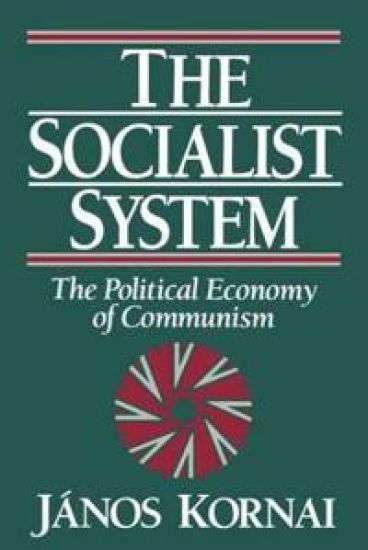
The Socialist System

The Socialist System

Janos Kornai

Clarendon Press
1992
nidottu
This book provides a comprehensive account of the structure, conduct, and performance of the centrally planned economies of Eastern Europe, the USSR, Communist China and the Marxist LDCs, looking at 26 nations in all. The author focuses on reform, perhaps the most important issue facing countries such as the USSR, Poland, Hungary, and China. Bureaucracy, soft budget constraints, markets, and the nature of the socialist state are the central issues that arise in the course of reforming a socialist economy. The first half of the book deals with 'classical socialism' and provides a theoretical summary of the main features of a now closed period of history. The second half deals with the processes of reform and concludes that the reform of classical socialist systems is doomed to failure as they are unable to renew themselves internally.
The Socialist System

The Socialist System

Janos Kornai

Princeton University Press
1992
pokkari
To understand the dramatic collapse of the socialist order and the current turmoil in the formerly communist world, this comprehensive work examines the most important common properties of all socialist societies. JNBnos Kornai brings a life-long study of the problems of the socialist system to his explanation of why inherent attributes of socialism inevitably produced in-efficiency. In his past work he has focused on the economic sphere, maintaining consistently that the weak economic performance of socialist countries resulted from the system itself, not from the personalities of top leaders or mistakes made by leading organizations and planners. This book synthesizes themes from his earlier investigations, while broadening the discussion to include the role of the political power structure and of communist ideology. Kornai distinguishes between two types, or historical phases, of socialism. The "classical socialism" of Stalin, Mao, and their followers is totalitarian and brutally repressive, but its components fit together and make up a coherent edifice. Associated with names like Tito, KNBdar, Deng-Xiaoping, and Gorbachev, "reform socialism" relaxes repression, but brings about a sharpening of inner contradictions and the eventual dissolution of the system. Kornai examines the classical system in the first half of the book, and moves on to explore the complex process of reform in the second half. The Socialist System is addressed to economists in the first place, but also to political scientists, sociologists, and historians. In addition, it will appeal to policymakers, business analysts, and government officials who need to understand either formerly or presently communist countries.