Kirjojen hintavertailu – 12 859 828 kirjaa ja 27 kauppaa

Kirjailija

Jarrett Blaustein

Kirjat ja teokset yhdessä paikassa: 5 kirjaa, julkaisuja vuosilta 2015–2024, suosituimpiin kuuluu Unraveling the Crime-Development Nexus. Vertaile teosten hintoja ja tarkista saatavuus suomalaisista kirjakaupoista.

5 kirjaa

Kirjojen julkaisuvuodet: 2015–2024.

Unraveling the Crime-Development Nexus

Unraveling the Crime-Development Nexus

Jarrett Blaustein; Tom Chodor; Nathan W. Pino

BLOOMSBURY PUBLISHING PLC
2024
nidottu
Unraveling the Crime-Development Nexus interrogates the claim that crime represents a significant threat to economic development. Combining historical analysis with a unique empirical perspective based on interviews with high-level international crime policy insiders, it accounts for how and why the ‘crime-development nexus’ has been invoked by international actors, including the United Nations, to advance and secure variations of a global capitalist development agenda since the 19th Century. Drawing on perspectives anchored in critical criminology, International Relations, and development studies, Unraveling the Crime Development Nexus reveals that the international crime policy agenda today remains overwhelmingly responsive to those who benefit from the further expansion of neoliberal globalisation, while simultaneously marginalising subordinate actors throughout the ‘developing’ world. The book concludes by considering how international organisations, civil society actors, and major donors might support a more equitable and sustainable model of global crime governance that addresses the structural causes of crime and uneven development at a global level.
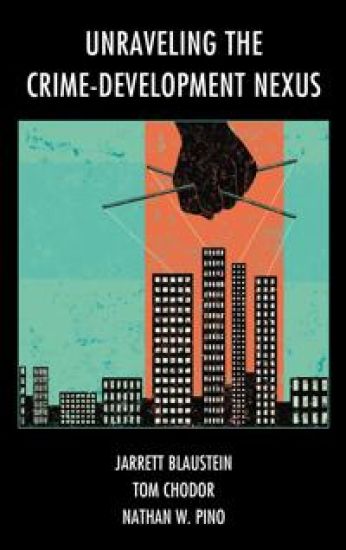
Unraveling the Crime-Development Nexus

Unraveling the Crime-Development Nexus

Jarrett Blaustein; Tom Chodor; Nathan W. Pino

BLOOMSBURY PUBLISHING PLC
2022
sidottu
Unraveling the Crime-Development Nexus offers the first criminological account of the relationship between international development, crime, and security in nearly thirty-five years. It historically situates and critiques the assumption that crime represents both a significant threat to economic development and a consequence of underdevelopment. The book acknowledges evidence of a heightened risk of experiencing crime and violence for residents of many ‘developing’ countries but challenges the uncritical embrace of this empirically and theoretically problematic discourse by proponents of a post-neoliberal development agenda. It is argued that many of the reforms advocated for are structurally criminogenic and that these prescriptions for economic liberalisation and securitisation fundamentally prioritise the economic interests and security needs of those who stand to profit from further incursions by neoliberal globalisation rather than the economic and security needs of local residents and communities. To confront this dynamic, the book concludes that international institutions like the United Nations Office for Drugs and Crime (UNODC) along with major international donors should shift their attention towards the structural causes of crime and embrace alternative development approaches, including those informed by feminist and post-colonial perspectives, in order to address the major drivers of crime, violence and exploitation in the global South.
Place, Race and Politics

Place, Race and Politics

Leanne Weber; Jarrett Blaustein; Kathryn Benier; Rebecca Wickes; Diana Johns

Emerald Publishing Limited
2024
nidottu
Place, Race and Politics presents an integrated analysis of the social and political processes that combined to construct a media-driven ‘crisis’ concerning African youth crime in the city of Melbourne, Australia. Combining original research and analysis alongside published sources, the authors carefully dissect the anatomy of a racialized and politicized public discourse and delve into the profound impact of this on African-Australian communities in Melbourne. Drawing on political and media analysis and community-based research, the authors investigate how South Sudanese Australians in Melbourne came to be identified, supposedly, as a unique threat to community safety, the role played by the media, state and federal politics, the policing and perceptions of race in this process, and the physical and emotional impacts on affected communities of the law and order crisis concerning ‘African crime’. While deeply rooted in local conditions, the book resonates with similar examples of the criminalization and othering of racialized communities, the surveillance and exclusion of ‘crimmigrants’, and with popular punitivism and the rise of far-right politics globally in response to deeply felt anxieties about rapid social, economic and cultural change.
Place, Race and Politics

Place, Race and Politics

Leanne Weber; Jarrett Blaustein; Kathryn Benier; Rebecca Wickes; Diana Johns

Emerald Publishing Limited
2021
sidottu
Place, Race and Politics presents an integrated analysis of the social and political processes that combined to construct a media-driven ‘crisis’ concerning African youth crime in the city of Melbourne, Australia. Combining original research and analysis alongside published sources, the authors carefully dissect the anatomy of a racialized and politicized public discourse and delve into the profound impact of this on African-Australian communities in Melbourne. Drawing on political and media analysis and community-based research, the authors investigate how South Sudanese Australians in Melbourne came to be identified, supposedly, as a unique threat to community safety, the role played by the media, state and federal politics, the policing and perceptions of race in this process, and the physical and emotional impacts on affected communities of the law and order crisis concerning ‘African crime’. While deeply rooted in local conditions, the book resonates with similar examples of the criminalization and othering of racialized communities, the surveillance and exclusion of ‘crimmigrants’, and with popular punitivism and the rise of far-right politics globally in response to deeply felt anxieties about rapid social, economic and cultural change.
Speaking Truths to Power

Speaking Truths to Power

Jarrett Blaustein

Oxford University Press
2015
sidottu
Speaking Truths to Power: Policy Ethnography and Police Reform in Bosnia and Herzegovina presents a rigorous analysis of the effects of globalisation on local policing, drawing on data generated from two ethnographic case studies conduscted in 2011 in Bosnia and Herzegovina. By examining structures, mentalities, and practices, it situates the phenomenon of 'glocal policing' in relation to the convergence of development and security discourses, and raises important questions about the purpose and value of criminological engagements with transnational policing fields. The idea of 'speaking truths to power' (as opposed to a single 'truth') is illustrated by the author's fieldwork, covering active police capacity building projects implemented by international development agencies. Both studies illustrate that global power inequalities affect police reform projects, but also that nodal opportunities exist for seemingly disempowered stakeholders, specifically international development workers and rank-and-file police officers to mediate their effects. This mediatory role is analysed through the conceptual lens of 'policy translation', providing an innovative framework for interpreting how policy meaning and content are altered as a result of their transmission between contexts. Through detailed and persuasive investigation, Speaking Truths to Power argues that it is time for criminologists to look beyond the established structural critiques of transnational policing power in order to ensure that this growing body of research reflects the diverse interests, experiences, and understandings of the agents and institutions who collectively populate these fields of policy and practice. Conceptually sophisticated and thematically ambitious, the book will be of interest to scholars in the fields of criminology, sociaology, international relations and socio-legal studies as well as those who are researching and studying transnational policing, police reform, and the global governance of crime.