Kirjojen hintavertailu – 12 859 819 kirjaa ja 27 kauppaa

Kirjailija

Jarvis

Kirjat ja teokset yhdessä paikassa: 43 kirjaa, julkaisuja vuosilta 1991–2027, suosituimpiin kuuluu Fred Forgets. Vertaile teosten hintoja ja tarkista saatavuus suomalaisista kirjakaupoista.

43 kirjaa

Kirjojen julkaisuvuodet: 1991–2027.

Lazy Dave

Lazy Dave

Jarvis

HarperCollins
2015
sidottu
Dave is a dog. Dave is a dog who loves to sleep all day long. Lilly thinks Dave is the laziest dog in the world! But maybe Dave isn't as lazy as Lilly thinks... Find out what Dave really does all day in this debut picture book from author-illustrator Jarvis!
Political Keywords

Political Keywords

Hart; Jarvis; Jennings; Smith-Howell

Oxford University Press Inc
2004
nidottu
The Declaration of Independence states that all men are created equal in the United States, but that statement does not hold true for words. Some words carry more weight than others-they seem to work harder, get more done, and demand more respect. Political Keywords: Using Language that Uses Us looks at eight dominant words that are crucial to American political discourse, and how they have been employed during the last fifty years. Based on an analysis of eleven separate studies of political language, Political Keywords helps readers to understand what these terms mean and how they are used. For example, the book tracks what politics now means to modern commentators, how schoolteacher impress certain values upon the nation's children by invoking the office of the president, and why an innocent word like government sometimes makes people so upset. It details how the people are referenced in political talk and how the media portray themselves. The book also considers the work done by political parties, political promises, and political consultants because, together, they shed special light on modern elections. Combining social science with subtle forms of cultural interpretation, Political Keywords: Using Language that Uses Us provides a fresh look at both American politics and American language. It is an ideal text for undergraduate and graduate courses in political communication, political language, political campaigns, media and politics, political psychology, public opinion, rhetorical criticism, contemporary public address, and presidential rhetoric.

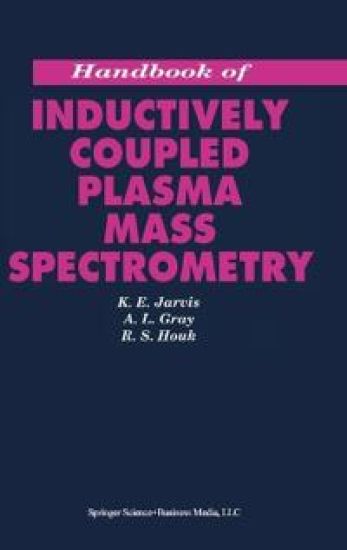
Handbook of Inductively Coupled Plasma Mass Spectrometry

Handbook of Inductively Coupled Plasma Mass Spectrometry

A. L. Gray; Jarvis; Houk

Blackie Academic and Professional
1991
nidottu
1 Origins and development.- 1.1. Introduction.- 1.2 The ICP-MS system.- 2 Instrumentation for ICP-MS.- 2.1 The inductively coupled plasma.- 2.1.1 Torch and plasma.- 2.1.2 RF coupling.- 2.1.3 Sample introduction.- 2.1.4 Sample history.- 2.1.5 Plasma populations.- 2.1.6 Distribution of ions in the plasma.- 2.1.7 Other plasmas.- 2.2 Ion extraction.- 2.2.1 Boundary layer and sheath.- 2.2.2 Plasma potential and secondary discharge.- 2.2.3 Supersonic jet.- 2.2.4 Gas dynamics.- 2.2.5 Ion kinetic energies.- 2.3 Ion focusing.- 2.3.1 Operation of ion lenses.- 2.3.2 Ion lenses in ICP-MS.- 2.3.3 Space charge effects.- 2.4 Quadrupole mass spectrometers.- 2.4.1 Quadrupole configuration.- 2.4.2 Ion trajectories and stability diagrams.- 2.4.3 Characteristics of mass spectra from quadrupoles.- 2.4.4 RF-only quadrupoles.- 2.4.5 Scanning and data acquisition.- 2.5 Other mass spectrometers.- 2.6 Ion detection.- 2.6.1 Channeltron electron multipliers.- 2.6.2 Signal measurement by pulse counting.- 2.6.3 Other detectors.- 2.7 Vacuum considerations.- 2.7.1 Properties and flow of gases.- 2.7.2 A vacuum system for ICP-MS.- 2.7.3 Pumps used in ICP-MS.- 3 Instrument options.- 3.1 Introduction.- 3.2 Nebulisers.- 3.2.1 Introduction.- 3.2.2 Concentric nebulisers.- 3.2.3 Cross-flow nebulisers.- 3.2.4 Babington type nebuliser.- 3.2.5 Frit type nebuliser.- 3.2.6 Ultrasonic nebuliser.- 3.3 Spray chambers.- 3.3.1 Principles.- 3.3.2 Operation.- 3.3.3 Thermally stabilised spray chambers for ICP-MS.- 3.4 Torches.- 3.4.1 Construction.- 3.4.2 Demountable torches.- 3.4.3 Alignment.- 3.4.4 Specialised torches.- 3.5 Interface.- 3.5.1 Introduction.- 3.5.2 Sampling cones.- 3.5.3 Skimmer cones.- 4 Sample introduction for liquids and gases.- 4.1 Introduction.- 4.2 Electrothermal vaporisation.- 4.2.1 Principles.- 4.2.2 Instrumentation.- 4.2.3 Operating parameters.- 4.2.4 Applications and analytical performance of ETV-ICP-MS.- 4.3 Vapour generation and gas phase sample introduction.- 4.3.1 Introduction.- 4.3.2 Hydride generation.- 4.3.3 Osmium tetroxide vapour generation.- 4.3.4 Reactive gases.- 4.4 Liquid chromatography.- 4.4.1 Introduction.- 4.4.2 Principles.- 4.4.3 Instrumentation, reagents and operating parameters.- 4.4.4 Applications.- 4.5 Flow injection.- 4.5.1 Introduction.- 4.5.2 Apparatus.- 4.5.3 Sample introduction.- 4.5.4 Operating parameters.- 4.5.5 Applications.- 4.6 Direct sample insertion.- 4.6.1 Principles.- 4.6.2 Applications.- 5 Interferences.- 5.1 Introduction.- 5.2 Spectroscopic interferences.- 5.2.1 Isobaric overlap.- 5.2.2 Polyatomic ions.- 5.2.3 Refractory oxides.- 5.2.4 Doubly charged ions.- 5.2.5 Alleviation of spectroscopic interferences.- 5.3 Non-spectroscopic interferences.- 5.3.1 High dissolved solids.- 5.3.2 Suppression and enhancement effects.- 6 Calibration and data handling.- 6.1 Introduction.- 6.2 General concepts.- 6.2.1 Mass scale calibration.- 6.2.2 Accuracy, precision and reproducibility.- 6.3 Instrumental modes of data collection.- 6.3.1 Peak hopping.- 6.3.2 Scanning.- 6.4 Linearity of response.- 6.5 Blanks.- 6.6 Factors affecting signal stability.- 6.7 Qualitative analysis.- 6.8 Semi-quantitative calibration.- 6.9 Quantitative analysis.- 6.9.1 External calibration techniques.- 6.9.2 Raw data correction procedures.- 6.9.3 Standard additions.- 6.9.4 Isotope dilution.- 7 Sample preparation for ICP-MS.- 7.1 Introduction.- 7.2 General considerations.- 7.2.1 Laboratory equipment and practices.- 7.2.2 Choice of mineral acids.- 7.2.3 Limits of quantitative analysis.- 7.2.4 Precision and accuracy: assessing a digestion procedure.- 7.3 Digestion procedures.- 7.3.1 Open vessel digestions.- 7.3.2 Closed vessel digestions.- 7.3.3 Alkali fusions.- 7.3.4 Microwave digestion.- 7.4 Separation and pre-concentration methods.- 7.4.1 Rare earth elements.- 7.4.2 Precious metals.- 7.4.3 Petrogenic disciminators: Hf, Nb, Ta, Zr.- 7.5 Conclusions and overview.- 8 Elemental analysis of solutions and applications.- 8.1 Introduction.- 8.2 Multi-element determin...