Kirjojen hintavertailu – 12 859 828 kirjaa ja 27 kauppaa

Kirjailija

Jasleen Kaur

Kirjat ja teokset yhdessä paikassa: 16 kirjaa, julkaisuja vuosilta 2013–2026, suosituimpiin kuuluu The Magic What-If Machine. Vertaile teosten hintoja ja tarkista saatavuus suomalaisista kirjakaupoista.

16 kirjaa

Kirjojen julkaisuvuodet: 2013–2026.

Optical Fiber Micro–Nano Axicon

Optical Fiber Micro–Nano Axicon

Samir K. Mondal; Pooja Gupta; Kaushal Vairagi; Jasleen Kaur

TAYLOR FRANCIS LTD
2026
sidottu
The book highlights the development of negative and positive axicons at the optical fiber tip, presenting their optical behavior with theoretical support and demonstrating applications across various domains. It also outlines recent advancements, including novel micro- and nano-scale negative and positive axicon lens designs on optical fiber tips, enabling readers to evaluate whether this approach meets their requirements in terms of fabrication ease and practical utility. Key features Integration of computer vision, immersive technologies (VR/AR/MR), and Industry 4.0 concepts Exploration of real-world scenarios showcasing the synergy between computer vision and immersive technologies in Industry 4.0 environments Expanded discussion of global regulatory frameworks, including GDPR, CCPA, and China’s cybersecurity laws Review of specific projects and implementations across relevant fields Industrial examples demonstrating practical applications in sectors such as manufacturing, healthcare, retail, and automotive This book is intended for graduate students and researchers in electrical engineering, mechanical engineering, and biomedical sensing and imaging.

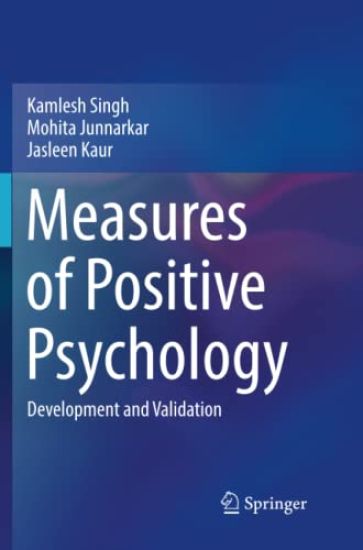
Measures of Positive Psychology

Measures of Positive Psychology

Kamlesh Singh; Mohita Junnarkar; Jasleen Kaur

Springer, India, Private Ltd
2018
nidottu
The book contributes to the vast field of research in psychometrics as well as to the growing field of positive psychology. It analyses the development and validation of several constructs of positive psychology like resilience, flow, mindfulness, spirituality, and intrapersonal and interpersonal strengths. The chapters discuss the test construction process and develop scales for constructs that are validated on the Indian population. In most Indian behavioral research, psychological tests from the West are employed without assessing psychometric properties in India. However, establishing validation of psychological tests in a new culture is necessary in order to claim results based on these tests. Hence, this book bridges this gap in positive psychology and its allied fields and develops and standardizes these scales for the Indian population. The new constructed and validated scales have undergone rigorous statistical screening. Psychologists, psychiatrists, and social workers interested in studying well-being in India and in understanding how to create psychometric scales for non-Western populations will find the book useful for their research.
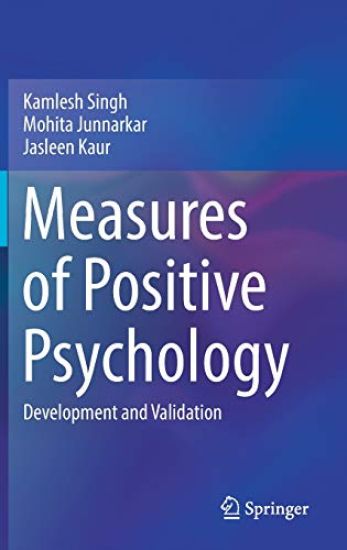
Measures of Positive Psychology

Measures of Positive Psychology

Kamlesh Singh; Mohita Junnarkar; Jasleen Kaur

Springer, India, Private Ltd
2016
sidottu
The book contributes to the vast field of research in psychometrics as well as to the growing field of positive psychology. It analyses the development and validation of several constructs of positive psychology like resilience, flow, mindfulness, spirituality, and intrapersonal and interpersonal strengths. The chapters discuss the test construction process and develop scales for constructs that are validated on the Indian population. In most Indian behavioral research, psychological tests from the West are employed without assessing psychometric properties in India. However, establishing validation of psychological tests in a new culture is necessary in order to claim results based on these tests. Hence, this book bridges this gap in positive psychology and its allied fields and develops and standardizes these scales for the Indian population. The new constructed and validated scales have undergone rigorous statistical screening. Psychologists, psychiatrists, and social workers interested in studying well-being in India and in understanding how to create psychometric scales for non-Western populations will find the book useful for their research.