Kirjojen hintavertailu – 12 903 735 kirjaa ja 27 kauppaa

Kirjailija

Javier Revilla Diez

Kirjat ja teokset yhdessä paikassa: 5 kirjaa, julkaisuja vuosilta 2001–2023, suosituimpiin kuuluu Mega-Urban Development and Transformation Processes in Vietnam. Vertaile teosten hintoja ja tarkista saatavuus suomalaisista kirjakaupoista.

5 kirjaa

Kirjojen julkaisuvuodet: 2001–2023.

Mega-Urban Development and Transformation Processes in Vietnam

Mega-Urban Development and Transformation Processes in Vietnam

Frauke Kraas; Matthias Garschagen; Hoa Thu Le; Javier Revilla Diez

LIT VERLAG
2023
pokkari
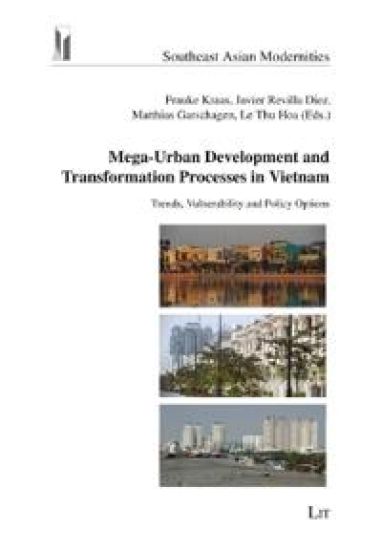
Since the beginning of the Doi Moi reforms, Vietnam's economy and society have been profoundly transformed. While in 1986 less than 13 million of Vietnam's inhabitants lived in areas classified as urban (20%), the number has risen to more than 30 million inhabitants today (35% of the total population). This massive urbanization was made possible by the rapid transformation of the former agricultural state into an industrial and service state and extensive migration processes from rural areas to the fast growing cities and megacities. Fifteen articles analyze the current situation.
Regional Resilience, Economy and Society

Regional Resilience, Economy and Society

Christine Tamásy; Javier Revilla Diez

Routledge
2016
nidottu
There has been a great deal of restructuring of rural places and communities under globalisation, highlighting the interaction of local and global actors to produce new hybrid socio-economic relations. Recent research highlights the heterogeneity of globalisation in which rural places are different to each other, but also different to how they were in the past. Bringing together an interdisciplinary team of academics, and comparative case studies from Europe (West and East) and Asia, this book explores and discusses opportunities and challenges associated with globalising rural places, and identifies possibilities for policy and practical intervention by rural development actors. Special attention is paid to multi-scalar processes through which rural places are reshaped through globalisation. Taking a geographical approach, the book produces new critical work on the interdependence between globalisation and rural spaces. It is organised into five sections: Part I focuses on ’Global-Rural Linkages’ showing the multifaceted interrelation between actors at different geographical scale and demonstrating that globalisation is not only external to rural spaces. Part II on ’Rural Entrepreneurship and Labour Markets’ explores the potential of business start-ups in rural spaces which are not only necessity driven. Part III ’Rural Innovation and Learning’ shows that rural places are also places for innovation and learning. Part IV on ’Rural Policies and Governance’ argues that regional policies for rural places should promote side activities to maintain social capital and that regional policy should take a more integrative perspective between urban and rural spaces in order to explore complementary development paths. The concluding chapter ’New Approaches to Rural Spaces’ discusses new approaches to globalising rural places in relation to the preceding chapters published in this book.
Regional Resilience, Economy and Society

Regional Resilience, Economy and Society

Christine Tamásy; Javier Revilla Diez

Ashgate Publishing Limited
2013
sidottu
There has been a great deal of restructuring of rural places and communities under globalisation, highlighting the interaction of local and global actors to produce new hybrid socio-economic relations. Recent research highlights the heterogeneity of globalisation in which rural places are different to each other, but also different to how they were in the past. Bringing together an interdisciplinary team of academics, and comparative case studies from Europe (West and East) and Asia, this book explores and discusses opportunities and challenges associated with globalising rural places, and identifies possibilities for policy and practical intervention by rural development actors. Special attention is paid to multi-scalar processes through which rural places are reshaped through globalisation. Taking a geographical approach, the book produces new critical work on the interdependence between globalisation and rural spaces. It is organised into five sections: Part I focuses on ’Global-Rural Linkages’ showing the multifaceted interrelation between actors at different geographical scale and demonstrating that globalisation is not only external to rural spaces. Part II on ’Rural Entrepreneurship and Labour Markets’ explores the potential of business start-ups in rural spaces which are not only necessity driven. Part III ’Rural Innovation and Learning’ shows that rural places are also places for innovation and learning. Part IV on ’Rural Policies and Governance’ argues that regional policies for rural places should promote side activities to maintain social capital and that regional policy should take a more integrative perspective between urban and rural spaces in order to explore complementary development paths. The concluding chapter ’New Approaches to Rural Spaces’ discusses new approaches to globalising rural places in relation to the preceding chapters published in this book.
Metropolitan Innovation Systems

Metropolitan Innovation Systems

Manfred M. Fischer; Javier Revilla Diez; Folke Snickars

Springer-Verlag Berlin and Heidelberg GmbH Co. K
2010
nidottu
This book presents the fmdings of a comparative study of three European metropolitan regions: Vienna, Barcelona and Stockholm. The heart of the work consists of empirical studies carefully designed and developed in order to identify the main actors and mechanisms supporting technological innovation in each of the metropolitan regions. The authors have also highlighted the similarities and differences across regions and countries, investigating how these came to be, and discussing the possible implications. The introductory as well as the concluding Chapter was written by Manfred M. Fischer who, assisted by Attila Varga, was also responsible for Chapter 2 on the Metropolitan Region of Vienna. Javier Revilla Diez contributed Chapter 3 on the Barcelona Metropolitan Region. Folke Snickars has provided Chapter 4 which examines the Metropolitan Region of Stockholm and. All authors have reviewed and commented on the whole contents so that the volume represents a collective endeavour which has been rendered as homogeneous as possible. A particular effort has been made to ensure that the study is based on a common conceptual framework.
Metropolitan Innovation Systems

Metropolitan Innovation Systems

Manfred M. Fischer; Javier Revilla Diez; Folke Snickars

Springer-Verlag Berlin and Heidelberg GmbH Co. K
2001
sidottu
This book presents the fmdings of a comparative study of three European metropolitan regions: Vienna, Barcelona and Stockholm. The heart of the work consists of empirical studies carefully designed and developed in order to identify the main actors and mechanisms supporting technological innovation in each of the metropolitan regions. The authors have also highlighted the similarities and differences across regions and countries, investigating how these came to be, and discussing the possible implications. The introductory as well as the concluding Chapter was written by Manfred M. Fischer who, assisted by Attila Varga, was also responsible for Chapter 2 on the Metropolitan Region of Vienna. Javier Revilla Diez contributed Chapter 3 on the Barcelona Metropolitan Region. Folke Snickars has provided Chapter 4 which examines the Metropolitan Region of Stockholm and. All authors have reviewed and commented on the whole contents so that the volume represents a collective endeavour which has been rendered as homogeneous as possible. A particular effort has been made to ensure that the study is based on a common conceptual framework.