Kirjojen hintavertailu – 12 903 725 kirjaa ja 27 kauppaa

Kirjailija

Jay K. Rosengard

Kirjat ja teokset yhdessä paikassa: 4 kirjaa, julkaisuja vuosilta 1997–2015, suosituimpiin kuuluu Economics of the Public Sector. Vertaile teosten hintoja ja tarkista saatavuus suomalaisista kirjakaupoista.

4 kirjaa

Kirjojen julkaisuvuodet: 1997–2015.

Economics of the Public Sector

Economics of the Public Sector

Joseph E. Stiglitz; Jay K. Rosengard

WW Norton Co
2015
nidottu

Halvin toimitettuna 88,00 €

What should be the role of government in society? How should it design its programmes? How should tax systems be designed to promote both efficiency and fairness? Nobel Laureate Joseph Stiglitz and new co-author Jay Rosengard bring an unparalleled level of expertise to address these key issues of public-sector economics. No other text is as modern, as accessible, or incorporates as much first-hand policy-advising experience by its authors as Stiglitz/Rosengard.
Economics of the Public Sector

Economics of the Public Sector

Joseph E. Stiglitz; Jay K. Rosengard

WW Norton Co
2015
nidottu
What should be the role of government in society? How should it design its programs? How should tax systems be designed to promote both efficiency and fairness? Nobel Laureate Joseph Stiglitz and new co-author Jay Rosengard use their first-hand policy-advising experience to address these key issues of public-sector economics in this modern and accessible Fourth Edition.
Property Tax Reform in Developing Countries

Property Tax Reform in Developing Countries

Jay K. Rosengard

Springer-Verlag New York Inc.
2012
nidottu
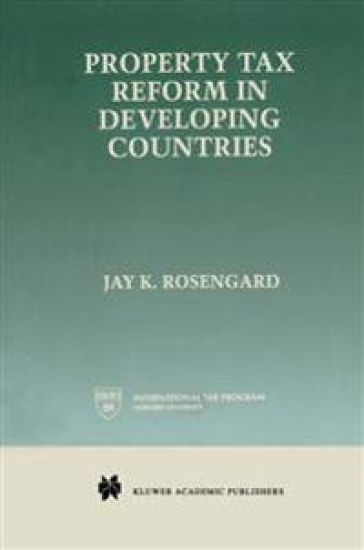
Property Tax Reform in Developing Countries provides a conceptual framework for property tax reform with the intention of making the most compelling argument possible to persuade the reader as to its validity. The text claims that a model for property tax reform in developing countries is derived from a theoretical distillation of empirical experience. The primary objective of this study is to establish, through logic, theory and observation: what constitutes a good property tax system, for whom, and under what conditions; why such a system works; and how inferior systems can be upgraded to approximate well-functioning systems. Property Tax Reform in Developing Countries develops its examination in three stages. First, a conceptual framework is presented for the formulation, implementation, and evaluation of property tax reform in developing countries. Second, attempts to reform property taxation in four developing countries are examined in detail. Finally, the results of the reform efforts described in the four case studies are evaluated and guidelines for reform are offered. The study concludes with specific recommendations for reforming property tax systems in developing countries, based on the conceptual framework and synthesizing lessons of the case studies.
Property Tax Reform in Developing Countries
Property Tax Reform in Developing Countries provides a conceptual framework for property tax reform with the intention of making the most compelling argument possible to persuade the reader as to its validity. The text claims that a model for property tax reform in developing countries is derived from a theoretical distillation of empirical experience. The primary objective of this study is to establish, through logic, theory and observation: what constitutes a good property tax system, for whom, and under what conditions; why such a system works; and how inferior systems can be upgraded to approximate well-functioning systems. Property Tax Reform in Developing Countries develops its examination in three stages. First, a conceptual framework is presented for the formulation, implementation, and evaluation of property tax reform in developing countries. Second, attempts to reform property taxation in four developing countries are examined in detail. Finally, the results of the reform efforts described in the four case studies are evaluated and guidelines for reform are offered. The study concludes with specific recommendations for reforming property tax systems in developing countries, based on the conceptual framework and synthesizing lessons of the case studies.