Kirjojen hintavertailu – 12 859 828 kirjaa ja 27 kauppaa

Kirjailija

Jean B. Lasserre

Kirjat ja teokset yhdessä paikassa: 7 kirjaa, julkaisuja vuosilta 1995–2012, suosituimpiin kuuluu Further Topics on Discrete-Time Markov Control Processes. Vertaile teosten hintoja ja tarkista saatavuus suomalaisista kirjakaupoista.

7 kirjaa

Kirjojen julkaisuvuodet: 1995–2012.

Markov Chains and Invariant Probabilities

Markov Chains and Invariant Probabilities

Onésimo Hernández-Lerma; Jean B. Lasserre

Springer Basel
2012
nidottu
This book is about discrete-time, time-homogeneous, Markov chains (Mes) and their ergodic behavior. To this end, most of the material is in fact about stable Mes, by which we mean Mes that admit an invariant probability measure. To state this more precisely and give an overview of the questions we shall be dealing with, we will first introduce some notation and terminology. Let (X,B) be a measurable space, and consider a X-valued Markov chain ~. = {~k' k = 0, 1, ... } with transition probability function (t.pJ.) P(x, B), i.e., P(x, B) := Prob (~k+1 E B I ~k = x) for each x E X, B E B, and k = 0,1, .... The Me ~. is said to be stable if there exists a probability measure (p.m.) /.l on B such that (*) VB EB. /.l(B) = Ix /.l(dx) P(x, B) If (*) holds then /.l is called an invariant p.m. for the Me ~. (or the t.p.f. P).
Further Topics on Discrete-Time Markov Control Processes

Further Topics on Discrete-Time Markov Control Processes

Onesimo Hernandez-Lerma; Jean B. Lasserre

Springer-Verlag New York Inc.
2012
nidottu
This book presents the second part of a two-volume series devoted to a sys­ tematic exposition of some recent developments in the theory of discrete­ time Markov control processes (MCPs). As in the first part, hereafter re­ ferred to as "Volume I" (see Hernandez-Lerma and Lasserre [1]), interest is mainly confined to MCPs with Borel state and control spaces, and possibly unbounded costs. However, an important feature of the present volume is that it is essentially self-contained and can be read independently of Volume I. The reason for this independence is that even though both volumes deal with similar classes of MCPs, the assumptions on the control models are usually different. For instance, Volume I deals only with nonnegative cost­ per-stage functions, whereas in the present volume we allow cost functions to take positive or negative values, as needed in some applications. Thus, many results in Volume Ion, say, discounted or average cost problems are not applicable to the models considered here. On the other hand, we now consider control models that typically re­ quire more restrictive classes of control-constraint sets and/or transition laws. This loss of generality is, of course, deliberate because it allows us to obtain more "precise" results. For example, in a very general context, in §4.
Discrete-Time Markov Control Processes

Discrete-Time Markov Control Processes

Onesimo Hernandez-Lerma; Jean B. Lasserre

Springer-Verlag New York Inc.
2012
nidottu
This book presents the first part of a planned two-volume series devoted to a systematic exposition of some recent developments in the theory of discrete-time Markov control processes (MCPs). Interest is mainly confined to MCPs with Borel state and control (or action) spaces, and possibly unbounded costs and noncompact control constraint sets. MCPs are a class of stochastic control problems, also known as Markov decision processes, controlled Markov processes, or stochastic dynamic pro­ grams; sometimes, particularly when the state space is a countable set, they are also called Markov decision (or controlled Markov) chains. Regardless of the name used, MCPs appear in many fields, for example, engineering, economics, operations research, statistics, renewable and nonrenewable re­ source management, (control of) epidemics, etc. However, most of the lit­ erature (say, at least 90%) is concentrated on MCPs for which (a) the state space is a countable set, and/or (b) the costs-per-stage are bounded, and/or (c) the control constraint sets are compact. But curiously enough, the most widely used control model in engineering and economics--namely the LQ (Linear system/Quadratic cost) model-satisfies none of these conditions. Moreover, when dealing with "partially observable" systems) a standard approach is to transform them into equivalent "completely observable" sys­ tems in a larger state space (in fact, a space of probability measures), which is uncountable even if the original state process is finite-valued.
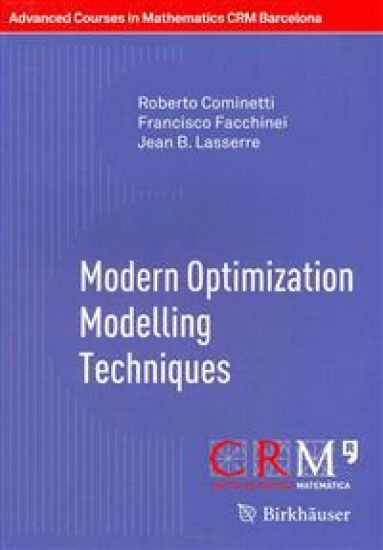
Modern Optimization Modelling Techniques

Modern Optimization Modelling Techniques

Roberto Cominetti; Francisco Facchinei; Jean B. Lasserre

Birkhauser Verlag AG
2012
nidottu
The theory of optimization, understood in a broad sense, is the basis of modern applied mathematics, covering a large spectrum of topics from theoretical considerations (structure, stability) to applied operational research and engineering applications. The compiled material of this book puts on display this versatility, by exhibiting the three parallel and complementary components of optimization: theory, algorithms, and practical problems. The book contains an expanded version of three series of lectures delivered by the authors at the CRM in July 2009. The first part is a self-contained course on the general moment problem and its relations with semidefinite programming. The second part is dedicated to the problem of determination of Nash equilibria from an algorithmic viewpoint. The last part presents congestion models for traffic networks and develops modern optimization techniques for finding traffic equilibria based on stochastic optimization and game theory.
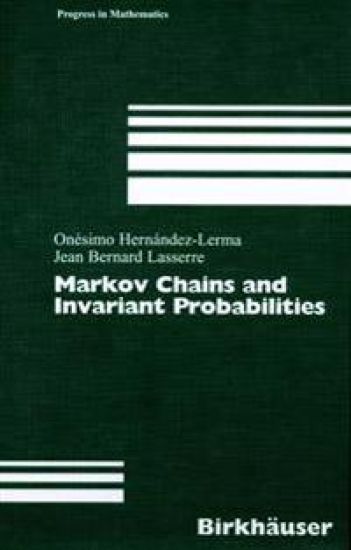
Markov Chains and Invariant Probabilities

Markov Chains and Invariant Probabilities

Onésimo Hernández-Lerma; Jean B. Lasserre

Birkhauser Verlag AG
2003
sidottu
This book is about discrete-time, time-homogeneous, Markov chains (Mes) and their ergodic behavior. To this end, most of the material is in fact about stable Mes, by which we mean Mes that admit an invariant probability measure. To state this more precisely and give an overview of the questions we shall be dealing with, we will first introduce some notation and terminology. Let (X,B) be a measurable space, and consider a X-valued Markov chain ~. = {~k' k = 0, 1, ... } with transition probability function (t.pJ.) P(x, B), i.e., P(x, B) := Prob (~k+1 E B I ~k = x) for each x E X, B E B, and k = 0,1, .... The Me ~. is said to be stable if there exists a probability measure (p.m.) /.l on B such that (*) VB EB. /.l(B) = Ix /.l(dx) P(x, B) If (*) holds then /.l is called an invariant p.m. for the Me ~. (or the t.p.f. P).
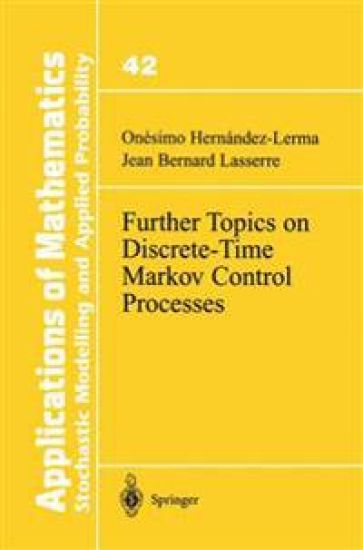
Further Topics on Discrete-Time Markov Control Processes

Further Topics on Discrete-Time Markov Control Processes

Onesimo Hernandez-Lerma; Jean B. Lasserre

Springer-Verlag New York Inc.
1999
sidottu
This book presents the second part of a two-volume series devoted to a sys­ tematic exposition of some recent developments in the theory of discrete­ time Markov control processes (MCPs). As in the first part, hereafter re­ ferred to as "Volume I" (see Hernandez-Lerma and Lasserre [1]), interest is mainly confined to MCPs with Borel state and control spaces, and possibly unbounded costs. However, an important feature of the present volume is that it is essentially self-contained and can be read independently of Volume I. The reason for this independence is that even though both volumes deal with similar classes of MCPs, the assumptions on the control models are usually different. For instance, Volume I deals only with nonnegative cost­ per-stage functions, whereas in the present volume we allow cost functions to take positive or negative values, as needed in some applications. Thus, many results in Volume Ion, say, discounted or average cost problems are not applicable to the models considered here. On the other hand, we now consider control models that typically re­ quire more restrictive classes of control-constraint sets and/or transition laws. This loss of generality is, of course, deliberate because it allows us to obtain more "precise" results. For example, in a very general context, in §4.
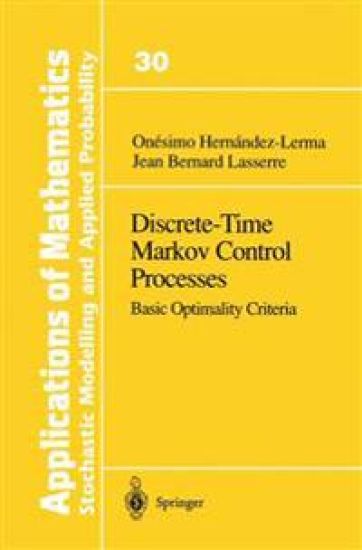
Discrete-Time Markov Control Processes

Discrete-Time Markov Control Processes

Onesimo Hernandez-Lerma; Jean B. Lasserre

Springer-Verlag New York Inc.
1995
sidottu
This book presents the first part of a planned two-volume series devoted to a systematic exposition of some recent developments in the theory of discrete-time Markov control processes (MCPs). Interest is mainly confined to MCPs with Borel state and control (or action) spaces, and possibly unbounded costs and noncompact control constraint sets. MCPs are a class of stochastic control problems, also known as Markov decision processes, controlled Markov processes, or stochastic dynamic pro­ grams; sometimes, particularly when the state space is a countable set, they are also called Markov decision (or controlled Markov) chains. Regardless of the name used, MCPs appear in many fields, for example, engineering, economics, operations research, statistics, renewable and nonrenewable re­ source management, (control of) epidemics, etc. However, most of the lit­ erature (say, at least 90%) is concentrated on MCPs for which (a) the state space is a countable set, and/or (b) the costs-per-stage are bounded, and/or (c) the control constraint sets are compact. But curiously enough, the most widely used control model in engineering and economics--namely the LQ (Linear system/Quadratic cost) model-satisfies none of these conditions. Moreover, when dealing with "partially observable" systems) a standard approach is to transform them into equivalent "completely observable" sys­ tems in a larger state space (in fact, a space of probability measures), which is uncountable even if the original state process is finite-valued.