
Kirjailija
Jean-Baptiste Say
Kirjat ja teokset yhdessä paikassa: 66 kirjaa, julkaisuja vuosilta 2006–2025, suosituimpiin kuuluu Cours Complet D'économie Politique Pratique. Vertaile teosten hintoja ja tarkista saatavuus suomalaisista kirjakaupoista.
Nimi esiintyy myös muodoissa: Jean Baptiste Say
66 kirjaa
Kirjojen julkaisuvuodet: 2006–2025.

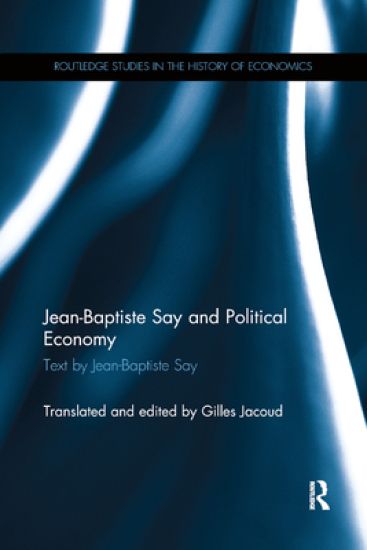
Jean-Baptiste Say (1767–1832) was one of the first great economists to have laid down the foundations of economic science. Author of the famous Treatise on Political Economy in 1803, which was revised and re-edited on several occasions, he published numerous other works including a voluminous Complete Course in Practical Political Economy in 1828–9. He also taught political economy successively from 1815 until his death in three Parisian establishments: the Athénée, the Conservatory of Arts and Trades, and the Collège de France. The texts in which Say exposes his approach to political economy have not been available in the English language until now except for the fourth edition of the ‘Preliminary Discourse’ which serves as an introduction to the Treatise. This book presents a translation which renders his works accessible to the English speaking world. For the first time, English readers will be able to become directly immersed in Say’s principal texts, where he develops his conception of political economy. Jean-Baptiste Say and Political Economy proposes a translation of a selection of eleven of Say’s texts. The first three are versions of the ‘Preliminary Discourse’ from the Treatise’s editions of 1803, 1814 and 1826 with the variations of the editions of 1817, 1819 and 1841. The following four texts are the opening discourses pronounced at the Conservatory in 1820 and 1828 and the Collège de France in 1831 and 1832. The eighth text is the ‘General Considerations’ which open the Complete Course in Practical Political Economy of 1828, with the variations of the 1840 re-edition. The final three texts are those Say devotes to ‘the progress of political economy’ in what is akin to a history of economic thought. This volume is of great importance to economic historians and people studying Jean-Baptiste Say, as well as those who are interested in economic theory and philosophy

Chansons Choisies. Tome 1
Heinrich Friedrich Von Storch; Jean-Baptiste Say
Hachette Livre - BNF
2019
pokkari

Chansons Choisies. Tome 2
Heinrich Friedrich Von Storch; Jean-Baptiste Say
Hachette Livre - BNF
2019
pokkari

Chansons Choisies. Tome 3
Heinrich Friedrich Von Storch; Jean-Baptiste Say
Hachette Livre - BNF
2019
pokkari

Chansons Choisies. Tome 4
Heinrich Friedrich Von Storch; Jean-Baptiste Say
Hachette Livre - BNF
2019
pokkari
Dictionnaire de l'Économie Politique: Contenant l'Exposition Des Principes de la Science
Jean-Baptiste Say
Hachette Livre - BNF
2017
pokkari
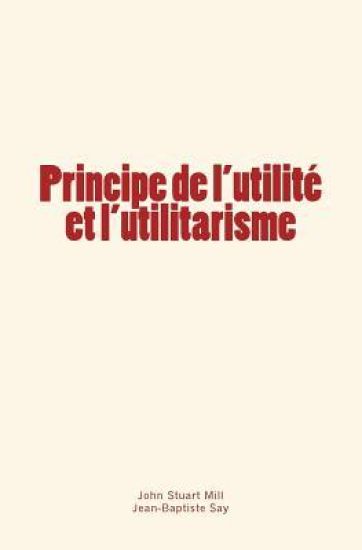
Principe de l'utilité et l'utilitarisme
Jean-Baptiste Say; John Stuart Mill
Editions Le Mono
2017
nidottu
Ce livre bas sur les travaux de deux grands auteurs, John Stuart Mill et Jean-Baptiste Say, traite du principe de l'utilit et de l'utilitarisme. Les besoins qu' prouve l'homme sont beaucoup plus nombreux dans une soci t civilis e que dans l' tat sauvage. En dehors de ses besoins d'ordre social, l'homme prouve aussi des besoins individuels. On d signe par biens toutes les choses qui permettent l'homme de satisfaire ses besoins, aussi bien en soci t que sur le plan individuel; et par utilit la qualit qui les rend propres satisfaire ces diff rents besoins. Le principe de l'utilit consiste mesurer l'estime que nous faisons des choses ou des actions sur le degr d'importance de cette utilit . Tout homme dou de son bon sens d sire ce qui peut contribuer son bien- tre, ce qui lui est utile, et repousse ce qui produit en lui du malaise ou de la douleur, ce qui lui est nuisible...
Jean-Baptiste Say (1767–1832) was one of the first great economists to have laid down the foundations of economic science. Author of the famous Treatise on Political Economy in 1803, which was revised and re-edited on several occasions, he published numerous other works including a voluminous Complete Course in Practical Political Economy in 1828–9. He also taught political economy successively from 1815 until his death in three Parisian establishments: the Athénée, the Conservatory of Arts and Trades, and the Collège de France. The texts in which Say exposes his approach to political economy have not been available in the English language until now except for the fourth edition of the ‘Preliminary Discourse’ which serves as an introduction to the Treatise. This book presents a translation which renders his works accessible to the English speaking world. For the first time, English readers will be able to become directly immersed in Say’s principal texts, where he develops his conception of political economy. Jean-Baptiste Say and Political Economy proposes a translation of a selection of eleven of Say’s texts. The first three are versions of the ‘Preliminary Discourse’ from the Treatise’s editions of 1803, 1814 and 1826 with the variations of the editions of 1817, 1819 and 1841. The following four texts are the opening discourses pronounced at the Conservatory in 1820 and 1828 and the Collège de France in 1831 and 1832. The eighth text is the ‘General Considerations’ which open the Complete Course in Practical Political Economy of 1828, with the variations of the 1840 re-edition. The final three texts are those Say devotes to ‘the progress of political economy’ in what is akin to a history of economic thought. This volume is of great importance to economic historians and people studying Jean-Baptiste Say, as well as those who are interested in economic theory and philosophy and political economy.

Olbie: ou Essai sur les moyens de réformer les moeurs d'une nation
Jean-Baptiste Say
Createspace Independent Publishing Platform
2016
nidottu
Dans ce livre Jean-Baptiste Say tudie les moyens de r former une nation, pour lui apporter un plus haut niveau moral ainsi qu'un plus grand bonheur. Pour viter toute censure, Say cr a le peuple fictif d'Olbie, bien que ce soit de la France dont il soit exclusivement question.
Traité d'économie politique: ou simple exposition de la manière dont se forment, se distribuent et se consomment les richesses
Jean-Baptiste Say
Createspace Independent Publishing Platform
2016
nidottu
L'ouvrage pr sente la synth se de la pens e conomique de Say de fa on rigoureuse en suivant les trois tapes d sormais classiques du circuit conomique: production, distribution ou r partition, consommation. Il s'y appuie r guli rement sur ses observations et sur son exp rience. Il sera par la suite entrepreneur dans la production de coton. Il est marqu par la reprise d'id es existantes ainsi que par plusieurs id es fortes ou novatrices dans l'histoire de la pens e conomique: Il s'oppose de fa on g n rale l'intervention de l' tat dans l' conomie et d veloppe le r le de l'entrepreneur dans une conomie qui n'est pas condamn e la fin de la croissance conomique comme le pensait Adam Smith ou David Ricardo. galement la diff rence d'Adam Smith, il consid re une version tr s large de la d finition de la richesse, qui ne correspond pas une somme de produits mais une somme d'utilit s. Par cons quent il inclut les services dans l'activit productive. Il d veloppe donc une th orie de la valeur bas e sur l'utilit et non sur le travail, se rapprochant par l de la conception subjective de la valeur. Pour lui, la monnaie n'a que le simple r le de voile, sans effet sur l'activit productive. Il crit ainsi: L'argent n'est que la voiture des produits Enfin, il d veloppe ce quoi son nom reste le plus attach , la loi des d bouch s ou loi de Say". Elle postule que c'est la production qui ouvre des d bouch s aux produits ou que un produit termin offre, d s cet instant, un d bouch d'autres produits pour tout le montant de sa valeur . Formul autrement, la production est une condition n cessaire pour cr er des d bouch s, mais pas forc ment suffisante. Elle exclut la possibilit de crises de surproduction g n ralis es. Cette perspective conduit favoriser l'offre et non la demande et sera reprise par l' cole de l'offre d'Arthur Laffer et de Robert Mundell au xxe si cle.
De l'Angleterre et des Anglais
Jean-Baptiste Say
Createspace Independent Publishing Platform
2015
nidottu
Publi en 1815, ce livre est tir du rapport de Say remis au gouvernement fran ais apr s son retour d'un voyage en Angleterre: il y avait t envoy pour tudier l' conomie du pays qui dominait le monde l' poque.
Petit volume contenant quelques aperçus des hommes et de la société
Jean-Baptiste Say
Createspace Independent Publishing Platform
2015
nidottu
"On a fait bien des crits dans le genre de La Bruy re et de La Rochefoucauld; on en fera beaucoup encore, et la mati re ne sera pas puis e. Quelle mati re que l'homme et la soci t , nos go ts et nos travers, nos ridicules et nos vices, nos int r ts et nos actions .."
Traité d'économie politique
Jean-Baptiste Say
Createspace Independent Publishing Platform
2015
nidottu
"Trait d' conomie politique" de Jean-Baptiste Say. conomiste classique fran ais, journaliste et industriel (17667-1832).
Quelques aperçus des hommes et de la société
Jean-Baptiste Say
Createspace Independent Publishing Platform
2015
nidottu
"Quelques aper us des hommes et de la soci t " de Jean-Baptiste Say. conomiste classique fran ais, journaliste et industriel (17667-1832).