Kirjojen hintavertailu – 12 903 735 kirjaa ja 27 kauppaa

Kirjailija

Jean Dhombres

Kirjat ja teokset yhdessä paikassa: 5 kirjaa, julkaisuja vuosilta 2002–2025, suosituimpiin kuuluu Freedom in Mathematics. Vertaile teosten hintoja ja tarkista saatavuus suomalaisista kirjakaupoista.

5 kirjaa

Kirjojen julkaisuvuodet: 2002–2025.

Homage to Evangelista Torricelli’s Opera Geometrica 1644–2024

Homage to Evangelista Torricelli’s Opera Geometrica 1644–2024

Raffaele Pisano; Jean Dhombres; Patricia Radelet de Grave; Paolo Bussotti

Springer International Publishing AG
2025
nidottu
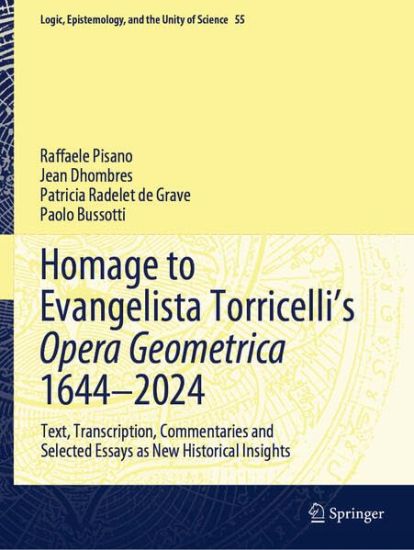
Evangelista Torricelli exemplifies the use the moderns made of the ancients' mathematical methods. Celebrating Evangelista Torricelli's monumental Opera geometrica, this book marks 380 years since its publication (1644-2024). This homage to Torricelli introduces the magnificent major work in Mechanics and Mathematics of a brilliant Archimedean–and–Galilean scientist to modern readers. Opera geometrica deals with Motion & Mechanics and Geometry & Infinitesimals. In quibus Archimedis doctrina Torricelli also presents his mechanical principle of equilibrium – the foundation of the modern Principle of Virtual Work/Static. This outstanding source and research book spotlights the relevance and originality of Torricelli’s Mechanics, and is the first and most profound analysis of the Opera geometrica to date. The historical study is achieved in extensive Introduction, 5 Essays and an accurate Transcription of Opera geometrica with parallel side–by–side text, including substantive explicative notes. The book is an accessible avenue to understanding this work by leading authorities who offer much-needed insights into the relationship Physics–Mathematics, Mechanics and Fundamentals. It appeals to historians, epistemologists and scientists.
Homage to Evangelista Torricelli’s Opera Geometrica 1644–2024

Homage to Evangelista Torricelli’s Opera Geometrica 1644–2024

Raffaele Pisano; Jean Dhombres; Patricia Radelet De Grave; Paolo Bussotti

Springer International Publishing AG
2024
sidottu
Evangelista Torricelli exemplifies the use the moderns made of the ancients' mathematical methods. Celebrating Evangelista Torricelli's monumental Opera geometrica, this book marks 380 years since its publication (1644-2024). This homage to Torricelli introduces the magnificent major work in Mechanics and Mathematics of a brilliant Archimedean–and–Galilean scientist to modern readers. Opera geometrica deals with Motion & Mechanics and Geometry & Infinitesimals. In quibus Archimedis doctrina Torricelli also presents his mechanical principle of equilibrium – the foundation of the modern Principle of Virtual Work/Static. This outstanding source and research book spotlights the relevance and originality of Torricelli’s Mechanics, and is the first and most profound analysis of the Opera geometrica to date. The historical study is achieved in extensive Introduction, 5 Essays and an accurate Transcription of Opera geometrica with parallel side–by–side text, including substantive explicative notes. The book is an accessible avenue to understanding this work by leading authorities who offer much-needed insights into the relationship Physics–Mathematics, Mechanics and Fundamentals. It appeals to historians, epistemologists and scientists.
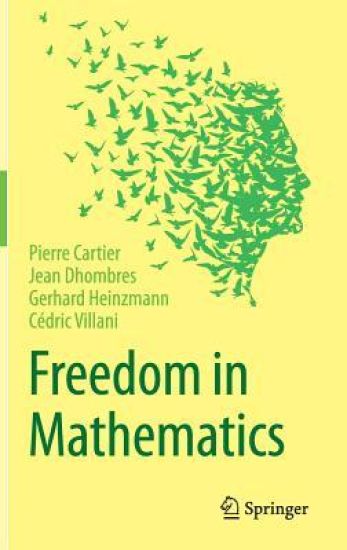
Freedom in Mathematics

Freedom in Mathematics

Pierre Cartier; Jean Dhombres; Gerhard Heinzmann; Cédric Villani

Springer, India, Private Ltd
2016
sidottu

Halvin toimitettuna 84,00 €

This book challenges the views put forward by Pierre Cartier, one of the anchors of the famous Bourbaki group, and Cédric Villani, one of the most brilliant mathematicians of his generation, who received the Fields Medal in 2010. Jean Dhombres, mathematician and science historian, and Gerhard Heinzmann, philosopher of science and also a specialist in mathematics engage in a fruitful dialogue with the two mathematicians, prompting readers to reflect on mathematical activity and its social consequences in history as well as in the modern world. Cédric Villani’s popular success proves once again that a common awareness has developed, albeit in a very confused way, of the major role of mathematics in the construction and efficiency of natural sciences, which are at the origin of our technologies. Despite this, the idea that mathematics cannot be shared remains firmly entrenched, a perceived failing that has even been branded a lack of culture by vocal forces in the media as well as cultural and political establishment. The authors explore three major directions in their dialogue: the highly complex relationship between mathematics and reality, the subject of many debates and opposing viewpoints; the freedom that the construction of mathematics has given humankind by enabling them to develop the natural sciences as well as mathematical research; and the responsibility with which the scientific community and governments should address the role of mathematics in research and education policies.
Gian-Carlo Rota on Analysis and Probability

Gian-Carlo Rota on Analysis and Probability

Jean Dhombres

Springer-Verlag New York Inc.
2011
nidottu
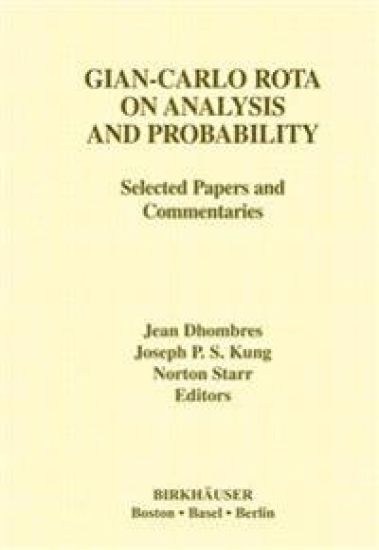
Gian-Carlo Rota was born in Vigevano, Italy, in 1932. He died in Cambridge, Mas­ sachusetts, in 1999. He had several careers, most notably as a mathematician, but also as a philosopher and a consultant to the United States government. His mathe­ matical career was equally varied. His early mathematical studies were at Princeton (1950 to 1953) and Yale (1953 to 1956). In 1956, he completed his doctoral thesis under the direction of Jacob T. Schwartz. This thesis was published as the pa­ per "Extension theory of differential operators I", the first paper reprinted in this volume. Rota's early work was in analysis, more specifically, in operator theory, differ­ ential equations, ergodic theory, and probability theory. In the 1960's, Rota was motivated by problems in fluctuation theory to study some operator identities of Glen Baxter (see [7]). Together with other problems in probability theory, this led Rota to study combinatorics. His series of papers, "On the foundations of combi­ natorial theory", led to a fundamental re-evaluation of the subject. Later, in the 1990's, Rota returned to some of the problems in analysis and probability theory which motivated his work in combinatorics. This was his intention all along, and his early death robbed mathematics of his unique perspective on linkages between the discrete and the continuous. Glimpses of his new research programs can be found in [2,3,6,9,10].
Gian-Carlo Rota on Analysis and Probability

Gian-Carlo Rota on Analysis and Probability

Jean Dhombres

Birkhauser Boston Inc
2002
sidottu
Gian-Carlo Rota was born in Vigevano, Italy, in 1932. He died in Cambridge, Mas­ sachusetts, in 1999. He had several careers, most notably as a mathematician, but also as a philosopher and a consultant to the United States government. His mathe­ matical career was equally varied. His early mathematical studies were at Princeton (1950 to 1953) and Yale (1953 to 1956). In 1956, he completed his doctoral thesis under the direction of Jacob T. Schwartz. This thesis was published as the pa­ per "Extension theory of differential operators I", the first paper reprinted in this volume. Rota's early work was in analysis, more specifically, in operator theory, differ­ ential equations, ergodic theory, and probability theory. In the 1960's, Rota was motivated by problems in fluctuation theory to study some operator identities of Glen Baxter (see [7]). Together with other problems in probability theory, this led Rota to study combinatorics. His series of papers, "On the foundations of combi­ natorial theory", led to a fundamental re-evaluation of the subject. Later, in the 1990's, Rota returned to some of the problems in analysis and probability theory which motivated his work in combinatorics. This was his intention all along, and his early death robbed mathematics of his unique perspective on linkages between the discrete and the continuous. Glimpses of his new research programs can be found in [2,3,6,9,10].