Kirjojen hintavertailu – 12 903 725 kirjaa ja 27 kauppaa
Kirjailija
Jean Leray
Kirjat ja teokset yhdessä paikassa: 4 kirjaa, julkaisuja vuosilta 2012–2014, suosituimpiin kuuluu Contributions to Functional Analysis. Vertaile teosten hintoja ja tarkista saatavuus suomalaisista kirjakaupoista.
Harro Heuser; R. E. Fullerton; C. C. Braunschweiger; Ebbe Thue Poulsen; Jean Leray; Gregers Krabbe; Anastasios Mallios; Tosio Kato; Felix E. Browder; Takako Komura; Yukio Komura; Helmut H. Schaefer; Kosaku Yosida; Nelson Dunford; Joseph Nieto; W. A. J. Luxemburg; A. C. Zaanen; J. L. B. Cooper; R. S. Bucy; G. Maltese; Jean Dieudonné; H. G. Garnir; Heinz König; Angus E. Taylor; Max Landsberg; Thomas Riedrich; E. Michael; A. Martineau; J. L. Kelley; Vlastimil Pták; Shozo Koshi; Horst Leptin; H. Reiter; L. Waelbroeck; N. Aronszajn
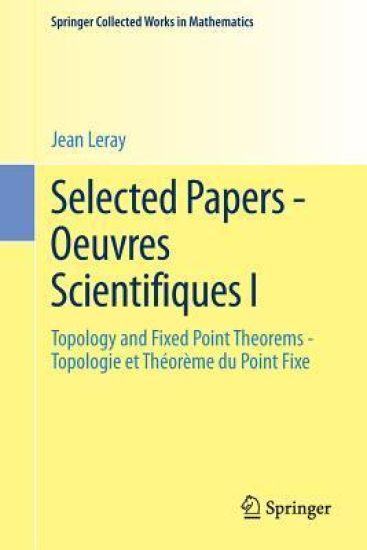
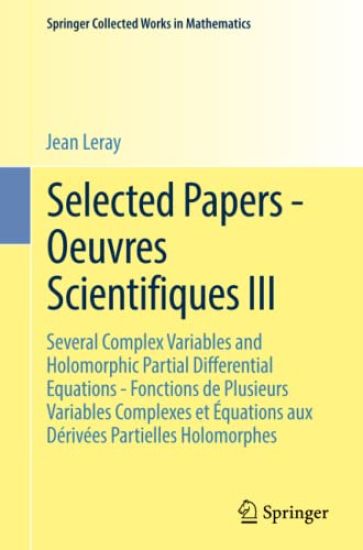
Jean Leray (1906-1998) was one of the great French mathematicians of his century. His life's work can be divided into 3 major areas, reflected in these 3 volumes. Volume I, to which an Introduction has been contributed by A. Borel, covers Leray's seminal work in algebraic topology, where he created sheaf theory and discovered the spectral sequences. Volume II, with an introduction by P. Lax, covers fluid mechanics and partial differential equations. Leray demonstrated the existence of the infinite-time extension of weak solutions of the Navier-Stokes equations; 60 years later this profound work has retained all its impact. Volume III, on the theory of several complex variables, has a long introduction by G. Henkin. Leray's work on the ramified Cauchy problem will stand for centuries alongside the Cauchy-Kovalevska theorem for the unramified case. He was awarded the Malaxa Prize (1938), the Grand Prix in Mathematical Sciences (1940), the Feltrinelli Prize (1971), the Wolf Prize in Mathematics (1979) and the Lomonosov Gold Medal (1988).
Jean Leray (1906-1998) was one of the great French mathematicians of his century. His life's work can be divided into 3 major areas, reflected in these 3 volumes. Volume I, to which an Introduction has been contributed by A. Borel, covers Leray's seminal work in algebraic topology, where he created sheaf theory and discovered the spectral sequences. Volume II, with an introduction by P. Lax, covers fluid mechanics and partial differential equations. Leray demonstrated the existence of the infinite-time extension of weak solutions of the Navier-Stokes equations; 60 years later this profound work has retained all its impact. Volume III, on the theory of several complex variables, has a long introduction by G. Henkin. Leray's work on the ramified Cauchy problem will stand for centuries alongside the Cauchy-Kovalevska theorem for the unramified case. He was awarded the Malaxa Prize (1938), the Grand Prix in Mathematical Sciences (1940), the Feltrinelli Prize (1971), the Wolf Prize in Mathematics (1979), and the Lomonosov Gold Medal (1988).
Jean Leray (1906-1998) was one of the great French mathematicians of his century. His life's work can be divided into 3 major areas, reflected in these three volumes. Volume I, to which an Introduction has been contributed by A. Borel, covers Leray's seminal work in algebraic topology, where he created sheaf theory and discovered the spectral sequences. Volume II, with an introduction by P. Lax, covers fluid mechanics and partial differential equations. Leray demonstrated the existence of the infinite-time extension of weak solutions of the Navier-Stokes equations; 60 years later this profound work has retained all its impact. Volume III, on the theory of several complex variables, has a long introduction by G. Henkin. Leray's work on the ramified Cauchy problem will stand for centuries alongside the Cauchy-Kovalevska theorem for the unramified case. He was awarded the Malaxa Prize (1938), the Grand Prix in Mathematical Sciences (1940), the Feltrinelli Prize (1971), the Wolf Prizein Mathematics (1979), and the Lomonosov Gold Medal (1988).