Kirjailija
Jean Moorcroft Wilson
Kirjat ja teokset yhdessä paikassa: 10 kirjaa, julkaisuja vuosilta 1988–2026, suosituimpiin kuuluu Robert Graves. Vertaile teosten hintoja ja tarkista saatavuus suomalaisista kirjakaupoista.
10 kirjaa
Kirjojen julkaisuvuodet: 1988–2026.
Robert Graves: From Great War Poet to Good-bye to All That casts new light on the life, prose and poetry of Graves, without which the story of Great War poetry is incomplete. The writer and poet Robert Graves suppressed virtually all of the poems he had published during and just after the First World War. Until his son, William Graves, reprinted almost all the Poems About War in 1988, Graves’s status as a ‘war poet’ seems to have depended mainly on his prose memoir (and bestseller), Good-bye to All That. None of the previous biographies written on Graves, however excellent, attempt to deal with this paradox in any depth. Robert Graves the war poet and the suppressed poems themselves have been largely neglected – until now. Jean Moorcroft Wilson, celebrated biographer of poets Siegfried Sassoon, Isaac Rosenberg and Edward Thomas, relates Graves’s fascinating life during this period, his experiences in the war, his being left for dead at the Battle of the Somme, his leap from a third-storey window after his lover Laura Riding’s even more dramatic jump from the fourth storey, his move to Spain and his final ‘goodbye’ to ‘all that’. In this deeply-researched new book, containing startling material never before brought to light, Dr Moorcroft Wilson traces not only Graves’s compelling life, but also the development of his poetry during the First World War, his thinking about the conflict and his shifting attitude towards it.
'An exemplary biography' -- Sunday Times ‘Commanding’ – Observer ‘Diligent and insightful’ – The Times This revelatory biography of Robert Graves re-examines his position as a major First World War poet, as well as a master prose writer. The writer and poet Robert Graves suppressed virtually all of the poems he had published during and just after the First World War. Until his son, William Graves, reprinted almost all the Poems About War in 1988, Graves’s status as a ‘war poet’ depended mainly on his prose memoir, Good-bye to All That. In this exemplary biography, Jean Moorcroft Wilson relates Graves’s fascinating early life, his experiences in the war, his being left for dead at the Battle of the Somme, his leap from a third-storey window after his lover Laura Riding’s even more dramatic jump from the fourth storey, his move to Spain and his final ‘goodbye’ to ‘all that’. Containing startling new archival material about the breakdown of the friendship between Robert Graves and the war poet Siegfried Sassoon, including photographs, Dr Moorcroft Wilson traces not only Graves’s compelling life, but also the development of his poetry during the First World War, his thinking about the conflict and his shifting attitude towards it.
This is the extraordinary life of a poetic genius. Along with Sassoon and Wilfred Owen, Edward Thomas is by any reckoning a major first world war poet. A war poet is not one who chooses to commemorate or celebrate a war, but one who reacts against having a war thrust upon him. His great friend Robert Frost wrote 'his poetry is so very brave, so unconsciously brave.'Apart from a most illuminating understanding of his poetry, Dr Wilson shows how Thomas' life alone makes for absorbing reading: his early marriage, his dependence on laudanum, his friendships with Joseph Conrad, Edward Garnett, Rupert Brooke and Hilaire Belloc among others. The novelist Eleanor Farjeon entered into a curious menage a trois with him and his wife. He died in France in 1917, on the first day of the Battle of Arras. This is the stuff of which myths are made and posterity has been quick to oblige. But this has tended to obscure his true worth as a writer, as Dr Wilson argues. Edward Thomas's poems were not published until some months after his death, but they have never since been out of print. Described by Ted Hughes as 'the father of us all', Thomas's distinctively modern sensibility is probably the one most in tune with our twenty-first century outlook. He occupies a crucial place in the development of twentieth century poetry.
Siegfried Sassoon (1886-1967), soldier, poet, and witness to a century of war, is an icon of the twentieth century; Jean Moorcroft Wilson is the leading authority on him. In this two-volume biography, she offers her definitive analysis of his life and works. The first critically acclaimed volume, covering Sassoon's life up until the end of the Great War, offers rich material on his poetry, his patriotism, and his anti-war stance. In volume two, Moorcroft Wilson reveals the truth of Sassoon's life after the armistice, when most people thought he was dead; the story includes a series of love affairs with such larger-than-life characters as Queen Victoria's great-grandson, Prince Phillip of Hesse, the flamboyant Ivor Novello, and the exotic and bejeweled Stephen Tennant. But this was also the period of Sassoon's close friendships with the greatest literary figures of the age, including Hardy, Beerbohm, E. M. Forster, and T. E. Lawrence. Written with the cooperation of Siegfried Sassoon's family and friends, and with access to a mass of private and unpublished material, poems, diaries, letters, and photographs, this meticulously researched biography will be the standard work on Sassoon's life and legacy.
The definitive biography of one of the twentieth century's finest poets, Siegfried Sassoon combines material from The Making of a War Poet and The Journey from the Trenches, the two bestselling volumes on Sassoon from his biographer and foremost scholar, Jean Moorcroft Wilson. Encompassing the poet's complete life and works, from his patriotic youth that led him to the frontline, to the formation of his anti-war convictions, great literary friendships and flamboyant love affairs, this single-volume opus also includes new poems only just come to light. With over a decade's research, and unparalleled access to Sassoon's private correspondence, Wilson presents the complete portrait, both elegant and heartfelt, of an extraordinary man, and an extraordinary poet.
First full-length biography for 30 years of the great First World War poet. Siegfried Sassoon praised Isaac Rosenberg's 'genius' and T. S. Eliot called him the 'most extraordinary' of the Great War poets. Rosenberg died on the Western Front in 1918 aged only twenty-seven, his tragic early death resembling that of many other well-known poets of that conflict. But he differed from the majority of Great War poets in almost every other respect - race, class, education, upbringing, experience and technique. He was a skilled painter as well as a brilliant poet. The son of impoverished immigrant Russian Jews, he served as a private in the army and his perspective on the trenches is quite different from the other mainly officer-poets. Jean Moorcroft Wilson focuses on the relationship between Rosenberg's life and work - his childhood in Bristol and the Jewish East End of London; his time at the Slade School of Art and friendship with David Bomberg, Mark Gertler and Stanley Spencer; and his harrowing life as a private in the British Army.
Siegfried Sassoon: The Making of a War Poet, a Biography (1886-1918)
Jean Moorcroft Wilson
ROUTLEDGE
2005
nidottu
This book encompasses the complete life and works of Siegfried Sassoon, from his patriotic youth that led him to the frontline, to the formation of his anti-war convictions, great literary friendships and flamboyant love affairs.
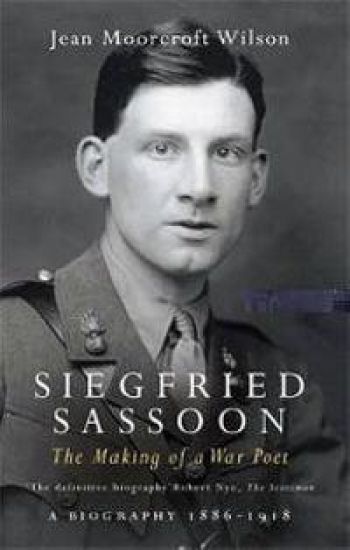
The definitive biography of one of the twentieth century's finest poets, Siegfried Sassoon - The Making of a War Poet is based on 7 years of detailed research by Jean Moorcroft Wilson. Published to great critical acclaim, this first volume covers Sassoon's life up until the end of the First World War. Wilson has unearthed many private and unpublished letters and papers, which have enabled her to embark on the journey towards self-knowledge that Sassoon himself felt that he could never take.