

Kirjailija
Jean Piaget
Kirjat ja teokset yhdessä paikassa: 88 kirjaa, julkaisuja vuosilta 1969–2026, suosituimpiin kuuluu Conversations with Jean Piaget. Vertaile teosten hintoja ja tarkista saatavuus suomalaisista kirjakaupoista.
88 kirjaa
Kirjojen julkaisuvuodet: 1969–2026.
Originally published in English in 1971, structuralism was an increasingly important method of analysis in disciplines as diverse as mathematics, physics, biology, psychology, linguistics, sociology, anthropology and philosophy. Piaget here offers both a definitive introduction to the method and a brilliant critique of the principal structuralist positions. He explains and evaluates the work of the main people at work in the field – Claude Lévi-Strauss, Michel Foucault, Talcott Parsons, Noam Chomsky – and concludes that structuralism has a rich and fruitful future ahead of it. An indispensable work for serious students and working scholars in almost every field, the book is also an important addition to Piaget’s life-long study of the relationship of language and thought.

Memory and Intelligence (Psychology Revivals)
Jean Piaget; Bärbel Inhelder
Psychology Press Ltd
2015
sidottu
In the course of their researches for Mental Imagery in the Child (1971), the authors came to appreciate that action may be more conducive to the formation and conservation of images than is mere perception. This raised the problem of memory and its relation to intelligence, which they examine in this title, originally published in English in 1973. Through the analysis primarily of the child’s capacity for remembering additive and multiplicative logical structures, and his remembrance of causal and spatial structures, the authors investigate whether memories pursue their own course, regardless of the intelligence or whether, in specified conditions, mnemonic improvements may be due to progress in intelligence. They examine the relationship between the memory’s figurative aspects (from perceptive recognition to the memory-image) and its operational aspects (the schemata of the intelligence), and stress the fundamental significance of the mnemonic level known as the ‘reconstructive memory’. This was a pioneering work at the time, presenting illuminating conclusions drawn from extensive research, together with a number of constructive ideas which opened up a fresh approach to an important area of educational psychology.

Experimental Psychology Its Scope and Method: Volume VII (Psychology Revivals)
Pierre Oléron; Jean Piaget; Bärbel Inhelder; Pierre Gréco
Psychology Press Ltd
2014
sidottu
First published in English in 1969, the book opens with a chapter by Pierre Oléron on intellectual activities. These fall into three groups: inductive activities (the apprehension of laws, relations and concepts), reasoning and problem solving. It describes typical methods and essential results obtained by relevant experiments. There are two chapters by Jean Piaget and his collaborator Bärbel Inhelder. The first, on mental images, breaks new ground: it describes original experiments carried out by Piaget and associates with children of various ages. Piaget examines the relations between images and motor activity, imitation, drawing and operations. He also classifies images according to their degree of complexity and show why children have inadequate images of some processes. The second chapter is on intellectual operations and Piaget gives a summary of the main findings of a number of his earlier books, on the child’s notions of conservation, classification, seriation, number, measurement, time, speed and chance. In the last chapter, Pierre Gréco discusses learning and intellectual structures. He describes the work of psychologists with rats in mazes and formulating theories of animal learning. Gestalt psychology and various other interpretations are examined and Greco also pays attention to Piaget’s view of ‘structural learning’ based on experience.
Experimental Psychology Its Scope and Method: Volume I (Psychology Revivals)
Jean Piaget; Maurice Reuchlin
Psychology Press Ltd
2014
sidottu
First published in English 1968, in this volume Paul Fraisse begins with history, looking at the evolution of experimental psychology, starting with its origins. He then moves on to the establishment of experimental psychology around the world. In the second chapter he discusses the experimental method. In the third chapter Jean Piaget tackles the questions of explanation and parallelism and their problems within experimental psychology. The final chapter by Maurice Reuchlin goes on to discuss measurement in psychology looking at various scales with their experimental conditions and numerical properties.

The Origin of the Idea of Chance in Children (Psychology Revivals)
Jean Piaget; Barbel Inhelder
Psychology Press Ltd
2014
sidottu
Although originally published in France in 1951 this English translation was not published until 1975. The book supplements the authors’ previous publications on the development of thought in the child and is the result of two preoccupations: how thought that is in the process of formation acts to assimilate those aspects of experience that cannot be assimilated deductively – for example, the randomly mixed; and the necessity of discovering how the mental processes work in the totality of spontaneous and experimental searchings that make up what is called the problem of ‘induction’. Induction is a sifting of our experiences to determine what depends on regularity, what on law, and what on chance. The authors examine the formation of the physical aspects of the notion of chance; they study groups of random subjects and of ‘special’ subjects; and they analyse the development of combining operations which contributes to determining the relationship between chance, probability, and the operating mechanisms of the mind.
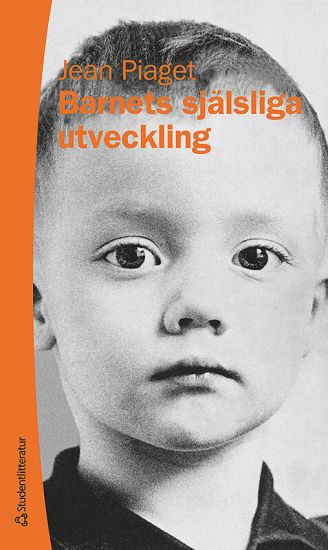
Schweizaren Jean Piaget (1896-1980) var barnpsykolog och en av de mest inflytelserika teoretikerna inom pedagogik och kunskapsteori. Under flera decennier låg Piagets tankar om barns utvecklingsfaser till grund för skolsystem runt om i världen. Barnets själsliga utveckling är en mycket god introduktion till Piagets tänkande. I denna bok lägger han särskild tonvikt på kunskapsprocessernas utveckling i olika stadier – de teorier som gjort honom världsberömd. Boken kom ut på svenska redan 1968, men är fortfarande aktuell. Barnets själsliga utveckling ges numera ut av Studentlitteratur AB. Denna upplaga innehåller dock inga förändringar av innehållet jämfört förra upplagan.
Jean Piaget is one of the greatest names in psychology. A knowledge of his ideas is essential for all in psychology and education. Sociological Studies is one of his major works to remain untranslated. Now an international team of Piaget experts has got together to ensure that this important work is available in English. This classic text, exploring the role of social experience in the development of understanding, shows the general perception of Piaget as someone who took insufficient account of social factors in psychology to be false.
First published in 1999. This volume is the third of a series devoted to the first years of the child’s development, the two others being concerned with the beginnings of intelligence and the child’s construction of reality (La naissance de intelligence chez Venfant and La construction du réel chez Venfant). Although this book contains frequent references to the two other volumes, which deal with the same three children and study the relationships between their mental activities, it nevertheless constitutes in itself an independent and complete study
First published in 1974. This is Volume VIII of selected works of Jean Piaget which along with Burbel Inhelder, looks at how children construct continuous quantity. That is where a quantity that is even more general than number or measurement, and gets included as special cases, namely the extensive quantity characterized by the comparison of the parts without the specification of a unit.
First Published in 1999. Readers will find in this book no direct analysis of child morality as it is practised in home and school life or in children's societies. It is the moral judgment that we propose to investigate, not moral behaviour or sentiments. With this aim in view, a large number of children from the Geneva and Neuchatel schools were questioned and held conversations with them, similar to those we had had before on their conception of the world and of causality. The present volume contains the results of these conversations.
This is Volume XX of thirty-two in the Developmental Psychology series. Initially published in 1954, in Piaget’s words the study of sensorimotor or practical intelligence in the first two years of development has taught us how the child, at first directly assimilating the external environment to his own activity, later, in order to extend this assimilation, forms an increasing number of schemata which are both more mobile and better able to inter-coordinate. This study looks at the second part of evolution of sensorimotor intelligence, as the description of behavior no longer suffices to account for these new products of intellectual activity; it is the subject’s own interpretation of things which we must now try to analyze.

First published in 1997. This is Volume XI of selected works of Jean Piaget which gives insights and illuminates illusions in the field of Philosophy. Piaget examines his own philosophical position and compares it with present-day continental philosophical thought.
First published in 1997. This Volume 4 of Jean Piaget's selected works and explores the study of the concept of space, or rather, of the innumerable ideas involved in the concept of space, which Piaget sees is for many reasons an indispensable part of child psychology.
Our encounters with the physical world are filled with miraculous puzzles-wind appears from somewhere, heavy objects (like oil tankers) float on oceans, yet smaller objects go to the bottom of our water-filled buckets. As adults, instead of confronting a whole world, we are reduced to driving from one parking garage to another. The Child's Conception of Physical Causality, part of the very beginning of the ground-breaking work of the Swiss naturalist Jean Piaget, is filled with creative experimental ideas for probing the most sophisticated ways of thinking in children. The strength of Piaget's research is evident in this collection of empirical data, systematically organized by tasks that illuminate how things work. Piaget's data are remarkably rich. In his new introduction, Jaan Valsiner observes that Piaget had no grand theoretical aims, yet the book's simple power cannot be ignored. Piaget's great contribution to developmental psychology was his clinical method-a tactic that integrated relevant aspects of naturalistic experiment, interview, and observation. Through this systematic inquiry, we gain insight into children's thinking. Reading Piaget will encourage the contemporary reader to think about the unity of psychological phenomena and their theoretical underpinnings. His wealth of creative experimental ideas probes into the most sophisticated ways of thinking in children. Technologies change, yet the creative curiosity of children remains basically unhindered by the consumer society. Piaget's data preserve the reality of the original phenomena. As such, this work will provide a wealth of information for developmental psychologists and those involved in the field of experimental science. Jean Piaget (1896-1980) is known for investigations of thought processes. He was professor at Geneva University (1929-1954) and director of the International Center for Epistemology (1955-1980). He is the author of The Language and Thought of the Child, Judgment and Reasoning in the Child, The Origin of Intelligence in Children, and The Early Growth of Logic in the Child. Jaan Valsiner is professor of psychology at Clark University, and a recognized authority on the life and work of Piaget.
Jean Piaget was one of the most salient and inspirational figures in psychological and educational research of the 20th century. He was also prolific, authoring or editing over 80 books and numerous journals and papers which spawned a continuation of his work over the following decades. His work now compromises a major component of many courses on children's psychological development and in a research tradition which is expanding, scholars may need access to the original texts rather than secondhand accounts. This volume is the sixth of nine reproducing Piaget's original works - they are also available as a boxed set.
First published in 1997. This is Volume II of selected works of Jean Piaget which looks at his thinking on children and how their interaction and perception of number, touching on the areas of development in thinking on conversation of quantities and invariance of wholes; cardinal and ordinal one-one correspondence; as well as additive and multicatitive compositions. These explorations look into tracing the development of the operations which give rise to number and continuous quantities, to space, time, speed, etc., operations which, in these essential fields, lead from intuitive and egocentric pre-logic to rational co-ordination that is both deductive and inductive.

The Developmental Psychology of Jean Piaget
John Hurley Flavell; Jean Piaget
Literary Licensing, LLC
2011
nidottu

The Developmental Psychology of Jean Piaget
John Hurley Flavell; Jean Piaget
Literary Licensing, LLC
2011
sidottu
The Developmental Psychology of Jean Piaget is a comprehensive exploration of the influential theories and research of Swiss psychologist Jean Piaget. Written by renowned psychologist John Flavell, the book delves into Piaget's groundbreaking work on cognitive development in children and adolescents, including his stages of development, his theories on how children learn and acquire knowledge, and his ideas on the role of play in development. Flavell also examines the criticisms of Piaget's work and offers his own insights and perspectives on the field of developmental psychology. This book is an essential resource for students, researchers, and professionals in the field of psychology, education, and child development. This scarce antiquarian book is a facsimile reprint of the old original and may contain some imperfections such as library marks and notations. Because we believe this work is culturally important, we have made it available as part of our commitment for protecting, preserving, and promoting the world's literature in affordable, high quality, modern editions, that are true to their original work.

First published in 1997. This volume is the seventh of nine reproducing Piaget's original works.