Kirjojen hintavertailu – 12 903 725 kirjaa ja 27 kauppaa

Kirjailija

Jean-Pierre Serre

Kirjat ja teokset yhdessä paikassa: 30 kirjaa, julkaisuja vuosilta 1971–2026, suosituimpiin kuuluu Oeuvres - Collected Papers I. Vertaile teosten hintoja ja tarkista saatavuus suomalaisista kirjakaupoista.

Nimi esiintyy myös muodoissa: Jean Pierre Serre

30 kirjaa

Kirjojen julkaisuvuodet: 1971–2026.

Lie Algebras and Lie Groups

Lie Algebras and Lie Groups

Jean-Pierre Serre

Springer-Verlag Berlin and Heidelberg GmbH Co. K
1992
nidottu
The main general theorems on Lie Algebras are covered, roughly the content of Bourbaki's Chapter I. I have added some results on free Lie algebras, which are useful, both for Lie's theory itself (Campbell-Hausdorff formula) and for applications to pro-Jrgroups. of time prevented me from including the more precise theory of Lack semisimple Lie algebras (roots, weights, etc.); but, at least, I have given, as a last Chapter, the typical case ofal,.. This part has been written with the help of F. Raggi and J. Tate. I want to thank them, and also Sue Golan, who did the typing for both parts. Jean-Pierre Serre Harvard, Fall 1964 Chapter I. Lie Algebras: Definition and Examples Let Ie be a commutativering with unit element, and let A be a k-module, then A is said to be a Ie-algebra if there is given a k-bilinear map A x A~ A (i.e., a k-homomorphism A0" A -+ A). As usual we may define left, right and two-sided ideals and therefore quo- tients. Definition 1. A Lie algebra over Ie isan algebrawith the following properties: 1). The map A0i A -+ A admits a factorization A (R)i A -+ A2A -+ A i.e., ifwe denote the imageof(x,y) under this map by [x,y) then the condition becomes for all x e k. [x,x)=0 2). (lx,II], z]+ny, z), x) + ([z,xl, til = 0 (Jacobi's identity) The condition 1) implies [x,1/]=-[1/,x).
Lectures on the Mordell-Weil Theorem

Lectures on the Mordell-Weil Theorem

Jean Pierre Serre

Vieweg+Teubner Verlag
1989
nidottu
This is a translation of "Auto ur du theoreme de Mordell-Weil", a course given by J . -P. Serre at the College de France in 1980 and 1981. These notes were originally written weekly by Michel Waldschmidt and have been reproduced by Publications Mathematiques de l'Universite de Paris VI, by photocopying the handwritten manuscript. The present translation follows roughly the French text, with many modi- fications and rearrangements. We have not tried to give a detailed account of the new results due to Faltings, Raynaud, Gross-Zagier . . .; we have just mentioned them in notes at the appropriate places, and given bibliographical references. Paris, Fall 1988 M. L. Brown J. -P. Serre VII CONTENTS 1. Summary. 1 1. 1. Heights. 3 1. 2. The Mordell-Weil theorem and Mordell's conjecture. 3 1. 3. Integral points on algebraic curves. Siegel's theorem. 4 1. 4. Balcer's method. 5 1. 5. Hilbert's irreducibility theorem. Sieves. 5 2. Heights. 7 2. 1. The product formula. 7 2. 2. Heights on Pm(K). 10 2. 3. Properties of heights. 13 2. 4. Northcott's finiteness theorem. 16 2. 5. Quantitative form of Northcott's theorem. 17 2. 6. Height associated to a morphism rj; X -t P . 19 n 2. 7. The group Pic(X). 20 2. 8. Heights and line bundles. 22 2. 9. hc = 0(1) {: } c is of finite order (number fields). 24 2. 10. Positivity of the height. 24 2. 11. Divisors algebraically equivalent to zero.
Complex Semisimple Lie Algebras

Complex Semisimple Lie Algebras

Jean-Pierre Serre

Springer-Verlag New York Inc.
1987
nidottu
These notes are a record of a course given in Algiers from lOth to 21st May, 1965. Their contents are as follows. The first two chapters are a summary, without proofs, of the general properties of nilpotent, solvable, and semisimple Lie algebras. These are well-known results, for which the reader can refer to, for example, Chapter I of Bourbaki or my Harvard notes. The theory of complex semisimple algebras occupies Chapters III and IV. The proofs of the main theorems are essentially complete; however, I have also found it useful to mention some complementary results without proof. These are indicated by an asterisk, and the proofs can be found in Bourbaki, Groupes et Algebres de Lie, Paris, Hermann, 1960-1975, Chapters IV-VIII. A final chapter shows, without proof, how to pass from Lie algebras to Lie groups (complex-and also compact). It is just an introduction, aimed at guiding the reader towards the topology of Lie groups and the theory of algebraic groups. I am happy to thank MM. Pierre Gigord and Daniel Lehmann, who wrote up a first draft of these notes, and also Mlle. Franr,:oise Pecha who was responsible for the typing of the manuscript.
Local Fields

Local Fields

Jean-Pierre Serre

Springer-Verlag New York Inc.
1980
sidottu
The goal of this book is to present local class field theory from the cohomo­ logical point of view, following the method inaugurated by Hochschild and developed by Artin-Tate. This theory is about extensions-primarily abelian-of "local" (i.e., complete for a discrete valuation) fields with finite residue field. For example, such fields are obtained by completing an algebraic number field; that is one of the aspects of "localisation". The chapters are grouped in "parts". There are three preliminary parts: the first two on the general theory of local fields, the third on group coho­ mology. Local class field theory, strictly speaking, does not appear until the fourth part. Here is a more precise outline of the contents of these four parts: The first contains basic definitions and results on discrete valuation rings, Dedekind domains (which are their "globalisation") and the completion process. The prerequisite for this part is a knowledge of elementary notions of algebra and topology, which may be found for instance in Bourbaki. The second part is concerned with ramification phenomena (different, discriminant, ramification groups, Artin representation). Just as in the first part, no assumptions are made here about the residue fields. It is in this setting that the "norm" map is studied; I have expressed the results in terms of "additive polynomials" and of "multiplicative polynomials", since using the language of algebraic geometry would have led me too far astray.
Linear Representations of Finite Groups

Linear Representations of Finite Groups

Jean-Pierre Serre

Springer-Verlag New York Inc.
1977
sidottu
This book consists of three parts, rather different in level and purpose: The first part was originally written for quantum chemists. It describes the correspondence, due to Frobenius, between linear representations and charac­ ters. This is a fundamental result, of constant use in mathematics as well as in quantum chemistry or physics. I have tried to give proofs as elementary as possible, using only the definition of a group and the rudiments of linear algebra. The examples (Chapter 5) have been chosen from those useful to chemists. The second part is a course given in 1966 to second-year students of I'Ecoie Normale. It completes the first on the following points: (a) degrees of representations and integrality properties of characters (Chapter 6); (b) induced representations, theorems of Artin and Brauer, and applications (Chapters 7-11); (c) rationality questions (Chapters 12 and 13). The methods used are those of linear algebra (in a wider sense than in the first part): group algebras, modules, noncommutative tensor products, semisimple algebras. The third part is an introduction to Brauer theory: passage from characteristic 0 to characteristic p (and conversely). I have freely used the language of abelian categories (projective modules, Grothendieck groups), which is well suited to this sort of question. The principal results are: (a) The fact that the decomposition homomorphism is surjective: all irreducible representations in characteristic p can be lifted "virtually" (i.e., in a suitable Grothendieck group) to characteristic O.
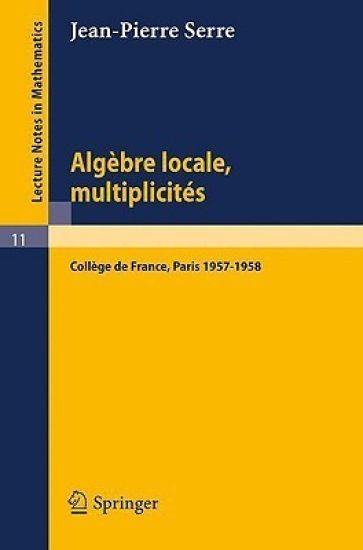
Algèbre Locale, Multiplicités

Algèbre Locale, Multiplicités

Jean-Pierre Serre

Springer-Verlag Berlin and Heidelberg GmbH Co. K
1975
nidottu
Chapitre I. 1DIAUX PIlEMIEIS IT LOCALISATION I I. Wotationa et definitions I 2. Lemme de Bakay. . . . 2 3. Localisation • • • 4. Anneaux et 80dules noethiriens 2 5. Spectre•••••• 3 4 6. Le cas noetherien. 4 7. Ideaux pre. iers associe. Chapitre 11. OUTILS IT SOUTES A) Filtr·ations et graduations. 8 I. Anneaux et modules filtres • 8 2. Topologie definie par UDe filtration 9 10 3. Coapletion des modules filtres • • • II 4. Anneaux et modules graduis • • • • • 5. au tout redevient noethirien; filtrations ~-adiques. 15 20 6. Modules differentiels filtres•••••••••••• B) Polynoaes de Hilbert-SamueL ••••••••••• 26 I. Rappel sur les polynOmes Ii valeurs entieres•••• 26 27 2. Fonctions additives sur les categories de modules. 29 3. Le polynOme caractiristique de Hilbert 32 4. Les invariants de Hilbert-Samuel Chapitre 111. T1I£ORlE DE LA DDlE! ISION A) Dimension des extensions. entieres. 38 I. Definitions. • • • • • • • • • • • • 38 2. Le premier theore- de Cohen-Seidenberg. 39 3. Le second theoreme de Cohen-Seidenberg • 4I B) Dimension dans les anneaux noetheriens. 43 I. Dimension d'un module. • • • 43 2. Le cas semi-local noetherien 44 3. Syste. es de parametres 47 C) Anneaux normaux 48 I. caracterisation des anneaux normaux. 48 2. Proprietes des anneaux noraaux 51 3. Fermeture integrale. 53 D) Anneaux de polynomes. • • • • • 54 I.
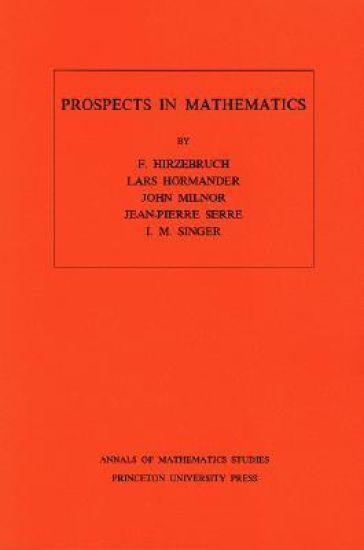
Prospects in Mathematics

Prospects in Mathematics

Friedrich Hirzebruch; Lars Hörmander; John Milnor; Jean-Pierre Serre; I. M. Singer

Princeton University Press
1971
pokkari
Five papers by distinguished American and European mathematicians describe some current trends in mathematics in the perspective of the recent past and in terms of expectations for the future. Among the subjects discussed are algebraic groups, quadratic forms, topological aspects of global analysis, variants of the index theorem, and partial differential equations.