Kirjojen hintavertailu – 12 859 819 kirjaa ja 27 kauppaa

Kirjailija

Jefferson P. Marquis

Kirjat ja teokset yhdessä paikassa: 22 kirjaa, julkaisuja vuosilta 2000–2024, suosituimpiin kuuluu From Patchwork to Framework. Vertaile teosten hintoja ja tarkista saatavuus suomalaisista kirjakaupoista.

Nimi esiintyy myös muodoissa: Jefferson P Marquis

22 kirjaa

Kirjojen julkaisuvuodet: 2000–2024.

From Patchwork to Framework

From Patchwork to Framework

David E. Thaler; Michael J. McNerney; Beth Grill; Jefferson P. Marquis; Amanda Kadlec

RAND
2016
pokkari
The accelerated proliferation of legislative authorities for the Department of Defense (DoD) after September 11, 2001, has created an increasingly unwieldy catalog of security cooperation statutes, which have generated challenges in DoD planning and execution for engagement with foreign partners. This report develops a framework and options to streamline this patchwork of authorities that the DoD employs in security cooperation.

Community Planning and Capacity Building in Puerto Rico After Hurricane Maria

Community Planning and Capacity Building in Puerto Rico After Hurricane Maria

Vivian L Towe; Elizabeth L Petrun Sayers; Edward W Chan; Alice Y Kim; Ashlyn Tom; Wing Yi Chan; Jefferson P Marquis; Michael W Robbins; Lisa Saum-Manning; Margaret M Weden; Leslie Adrienne Payne

RAND
2020
nidottu
The authors describe Puerto Rico's communities in terms of population characteristics, community and individual preparedness, and economic pressures leading up to Hurricanes Irma and Maria. They detail the storms' impact in terms of damage, community stress, and migration. The researchers developed courses of action to improve capacity for emergency preparedness, coordination, communication, recovery planning, and research and training.
Factoring Security Cooperation Into Core U.S. Air Force Decisionmaking Processes

Factoring Security Cooperation Into Core U.S. Air Force Decisionmaking Processes

David E Thaler; Beth Grill; Jefferson P Marquis; Jennifer D P Moroney; Stephanie Pezard

RAND
2018
nidottu
Security cooperation is an important mission of the U. S. Air Force. This report reviews two core Air Force decisionmaking processes--the strategy, planning, and programming process and the concept development and acquisition process--to determine the extent to which decisionmakers consider security cooperation impact and to recommend ways to make such considerations systematic and explicit.
Career Development for the Department of Defense Security Cooperation Workforce

Career Development for the Department of Defense Security Cooperation Workforce

M Wade Markel; Jefferson P Marquis; Peter Schirmer; Sean Robson; Lisa Saum-Manning; Katherine Hastings; Katharina Ley Best; Christina Panis; Alyssa Ramos; Barbara Bicksler

RAND
2018
nidottu
Security cooperation's importance, scale, and complexity have grown substantially in recent years, but efforts to develop and manage the Department of Defense security cooperation workforce have lagged. This study informs the development of career models for the security cooperation workforce, assesses potential requirements for competencies and experience, and identifies potential job families within the workforce to facilitate management.
Adding Value to Air Force Management Through Building Partnerships Assessment

Adding Value to Air Force Management Through Building Partnerships Assessment

Jefferson P. Marquis; Joe Hogler; Jennifer D. P. Moroney; Michael J. Neumann; Christopher Paul

RAND
2011
pokkari
The U. S. Air Force works to build strong and enduring partnerships with allies and friendly nations, to reinforce their capacity to defend themselves and to work in coalitions, and to ensure U. S. access to foreign territories. This volume evaluates existing Air Force capacity to conduct assessments of its security cooperation programs and describes a framework for improving assessment efforts.
Security Cooperation Organizations in the Country Team: Options for Success

Security Cooperation Organizations in the Country Team: Options for Success

Terrence M. Kelly; Jefferson P. Marquis; Cathryn Quantic Thurston; Jennifer D. P. Moroney; Charlotte Lynch

RAND
2010
pokkari
Security assistance and security cooperation are interrelated missions that rely on military staffs in U. S. embassies in partner countries. In countries threatened by insecurity or instability, actions may be required that are not easily accomplished under current systems. This report examines three options for improving current approaches to security assistance and cooperation. They range from changes in current practices to options requiring new policies, procedures, organizations, or authorities.
Aerospace Operations in Urban Environments

Aerospace Operations in Urban Environments

Alan Vick; John W. Stillion; David R. Frelinger; Joel S Kvitky; Benjamin S. Lambeth; Jefferson P. Marquis; Matthew C. Waxman

RAND
2000
pokkari
This title examines how the urban physical, social, and political environment constrains aerospace operations; identifies key operational tasks that aerospace forces can help accomplish; and discusses strategies and technologies that can improve success in urban operations.
Optimizing Foreign Military Sales Roles, Responsibilities, and Authorities

Optimizing Foreign Military Sales Roles, Responsibilities, and Authorities

Lisa Saum-Manning; Jefferson P Marquis; Irina a Chindea; Daniel Elinoff; Theiline Pigott; Elliott Brennan

RAND Corporation
2024
pokkari
In this report, the authors assess how the complex array of roles, responsibilities, and authorities (RRA) that shape the Foreign Military Sales (FMS) process are first defined in policy and related guidance and then implemented in practice by a diverse variety of stakeholder organizations at strategic, operational, and tactical levels of execution.
Sustaining the Army's Reserve Components as an Operational Force

Sustaining the Army's Reserve Components as an Operational Force

Christopher M Schnaubelt; Raphael S Cohen; Molly Dunigan; Gian Gentile; Jaime L Hastings; Joshua Klimas; Jefferson P Marquis; Agnes Gereben Schaefer; Bonnie Triezenberg; Michelle Darrah Ziegler

RAND
2017
nidottu
This report identifies emerging policy lessons regarding the use of, and reforms to, the U. S. Army's Reserve Components (RCs) as an operational reserve derived from analyses of their contributions to Operations Enduring Freedom, Iraqi Freedom, New Dawn, and other recent contingency operations. These lessons can be applied to sustain the readiness of the U. S. Army Reserve and Army National Guard in future contingencies.
Improving Oversight and Coordination of Department of Defense Programs That Address Problematic Behaviors Among Military Personnel

Improving Oversight and Coordination of Department of Defense Programs That Address Problematic Behaviors Among Military Personnel

Jefferson P. Marquis; Coreen Farris; Kimberly Curry Hall; Kristy N. Kamarck; Nelson Lim; Douglas Shontz; Paul S. Steinberg; Robert Stewart; Thomas E. Trail; Jennie W. Wenger; Anny Wong; Eunice C. Wong

RAND
2017
pokkari
A RAND study examined programs to address sexual harassment, sexual assault, unlawful discrimination, substance abuse, suicide, and hazing. This report discusses findings, then makes recommendations for the Office of the Secretary of Defense to better understand the relationships among these problematic behaviors and its oversight and coordination of programs to address those behaviors.
Developing an Assessment, Monitoring, and Evaluation Framework for U.S. Department of Defense Security Cooperation

Developing an Assessment, Monitoring, and Evaluation Framework for U.S. Department of Defense Security Cooperation

Jefferson P. Marquis; Michael J. McNerney; S. Rebecca Zimmerman; Jeremy Boback; David Stebbins

RAND
2016
pokkari
This report addresses the challenge of creating a U. S. Department of Defense wide (DoD-wide) system for security cooperation assessment, monitoring, and evaluation (AME) by (1) analyzing existing planning and AME principles, processes, and practices inside and outside DoD and (2) presenting a conceptual framework that explains how AME methods might be applied, integrated, and implemented by major security cooperation organizations."
Diversity Leadership in the U.S. Department of Defense

Diversity Leadership in the U.S. Department of Defense

Maria C. Lytell; Kirsten M. Keller; Beth Katz; Jefferson P. Marquis; Jerry M. Sollinger

RAND
2016
pokkari
This study identifies the knowledge, skills, abilities, and other personal characteristics needed in individuals who will be responsible for implementing strategic diversity plans in the Department of Defense (DoD). The authors interviewed more than 60 diversity leaders in industry, the public sector (including DoD), and academia and reviewed relevant scientific literature, education programs, and advertised job requirements.
Smart Security Cooperation Objectives

Smart Security Cooperation Objectives

Michael J. McNerney; Jefferson P. Marquis; S. Rebecca Zimmerman; Ariel Klein

RAND
2016
pokkari
To help ensure that limited security cooperation resources are properly directed for greatest effect, this report evaluates the U. S. Department of Defense s effectiveness in developing SMART (specific, measurable, achievable, relevant and results-oriented, and time-bound) security cooperation objectives that facilitate assessment, monitoring, and evaluation."
Force Drawdowns and Demographic Diversity

Force Drawdowns and Demographic Diversity

Maria C. Lytell; Kenneth Kuhn; Abigail Haddad; Jefferson P. Marquis; Nelson Lim; Kimberly Curry Hall; Robert Stewart; Jennie W. Wenger

RAND
2015
pokkari
In January 2012, the Department of Defense (DoD) announced plans for a large-scale reduction or drawdown of its military force, which could have unintended consequences for demographic diversity. The Office of Diversity Management and Equal Opportunity (ODMEO) in the Office of the Under Secretary of Defense (Personnel and Readiness) asked RAND to analyze how force reductions could affect the demographic diversity of the DoD workforce."
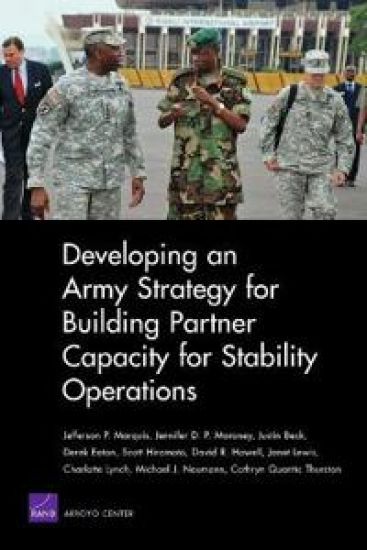
Developing an Army Strategy for Building Partner Capacity for Stability Operations

Developing an Army Strategy for Building Partner Capacity for Stability Operations

Jefferson P. Marquis; Jennifer D. P. Moroney; Justin Beck; Derek Eaton; Scott Hiromoto

RAND
2010
pokkari
The U. S. government is facing the dual challenge of building its own interagency capacity for conducting stability operations while simultaneously building partner capacity (BPC) for stability operations. This study finds that although BPC and stability operations are receiving a good deal of attention in official strategy and planning documents, insufficient attention is being paid to the details of an integrated strategy.
Developing an Assessment Framework for U.S. Air Force Building Partnerships Programs

Developing an Assessment Framework for U.S. Air Force Building Partnerships Programs

Jennifer D. P. Moroney; Joe Hogler; Jefferson P. Marquis; Christoher Paul; John E. Peters

RAND
2010
pokkari
Working with allies to build their defense capacity, acquire access to their territories for potential operations, and strengthen relationships with their air forces is an important U. S. Air Force activity. To determine the value of this activity, the authors outline an assessment framework that planners, strategists, and policymakers can use to see whether Air Force security cooperation activities are achieving the desired effects.
A Framework to Assess Programs for Building Partnerships

A Framework to Assess Programs for Building Partnerships

Jennifer D P Moroney; Jefferson P Marquis; Cathryn Quantic Thurston; Gregory F Treverton

RAND
2009
pokkari
It is often challenging to determine whether security cooperation activities conducted by the Defense Department have contributed to U. S. objectives. This monograph, based on themes that emerged from a May 2008 assessment workshop held at RAND, lays out a framework for security program assessment and stresses the need for injecting a greater level of objectivity into the assessment process.
Managing Diversity in Corporate America

Managing Diversity in Corporate America

Jefferson P. Marquis; Nelson Lim; Lynn Scott; Margaret C. Harrell; Jennifer Kavanagh

RAND
2008
pokkari
This book develops a fact-based approach to modeling diversity management in U. S. corporations, analyzes the strategies pursued by 14 large U. S. companies recognized for their diversity or human resource achievements, and compares a number of company characteristics. Firms recognized for diversity are distinguished by a core set of motives and practices, but best practices per se may not enable a company to achieve a high level of diversity. It develops a fact-based approach to diversity management in U. S. corporations and uses it to compare corporate practices.
The Civil-Military Gap in the United States: Does it Exist, Why, and Does it Matter?

The Civil-Military Gap in the United States: Does it Exist, Why, and Does it Matter?

Thomas S. Szayna; Kevin F. McCarthy; Jerry M. Sollinger; Linda J. Demaine; Jefferson P. Marquis

RAND
2007
pokkari
What is the potential for a divergence in views among civilian and military elites (sometimes referred to as the civil-military gap) to undermine military effectiveness? Although a variety of differences were found among the views of military and civilian survey respondents, these differences mostly disappeared when the authors focused on the attitudes that are pertinent to civilian control of the military and military effectiveness.
Assessing the Value of U.S. Army International Activities

Assessing the Value of U.S. Army International Activities

Jefferson P. Marquis; Richard E. Darilek; Jasen J. Castillo; Cathryn Quantic Thurston; Anny Wong; Cynthia Huger; Andrea Mejia; Jennifer D. P. Moroney; Brian Nichiporuk; Brett Steele

RAND
2006
pokkari
This report presents a framework for assessing U. S. Army International Activities (AIA). It also provides a matrix of eight AIA ends, derived from top-level national and Army guidance, and eight AIA ways, which summarize the various capabilities inherent in AIA programs. In addition, the report describes the new online AIA Knowledge Sharing System (AIAKSS) that is being used to solicit programmatic and assessment data from AIA officials in the Army's Major Commands.