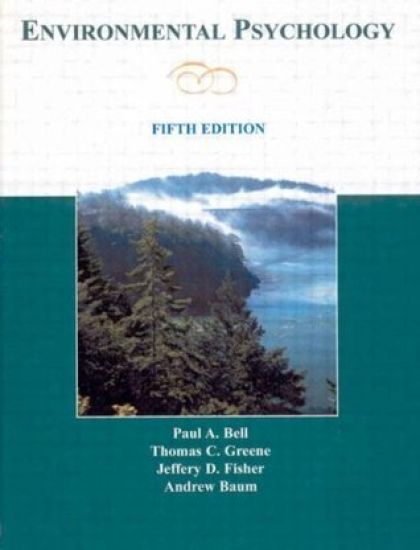
Environmental Psychology
Paul A. Bell; Thomas C. Greene; Jeffrey D. Fisher; Andrew S. Baum
Psychology Press
2005
sidottu
Bell et al’s Environmental Psychology is considered to be the most authoritative textbook available for this course. It is the only environmental psychology book to appear in five editions. It is noted for its focus on the application of science and theory to the solution of problems involving natural and altered environments. The book reviews the application of practical solutions to everyday environmental problems. The authors integrate theory, research, and application using their unifying, eclectic model to demonstrate human-environment interaction. The book reviews how we are a product of our environment, our biology, and the interaction of the two. It discusses how our physical environment such as noise and weather impact us. It also reviews how we can modify our environment through design principles such as aesthetics, and how we modify our environment when we disregard the impact other people and/or elements have on our ecological system. Each chapter addresses both micro and macro- environmental influences, including the short- and long-term effects of both. The opening chapter provides a historical context and introduces the reader to the research methods central to the discipline. The next 4 chapters introduce environmental attitudes, values, and ethics and the principles that apply to environmental assessment; models of perception & cognition, including how we process and store environmental information; and the major theories of human-environment interaction. The next 6 chapters explore a variety of environmental influences such as noise, climate, natural disasters (including the effects of pollution), crowding, and city life, and how they impact us. The next 2 chapters examine how environmental psychology principles can be applied to residences, institutional settings (i.e.schools) and work and leisure environments. The book concludes with a chapter on how we can change behavior that harms the environment. The book is intended as a text for courses on environmental psychology, environment and behavior, social ecology, architectural psychology, ecological psychology or environmental design or studies, taught in departments of psychology, sociology, environmental science, and biology.