Kirjojen hintavertailu – 12 903 725 kirjaa ja 27 kauppaa

Kirjailija

Jeffrey O'Connell

Kirjat ja teokset yhdessä paikassa: 3 kirjaa, julkaisuja vuosilta 1999–2021, suosituimpiin kuuluu Social Darwinism. Vertaile teosten hintoja ja tarkista saatavuus suomalaisista kirjakaupoista.

3 kirjaa

Kirjojen julkaisuvuodet: 1999–2021.

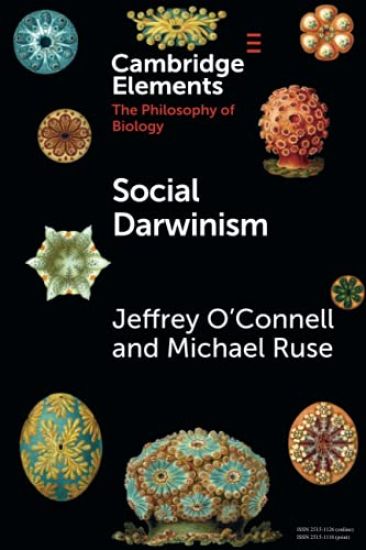
Social Darwinism

Social Darwinism

Jeffrey O'Connell; Michael Ruse

Cambridge University Press
2021
pokkari
This Element is a philosophical history of Social Darwinism. It begins by discussing the meaning of the term, moving then to its origins, paying particular attention to whether it is Charles Darwin or Herbert Spencer who is the true father of the idea. It gives an exposition of early thinking on the subject, covering Darwin and Spencer themselves and then on to Social Darwinism as found in American thought, with special emphasis on Andrew Carnegie, and Germany with special emphasis on Friedrich von Bernhardi. Attention is also paid to outliers, notably the Englishman Alfred Russel Wallace, the Russian Peter Kropotkin, and the German Friedrich Nietzsche. From here we move into the twentieth century looking at Adolf Hitler - hardly a regular Social Darwinian given he did not believe in evolution - and in the Anglophone world, Julian Huxley and Edward O. Wilson, who reflected the concerns of their society.
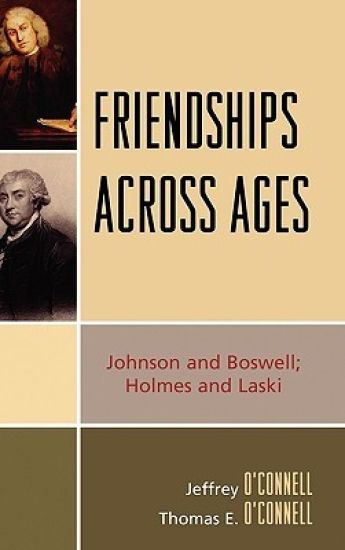
Friendships Across Ages

Friendships Across Ages

Jeffrey O'Connell; Thomas E. O'Connell

Lexington Books
2007
sidottu
Friendships Across Ages: Johnson & Boswell; Holmes & Laski considers each man and goes on to compare two unlikely, but pivotal, friendships. Through their writing and publishing, young Boswell and Laski both served their much older friends, Johnson and Holmes respectively, in brilliant fashion. Boswell's biography preserves Johnson for the present day reader as richly as any other biography has ever done. Though less commonly acknowledged, Laski preserves Holmes in a similar fashion. If Johnson's fame lies largely not on his prolific literary efforts, but rather on his persona as captured by his exchanges with Boswell, then Holmes's place in history, too, cannot be placed solely or even primarily on his prolific professional legal writing and opinions, but more broadly on his persona, captured best in his lengthy correspondence with Laski. Both Boswell and Laski were outcasts from the societies in which they lived: the former a Scot, the latter a Jew. Both were, and continue to be, scorned: Laski as a boastful, prevaricating self-promoter, Boswell as a buffoon, lecher, and drunk. However, each managed to befriend a much older man, a great man of his age, and carried on for twenty years an historically important relationship that was partly junior to mentor, partly son to father, but mostly stimulating mind to stimulating mind.
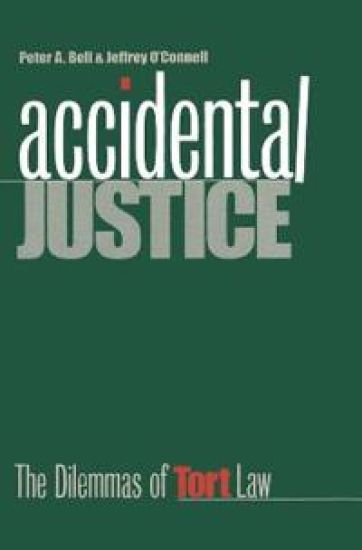
Accidental Justice

Accidental Justice

Peter A. Bell; Jeffrey O'Connell

Yale University Press
1999
pokkari
A woman suffers paralyzing injuries in a car accident but fails in court to prove the other driver's fault. She loses her case and is left bankrupt as well as maimed. An intoxicated man stumbles in the path of a subway train. He sues the local transit authority and wins a $9 million judgment. Real-life tort (or accident) cases like these inspire outrage against a system that seems frustratingly slow, inequitable, and expensive. In this even-handed and fascinating book, two leading tort experts explain to lay readers the strengths and weaknesses of our tort law system. Peter Bell and Jeffrey O'Connell demystify tort law and bring to life the process of tort litigation. The roots of tort law lie in human suffering, maimed bodies, shattered spirits, and extinguished lives, say the authors. They discuss tort law's compensatory and deterrent functions; its delays, fortuity, and high transaction costs (mostly in lawyer's fees); and its role in discouraging harmful—as well as, on occasion, useful—activities. In a discussion of mass toxic tort cases, the authors investigate the ability of the courts to deal adequately with huge suits (related to breast implants or tobacco-related illnesses, for example) that involve massive numbers of claimants. Bell and O'Connell conclude with an objective review of such current reform enactments and proposals as no-fault insurance, caps on damages, and contingency fee reform.