
Kirjailija
Jennifer Pearson
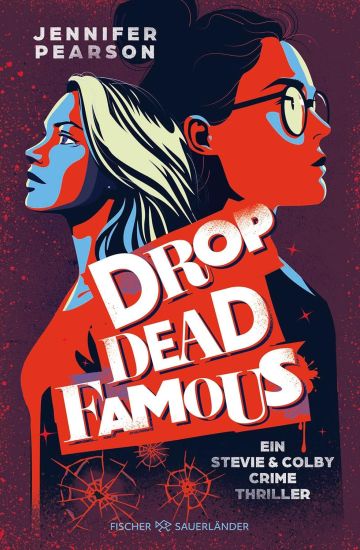
Kirjat ja teokset yhdessä paikassa: 10 kirjaa, julkaisuja vuosilta 2000–2026, suosituimpiin kuuluu Drop Dead Famous. Vertaile teosten hintoja ja tarkista saatavuus suomalaisista kirjakaupoista.
10 kirjaa
Kirjojen julkaisuvuodet: 2000–2026.

The hotly-anticipated YA crime thriller debut from bestselling and award-winning author, Jennifer Pearson. Perfect for fans of Holly Jackson and Ravena Guron. ?
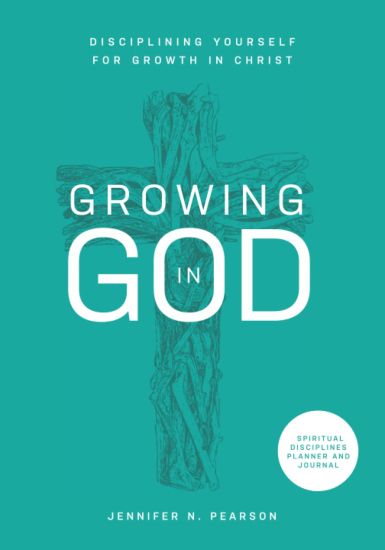
Growing in God: Disciplining Yourself for Growth in Christ
Jennifer Pearson
Cornerstone Christian Books
2021
nidottu
Growing in God serves as both a book and a journal that can encourage you to grow in your knowledge and understanding while deepening your walk with God. It includes a brief study of eight spiritual disciplines, a monthly calendar for planning and accountability purposes, prayer journal pages for writing out your daily prayers to the Father, a note-taking section to be used for Bible study notes, and so much more. You'll learn the importance of studying, memorizing, and meditating on God's holy Word; praying in absolute faith and trust; worshipping your Creator, sharing the gospel to a lost and dying world; fasting for the purpose of absolute dependence on God; and experiencing solitude and alone time with the heavenly Father.
Bibliography of Translation Studies: 2000
Lynne Bowker; Dorothy Kenny; Jennifer Pearson
Routledge
2017
sidottu
A volume of selected, annotated references arranged under specific headings to provide a non-partisan guide to teachers involved in designing courses in translation and/or interpreting.
Bibliography of Translation Studies: 2001
Lynne Bowker; Dorothy Kenny; Jennifer Pearson
Routledge
2017
sidottu
A volume of selected, annotated references arranged under specific headings to provide a non-partisan guide to teachers involved in designing courses in translation and/or interpreting.
Designing for Digital Reading
Jennifer Pearson; George Buchanan; Harold Thimbleby
Springer International Publishing AG
2013
nidottu
Reading is a complex human activity that has evolved, and co-evolved, with technology over thousands of years. Mass printing in the fifteenth century firmly established what we know as the modern book, with its physical format of covers and paper pages, and now-standard features such as page numbers, footnotes, and diagrams. Today, electronic documents are enabling paperless reading supported by eReading technologies such as Kindles and Nooks, yet a high proportion of users still opt to print on paper before reading. This persistent habit of "printing to read" is one sign of the shortcomings of digital documents -- although the popularity of eReaders is one sign of the shortcomings of paper. How do we get the best of both worlds? The physical properties of paper (for example, it is light, thin, and flexible) contribute to the ease with which physical documents are manipulated; but these properties have a completely different set of affordances to their digital equivalents. Paper can befolded, ripped, or scribbled on almost subconsciously -- activities that require significant cognitive attention in their digital form, if they are even possible. The nearly subliminal interaction that comes from years of learned behavior with paper has been described as lightweight interaction, which is achieved when a person actively reads an article in a way that is so easy and unselfconscious that they are not apt to remember their actions later. Reading is now in a period of rapid change, and digital text is fast becoming the predominant mode of reading. As a society, we are merely at the start of the journey of designing truly effective tools for handling digital text. This book investigates the advantages of paper, how the affordances of paper can be realized in digital form, and what forms best support lightweight interaction for active reading. To understand how to design for the future, we review the ways reading technology and reader behavior have both changed and remainedconstant over hundreds of years. We explore the reasoning behind reader behavior and introduce and evaluate several user interface designs that implement these lightweight properties familiar from our everyday use of paper. We start by looking back, reviewing the development of reading technology and the progress of research on reading over many years. Drawing key concepts from this review, we move forward to develop and test methods for creating new and more effective interactions for supporting digital reading. Finally, we lay down a set of lightweight attributes which can be used as evidence-based guidelines to improve the usability of future digital reading technologies. By the end of this book, then, we hope you will be equipped to critique the present state of digital reading, and to better design and evaluate new interaction styles and technologies.
Working with Specialized Language: a practical guide to using corpora introduces the principles of using corpora when studying specialized language. The resources and techniques used to investigate general language cannot be easily adopted for specialized investigations. This book is designed for users of language for special purposes (LSP). Providing guidelines and practical advice, it enables LSP users to design, build and exploit corpus resources that meet their specialized language needs. Highly practical and accessible, the book includes exercises, a glossary and an appendix describing relevant resources and corpus-analysis software. Working with Specialized Language is ideal for translators, technical writers and subject specialists who are interested in exploring the potential of a corpus-based approach to teaching and learning LSP.
Working with Specialized Language: a practical guide to using corpora introduces the principles of using corpora when studying specialized language. The resources and techniques used to investigate general language cannot be easily adopted for specialized investigations. This book is designed for users of language for special purposes (LSP). Providing guidelines and practical advice, it enables LSP users to design, build and exploit corpus resources that meet their specialized language needs. Highly practical and accessible, the book includes exercises, a glossary and an appendix describing relevant resources and corpus-analysis software. Working with Specialized Language is ideal for translators, technical writers and subject specialists who are interested in exploring the potential of a corpus-based approach to teaching and learning LSP.
Bibliography of Translation Studies: 2001
Lynne Bowker; Dorothy Kenny; Jennifer Pearson
St Jerome Publishing
2001
nidottu
A volume of selected, annotated references arranged under specific headings to provide a non-partisan guide to teachers involved in designing courses in translation and/or interpreting.
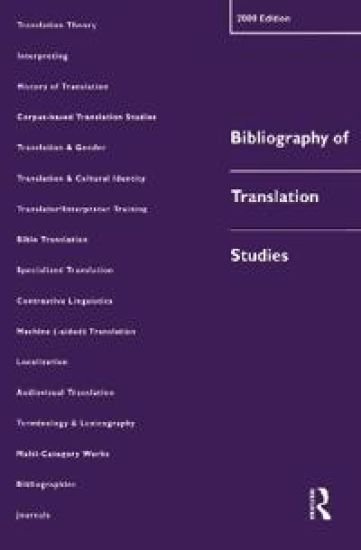
Bibliography of Translation Studies: 2000
Lynne Bowker; Dorothy Kenny; Jennifer Pearson
St Jerome Publishing
2000
nidottu
A volume of selected, annotated references arranged under specific headings to provide a non-partisan guide to teachers involved in designing courses in translation and/or interpreting.