Kirjojen hintavertailu – 12 903 725 kirjaa ja 27 kauppaa

Kirjailija

Jenny M. Lewis

Kirjat ja teokset yhdessä paikassa: 6 kirjaa, julkaisuja vuosilta 2009–2018, suosituimpiin kuuluu Networks, Innovation and Public Policy. Vertaile teosten hintoja ja tarkista saatavuus suomalaisista kirjakaupoista.

6 kirjaa

Kirjojen julkaisuvuodet: 2009–2018.

Innovation in City Governments

Innovation in City Governments

Jenny M. Lewis; Lykke Margot Ricard; Erik Hans Klijn; Tamyko Ysa Figueras

Routledge
2018
nidottu
Innovation has become an important focus for governments around the world over the last decade, with greater pressure on governments to do more with less, and expanding community expectations. Some are now calling this ‘social innovation’ – innovation that is related to creating new services that have value for stakeholders (such as citizens) in terms of the social and political outcomes they produce. Innovation in City Governments: Structures, Networks, and Leadership establishes an analytical framework of innovation capacity based on three dimensions: Structure - national governance and traditions, the local socioeconomic context, and the municipal structure Networks – interpersonal connections inside and outside the organization Leadership – the qualities and capabilities of senior individuals within the organization. Each of these are analysed using data from a comparative EU research project in Copenhagen, Barcelona and Rotterdam. The book provides major new insights on how structures, networks and leadership in city governments shape the social innovation capacity of cities. It provides ground-breaking analyses of how governance structures and local socio-economic challenges, are related to the innovations introduced by these cities. The volume maps and analyses the social networks of the three cities and examines boundary spanning within and outside of the cities. It also examines what leadership qualities are important for innovation. Innovation in City Governments: Structures, Networks, and Leadership combines an original analytical approach with comparative empirical work, to generate a novel perspective on the social innovation capacity of cities and is critical reading for academics, students and policy makers alike in the fields of Public Management, Public Administration, Local Government, Policy, Innovation and Leadership.
Innovation in City Governments

Innovation in City Governments

Jenny M. Lewis; Lykke Margot Ricard; Erik Hans Klijn; Tamyko Ysa Figueras

Routledge
2016
sidottu
Innovation has become an important focus for governments around the world over the last decade, with greater pressure on governments to do more with less, and expanding community expectations. Some are now calling this ‘social innovation’ – innovation that is related to creating new services that have value for stakeholders (such as citizens) in terms of the social and political outcomes they produce. Innovation in City Governments: Structures, Networks, and Leadership establishes an analytical framework of innovation capacity based on three dimensions: Structure - national governance and traditions, the local socioeconomic context, and the municipal structure Networks – interpersonal connections inside and outside the organization Leadership – the qualities and capabilities of senior individuals within the organization. Each of these are analysed using data from a comparative EU research project in Copenhagen, Barcelona and Rotterdam. The book provides major new insights on how structures, networks and leadership in city governments shape the social innovation capacity of cities. It provides ground-breaking analyses of how governance structures and local socio-economic challenges, are related to the innovations introduced by these cities. The volume maps and analyses the social networks of the three cities and examines boundary spanning within and outside of the cities. It also examines what leadership qualities are important for innovation. Innovation in City Governments: Structures, Networks, and Leadership combines an original analytical approach with comparative empirical work, to generate a novel perspective on the social innovation capacity of cities and is critical reading for academics, students and policy makers alike in the fields of Public Management, Public Administration, Local Government, Policy, Innovation and Leadership.

Getting Welfare to Work

Getting Welfare to Work

Mark Considine; Jenny M. Lewis; Siobhan O'Sullivan; Els Sol

Oxford University Press
2015
sidottu
Getting Welfare to Work traces the radical reform of the Australian, UK, and Dutch public employment services systems. Starting with major changes from 1998, this book examines how each national system has moved from traditional public services towards more privately provided and market-based methods. Each of these three countries developed innovative forms of contracting-out and complex incentive regimes to motivate welfare clients and to control the agencies charged with helping them. The Australian system pioneered the use of large, national contracts for services to all unemployed jobseekers. By the end of our study period this system was entirely outsourced to private agencies. Meanwhile the UK elected a form of contestability under Blair and Cameron, culminating in a new public-private financing model known as the 'Work Programme'. The Dutch had evolved their far more complex system from a traditional public service approach to one using a variety of specific contracts for private agencies. These innovations have changed welfare delivery and created both opportunities and new constraints for policy makers. Getting Welfare to Work tells the story of these bold policy reforms from the perspective of street-level bureaucrats. Interviews and surveys in each country over a fifteen year period are used to critically appraise this central pillar of the welfare state. The original data analysed in Getting Welfare to Work provides a unique comparative perspective on three intriguing systems. It points to new ways of thinking about modes of governance, system design, regulation of public services, and so-called activation of welfare clients. It also sheds light on the predicament of third sector organisations that contract to governments through competitive tenders with precise performance monitoring, raising questions of 'mission drift'.
Connecting and Cooperating

Connecting and Cooperating

Jenny M. Lewis

UNSW Press
2009
nidottu
Jenny M. Lewis establishes a set of parameters for social capital that help us examine how policy can increase cooperation between organisations and individuals, and how a social capital framework can also help us understand the public policy process. This is an invaluable text for researchers, policy-makers and students who are interested in how social capital theories can be integrated into grassroots policy making both in Australia and overseas.
Networks, Innovation and Public Policy

Networks, Innovation and Public Policy

M. Considine; Jenny M. Lewis; Damon Alexander

Palgrave Macmillan
2009
nidottu
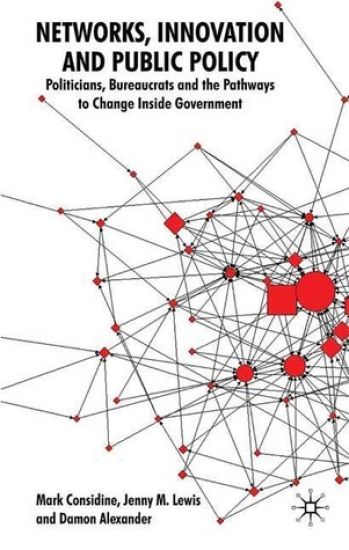
This book examines the different normative approaches politicians, bureaucrats and community actors use to frame the innovation puzzle, arguing that these create specific cultures of innovation. The authors explore the role of formal institutions and informal networks in promoting and impeding governmental innovation.
Networks, Innovation and Public Policy

Networks, Innovation and Public Policy

M. Considine; Jenny M. Lewis; Damon Alexander

Palgrave Macmillan
2009
sidottu
This book examines the different normative approaches politicians, bureaucrats and community actors use to frame the innovation puzzle, arguing that these create specific cultures of innovation. The authors explore the role of formal institutions and informal networks in promoting and impeding governmental innovation.