Kirjojen hintavertailu – 12 903 731 kirjaa ja 27 kauppaa
Kirjailija
Jenny Nagaoka
Kirjat ja teokset yhdessä paikassa: 8 kirjaa, julkaisuja vuosilta 2012–2019, suosituimpiin kuuluu The Educational Attainment of Chicago Public Schools Students: A Focus on Four-Year College Degrees. Vertaile teosten hintoja ja tarkista saatavuus suomalaisista kirjakaupoista.
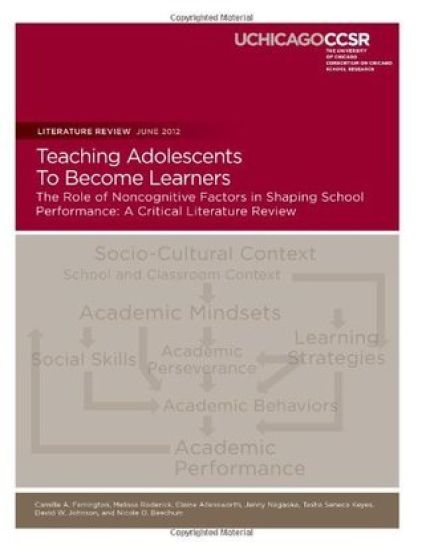
Social and emotional learning is a topic of increasing focus in the education sector. Though definitions and terminology vary, at its core this trend reflects an increased interest among educators, administrators, parents, and other stakeholders in students' development of individual and interpersonal skills beyond the realm of academic achievement. This project, conducted as a partnership between Ingenuity and the University of Chicago Consortium on School Research, consists of two components: a review of literature on this topic and an interview-based fieldwork component with educators, administrators, students, and parents in Chicago Public Schools. The authors reviewed more than 200 studies on arts education spanning six decades. They also conducted focus groups and interviews with key participants in the arts education process-including educators, administrators, students, and parents-to evaluate evidence of the effects of arts education on social-emotional development in school and after-school settings. They found a widespread belief that arts education contributes to children's and adolescents' social-emotional development.
This report builds on prior Consortium research on GPA loss across the transition from eighth to ninth grade. It explores how CPS students' grades declined during the transition to high school in more detail, and considers how both eighth- and ninth-grade grades have changed since the original report was written. It examines GPA declines in arts and PE/health grades, in addition to grades in the core subject areas, and breaks down these declines by race/ethnicity, gender, and eighth-grade achievement, and looks at how these patterns vary across schools. It also explores the relationships between failures in ninth-grade core and non-core courses, credit accumulation, and high school graduation.
In districts across the country, school practitioners rely on early warning indicator systems (EWI) to identify students in need of support to graduate high school and be prepared for college. By organizing pieces of data on student performance into indicators, practitioners can develop and test school strategies to improve students' educational attainment with data that are readily available, making indicator systems a potentially powerful tool for supporting student outcomes. While the use of indicators for reaching school and district goals around students' educational attainment has been widely embraced, it is not always clear how to do so in ways that will lead to better educational attainment for students. Questions about how to use indicator systems effectively generally focus on: 1) How are indicators used to improve high school and college graduation rates, and 2) Which indicators should be the focus of an early warning or college readiness indicator system? These questions are intertwined. Decisions about which indicators are the best indicators to use depend on how they are being used, and questions about how to use indicators depend on the choice of indicators. This paper provides a brief overview of the current state of the use of indicators for improving students' educational attainment, considerations about which indicators to use when developing an indicator system, and some of the questions that have arisen as schools, districts, and states engage in these efforts. It is intended for people who are positioned between the research and practice spheres, such as district and state institutional researchers, or researchers at universities and research organizations who work closely with schools and districts. It may also be of interest to school and district administrators with a strong interest in developing and refining high school graduation and college readiness indicator systems, and an interest in the data and research behind such systems.
The University of Chicago Consortium on School Research and the To&Through Project's annual look at Chicago Public Schools students' likelihood of obtaining a college degree within 10 years of beginning high school finds that 18 percent of 2016 ninth-graders are projected to earn a bachelor's degree within six years of high school graduation, a number that has held steady since 2015. The report also finds high school graduation and two- and four-year college enrollment have increased over the last 10 years. Four-year college graduation has remained fairly flat since 2009 and persistence rates for CPS students at four-year colleges has been declining since 2011. Across race and gender, CPS students have had increases on important educational milestones, however, progress has been uneven. The gaps in CPS high school graduation rates by gender and race/ethnicity have narrowed since 2006, but remain large. Male and female graduates of all races/ethnicities enroll in two-year colleges at comparable rates, but the race/ethnicity and gender gap in four-year college enrollment has increased. Finally, for those students who enroll in a four-year college, Black and Latino students obtain bachelor's degrees at lower rates than White and Asian students. Eight percent of Black young men who were first-time freshmen in 2016 are projected to obtain a bachelor's degree, compared to 16 percent of Black young women. For the first time, this report looks at achievement on key milestones, including six-year high school graduation and college enrollment, for students with identified disabilities. It finds, overall, graduation rates vary by disability category. Twenty-nine percent of students with behavioral disabilities graduated high school in 2015, a much lower rate than students with other disabilities. Also in 2015, 68 percent of students with learning disabilities graduated high school in six years, a significant increase from 50 percent in 2006. Rates of six-year high school graduation for students with physical and cognitive disabilities remained relatively stable between 2006 and 2015. Across all disability categories, 2015 high school graduates were much more likely to enroll in college than 2006 high school graduates.
As a college degree is increasingly seen as an essential step in a student's path to a successful future, this new report from the University of Chicago Consortium on School Research and the To&Through Project provides a descriptive examination of two- and four-year college enrollment patterns among Chicago Public Schools (CPS) graduates over the last 10 years. The study finds CPS graduates' immediate college enrollment rates increased over the last decade, with 63 percent of 2015 graduates enrolling in either a two- or four-year college immediately after high school, compared to 50 percent of graduates in 2006. However, many students delay enrollment. Nineteen percent of 2009 CPS high school graduates delayed enrollment, with 40 percent of those who delayed eventually enrolling in two-year colleges and 12 percent of delayed enrollees eventually enrolling in a four-year college. Further, immediate enrollment only tells part of the story. The study finds that 26 percent of CPS graduates who first enrolled in a four-year college transferred to a two-year college within four years of high school graduation, suggesting a need to better understand the factors driving this trend. Sixteen percent of immediate two-year college enrollees transferred to a four-year college within four years. The majority of 2009 CPS graduates who immediately enrolled in college enrolled in four-year colleges. The rate of two-year enrollment increased by 3 percentage points between 2006 and 2015, but the trend in two-year enrollment has recently diverged from the four-year enrollment trend. While rates of four-year enrollment increased since 2013, the rates of two-year enrollment decreased slightly. This means two-year enrollment now accounts for a smaller share of overall college enrollment than it has in the past. The growth in two-year enrollment was mainly at the City Colleges of Chicago. CPS graduates enrolled directly in two-year colleges at lower rates than seen in urban districts and nationally. In 2015, CPS graduates' rate of enrollment in four-year colleges was equal to the national rate at 44 percent, and higher than some urban districts, including New York and Los Angeles, which were 38 percent and 24 percent respectively. Nineteen percent of CPS graduates enrolled in two-year colleges, compared to 25 percent of graduates nationally. In looking at enrollment rates by student subgroup, the report finds Latino graduates had the lowest rates of overall college enrollment and the highest share of two-year college enrollment. Four-year college enrollment rates differed more by poverty level than two-year college enrollment rates. In 2015, 55 percent of graduates from high median income families enrolled in a four-year college, while 39 percent of graduates from low median income families enrolled in a four-year college. Graduates with lower grades and lower ACT scores were less likely to enroll in college and more likely to enroll in a two-year college. The report found variability in the academic characteristics of students who enroll in both two- and four-year colleges. Half of two-year enrollees had at least a 2.5 GPA, and about 40 percent of two-year enrollees had at least an 18 on the ACT. Nationally, the vast majority of four-year enrollees (91 percent) had at least a 2.5 GPA. There was considerable variability in students' GPA by institution attended, and students enrolled in the same colleges had very different ACT scores. The differences in GPA and ACT profiles of CPS graduates are greater across four-year institutions than across two-year institutions. Taken together, these findings suggest a need to better understand the myriad factors that inform students' college choices, as many students in the sample did not enroll in college, despite being qualified, while others did enroll despite relatively low levels of academic preparation.