Kirjailija
Jeremy Fernando
Kirjat ja teokset yhdessä paikassa: 29 kirjaa, julkaisuja vuosilta 2008–2026, suosituimpiin kuuluu that one time my grand-aunt tried to kill us all & some such tales. Vertaile teosten hintoja ja tarkista saatavuus suomalaisista kirjakaupoista.
29 kirjaa
Kirjojen julkaisuvuodet: 2008–2026.
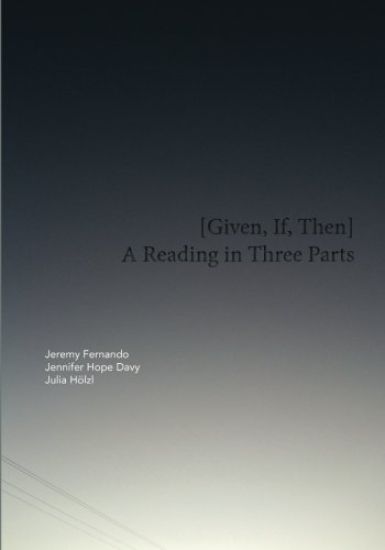
[Given, If, Then]: A Reading in Three Parts
Jennifer Hope Davy; Julia Hölzl; Jeremy Fernando
Dead Letter Office
2015
nidottu
Joyous in the exploration of reading's impossibilities and the mystery of being exposed, there, before the unknown. Christopher Fynsk, Director of the Centre for Modern Thought, University of Aberdeen and Dean of Media & Communication, European Graduate School Given, If, Then] attempts to conceive a possibility of reading, through a set of readings: reading being understood as the relation to an Other that occurs prior to any semantic or formal identification, and, therefore, prior to any attempt at assimilating, or appropriating, what is being read to the one who reads. As such, it is an encounter with an indeterminable Other, an Other who is other than other - an unconditional relation, and thus a relation to no fixed object of relation. The first reading by Jeremy Fernando, "Blind Reading," unfolds through an attempt to speak of reading as an event. Untheorisable in itself, it is a positing of reading as reading, through reading, where texts are read as a test site for reading itself. As such, it is a meditation on the finitude and exteriority in literature, philosophy, and knowledge; where blindness is both the condition and limit of reading itself. Folded into, or in between, this (re)reading are a selection of photographs from Jennifer Hope Davy's image archive. They are on the one hand simply a selection of 'impartial pictures' taken, and on the other hand that which allow for something singular and, therefore, always other to dis/appear - crossing that borderless realm between 'some' and 'some-thing.' Eventually, there is a writing on images on writings by Julia H lzl. A responding to the impossible response, a re-iteration, a re-reading of what could not have been written, a re-writing of what could not have been read; these poems, if one were to name them such, name them as such, answer (to) the impossibility of answering: answer to no call.
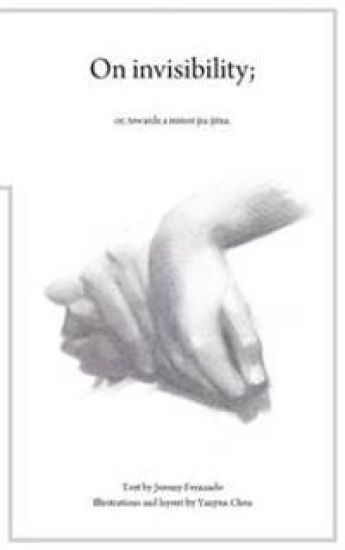
On Invisibility attempts to meditate on the relationality between the seen and unseen, known and unknowable, particularly when in relation with an other, when grappling - in touch with - another. This text opens the dossier that, whilst seemingly antonyms, invisibility is part of visibility; that each act of seeing is fraught with the possibility of blindness. And more than that, relationality with another is premised on this very unknowability. Which is why, not only does one encounter jiu-jitsu through practice, praxis; not only does one encounter jiu-jitsu through an encounter with the other; part of it always escapes us, remains enigmatic. Thus, not only is it arte suave, it is always also potentially arte bela. So, even as we attempt to address the question what is jiu-jitsu, part of it will always remain beyond us. Which might be why we have no choice but to turn to art: for, all that we know, can see, of jiu-jitsu will be fragments of it - sketches.