Kirjojen hintavertailu – 12 903 725 kirjaa ja 27 kauppaa

Kirjailija

Jeremy Gregory

Kirjat ja teokset yhdessä paikassa: 6 kirjaa, julkaisuja vuosilta 2000–2025, suosituimpiin kuuluu Faith in the Town. Vertaile teosten hintoja ja tarkista saatavuus suomalaisista kirjakaupoista.

6 kirjaa

Kirjojen julkaisuvuodet: 2000–2025.

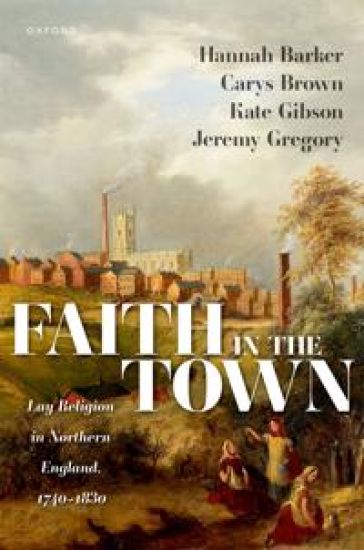
Faith in the Town

Faith in the Town

Hannah Barker; Carys Brown; Kate Gibson; Jeremy Gregory

Oxford University Press
2025
sidottu
This is an open access title available under the terms of a CC BY-NC-ND 4.0 International licence. It is free to read on the Oxford Academic platform and offered as a free PDF download from OUP and selected open access locations. Across eighteenth- and early nineteenth-century northern England, religious faith continued to affect the lives of men, women, and children in profound ways. Rather than abandoning their faith in the face of increasing urbanisation and industrialisation - as is often assumed was the case - town dwellers across the social and denominational spectrum commonly understood their relationships with their families, households, and the world within a framework of religious duty and virtue. For urban middling and labouring individuals, religious practice and the influence of faith was not limited to time spent in church or chapel but extended into all areas of activity and experience: the workplace, the streets and other public spaces, and the home. The importance of faith in the lived experience of town dwellers was not something that existed in spite of change; faith was promoted by the new conditions of urban life. Faith in the Town explores key decades of this transformational period, encompassing almost a century of urban development between 1740 and 1830. By placing lay religious belief centre-stage, this book demonstrates that many of the developments associated with 'modernity', specifically industrialisation, urbanisation, population growth, and Enlightenment thinking, were not inimical to faith. Instead, religious belief and lay piety was a crucial element in the formation of urban economy, society, and culture during the 'long' eighteenth century, meaning that northern towns were not only places where faith could both be nourished and flourish, but that these urban centres were themselves shaped by faith.
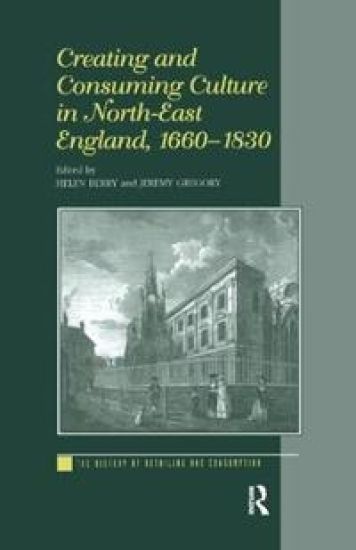
Creating and Consuming Culture in North-East England, 1660–1830

Creating and Consuming Culture in North-East England, 1660–1830

Helen Berry; Jeremy Gregory

TAYLOR FRANCIS LTD
2020
nidottu
Historians of the long eighteenth century have recently recognised that this period is central both to the history of cultural production and consumption and to the history of national and regional identity. Yet no book has, as yet, directly engaged with these two areas of interest at the same time. By uniting interest in the history of culture with the history of regional identity, Creating and Consuming Culture in North-East England, 1660-1830 is of crucial importance to a wide range of historians and intervenes in a number of highly important historical and conceptual debates in a timely and provocative way. The book makes a substantial contribution to eighteenth-century studies. Not only do these essays demonstrate that in thinking about cultural production and consumption in the eighteenth century there are important continuities as well as changes that need to be considered, but also they complicate the commonplace assumption of metropolitan-led cultural change and cultural innovation. Rather than the usual model of centre-periphery diffusion, a number of contributions show that cultural change in the provinces was happening at the same time as in, or in some cases even before, London. The essays also indicate the complex relationship between cultural consumption and social status, with some cultural forms being more inclusive than others.
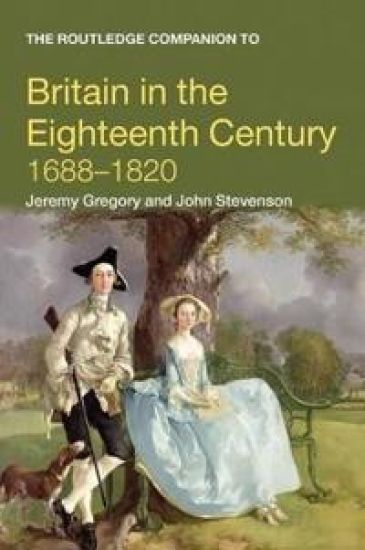
The Routledge Companion to Britain in the Eighteenth Century
Enormously rich and wide-ranging, The Routledge Companion to Britain in the Eighteenth Century brings together, in one handy reference, a wide range of essential information on the major aspects of eighteenth century British history. The information included is chronological, statistical, tabular and bibliographical, and the book begins with the eighteenth century political system before going on to cover foreign affairs and the empire, the major military and naval campaigns, law and order, religion, economic and financial advances, and social and cultural history. Key features of this user-friendly volume include:wide-ranging political chronologiesmajor wars and rebellionskey treaties and their termschronologies of religious eventsapproximately 500 biographies of leading figuresessential data on population, output and trade a detailed glossary of terms a comprehensive cultural and intellectual chronology set out in tabular form a uniquely detailed and comprehensive topic bibliography. All those studying or teaching eighteenth century British history will find this concise volume an indispensable resource for use and reference.
The Routledge Companion to Britain in the Eighteenth Century
Enormously rich and wide-ranging, The Routledge Companion to Britain in the Eighteenth Century brings together, in one handy reference, a wide range of essential information on the major aspects of eighteenth century British history. The information included is chronological, statistical, tabular and bibliographical, and the book begins with the eighteenth century political system before going on to cover foreign affairs and the empire, the major military and naval campaigns, law and order, religion, economic and financial advances, and social and cultural history. Key features of this user-friendly volume include:wide-ranging political chronologiesmajor wars and rebellionskey treaties and their termschronologies of religious eventsapproximately 500 biographies of leading figuresessential data on population, output and trade a detailed glossary of terms a comprehensive cultural and intellectual chronology set out in tabular form a uniquely detailed and comprehensive topic bibliography. All those studying or teaching eighteenth century British history will find this concise volume an indispensable resource for use and reference.
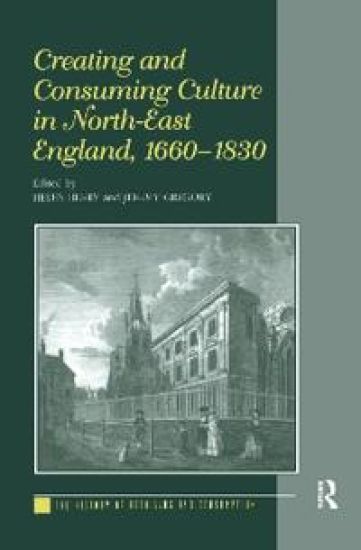
Creating and Consuming Culture in North-East England, 1660–1830

Creating and Consuming Culture in North-East England, 1660–1830

Helen Berry; Jeremy Gregory

Ashgate Publishing Limited
2004
sidottu
Historians of the long eighteenth century have recently recognised that this period is central both to the history of cultural production and consumption and to the history of national and regional identity. Yet no book has, as yet, directly engaged with these two areas of interest at the same time. By uniting interest in the history of culture with the history of regional identity, Creating and Consuming Culture in North-East England, 1660-1830 is of crucial importance to a wide range of historians and intervenes in a number of highly important historical and conceptual debates in a timely and provocative way. The book makes a substantial contribution to eighteenth-century studies. Not only do these essays demonstrate that in thinking about cultural production and consumption in the eighteenth century there are important continuities as well as changes that need to be considered, but also they complicate the commonplace assumption of metropolitan-led cultural change and cultural innovation. Rather than the usual model of centre-periphery diffusion, a number of contributions show that cultural change in the provinces was happening at the same time as in, or in some cases even before, London. The essays also indicate the complex relationship between cultural consumption and social status, with some cultural forms being more inclusive than others.
Restoration, Reformation, and Reform, 1660-1828
This wide-ranging and original book makes a significant contribution to our understanding of the Church of England in the long eighteenth century. It explores the nature of the Restoration ecclesiastical regime, the character of the clerical profession, the quality of the clergy's pastoral work, and the question of Church reform through a detailed study of the diocese of the archbishops of Canterbury. In so doing the book covers the political, social, economic, cultural, intellectual and pastoral functions of the Church and, by adopting a broad chronological span, it allows the problems and difficulties often ascribed to the eighteenth-century Church to be viewed as emerging from the seventeenth century and as continuing well into the nineteenth century. Moreover, the author argues that some of the traditional periodizations and characterisations of conventional religious history need modification. Much of the evidence presented here indicates that clergy in the one hundred and seventy years after 1660 were preoccupied with difficulties which had concerned their forebears and would concern their successors. In many ways, clergy in the diocese of Canterbury between 1660 and 1828 continued the work of seventeenth-century clergy, particularly in following through, and in some instances instigating, the pastoral and professional aims of the Reformation, as well as participating in processes relating to Church reform, and further anticipating some of the deals of the Evangelical and Oxford Movements. Reluctance to recognise this has led historians to neglect the strengths of the Church between the Restoration and the 1830s, which, it is argued, should not be judged primarily for its failure to attain the ideals of these other movements, but as an institution possessing its own coherent and positive rationale.