Kirjojen hintavertailu – 12 859 824 kirjaa ja 27 kauppaa

Kirjailija

Jeremy Richardson

Kirjat ja teokset yhdessä paikassa: 8 kirjaa, julkaisuja vuosilta 1994–2021, suosituimpiin kuuluu British Policy-Making and the Need for a Post-Brexit Policy Style. Vertaile teosten hintoja ja tarkista saatavuus suomalaisista kirjakaupoista.

8 kirjaa

Kirjojen julkaisuvuodet: 1994–2021.

Campaigning for the Environment

Campaigning for the Environment

Jeremy Richardson; Richard Kimber

Routledge
2021
nidottu
Originally published in 1974 Campaigning for the Environment addresses the issue of the environmental lobby. Using seven case-studies from the time of publication, the book covers the important aspects of environmental campaigning, where the environment has been threatened and where pressure groups have been formed to defend it. The book discusses the political problems of protecting and improving the environment, and states that each campaign involves taking on major sections of the political system. Despite having been published over 40 years ago, the commentary of the book, and the analysis in the case studies is still as relevant today as it was then. This book will be of interest to academics working in the field of environment and sustainability, conservation and political studies.

Campaigning for the Environment

Campaigning for the Environment

Jeremy Richardson; Richard Kimber

Routledge
2019
sidottu
Originally published in 1974 Campaigning for the Environment addresses the issue of the environmental lobby. Using seven case-studies from the time of publication, the book covers the important aspects of environmental campaigning, where the environment has been threatened and where pressure groups have been formed to defend it. The book discusses the political problems of protecting and improving the environment, and states that each campaign involves taking on major sections of the political system. Despite having been published over 40 years ago, the commentary of the book, and the analysis in the case studies is still as relevant today as it was then. This book will be of interest to academics working in the field of environment and sustainability, conservation and political studies.

British Policy-Making and the Need for a Post-Brexit Policy Style
This book revisits and re-defines the policy style concept and explores the long-standing debate in British political science concerning how best to characterise the British policy style. The book highlights several trends that suggest that the British policy style has shifted towards the impositional end of the policy style spectrum, bringing it more in line with the traditional Westminster model of governing. However, these changes also reflect a more frenetic policy style which might increase the number of policy blunders and failures in British Government unless means are found to access and manage the specialist expertise that interest groups possess.
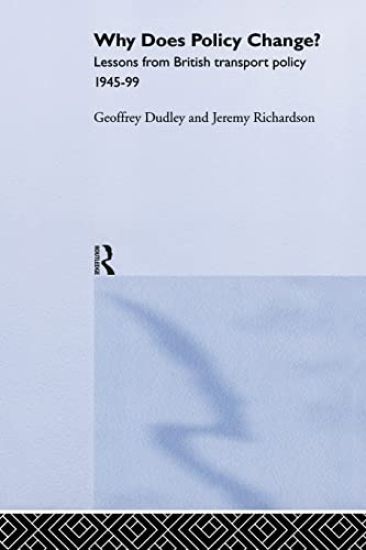
Why Does Policy Change?

Why Does Policy Change?

Geoffrey Dudley; Jeremy Richardson

Routledge
2015
nidottu
The tension between policy stability and change is a key political phenomenon, but its dynamics have been little understood. Why Does Policy Change? examines and explains the dynamics of major policy change by looking at case studies from British Transport policy since 1945. The significant contrasts between road and rail policies in this period lend themselves perfectly to the authors' theories of what brings about policy turnabout.
Policy Styles in Western Europe (Routledge Revivals)
First published in 1982, Policy Styles in Western Europe considers the growth of the modern state in the 1980s and examines the implications of this for the making and implementation of public policy decisions. It argues that the business of government was simply easier in the 1970s and that the growth of the modern state has meant an expansion of public policies, with the state widening in areas of societal activity. This book looks at the similarities and differences that exist among the countries of Western Europe. Whilst it is increasingly clear that most policy problems arise from areas of concern common to all Western democracies, for example, unemployment, inflation and crime, this book focuses on whether or not individual countries exhibit characteristic policy styles in response to them. In this volume, the country-studies consider the main characteristics of the individual policy processes in relation to a simple typology of political styles. Each author considers a series of central questions: the relationship between the government and other actors in the policy process; the degree to which policy-making has become sectorised and segmented; and the broad approach to problem solving in terms of anticipatory or reactive styles.
Why Does Policy Change?

Why Does Policy Change?

Geoffrey Dudley; Jeremy Richardson

Routledge
2001
sidottu
The tension between policy stability and change is a key political phenomenon, but its dynamics have been little understood. Why Does Policy Change? examines and explains the dynamics of major policy change by looking at case studies from British Transport policy since 1945. The significant contrasts between road and rail policies in this period lend themselves perfectly to the authors' theories of what brings about policy turnabout.
True Blues

True Blues

Paul Whiteley; Patrick Seyd; Jeremy Richardson

Oxford University Press
1994
sidottu
The Conservative Party is one of the most successful political parties in the western world. Its success has been built on its large grass roots membership. And yet that membership appears to be increasingly disaffected and in decline. This book is the first in depth study of this crucial section of the Conservative Party. Drawing on new and revealing survey data, it paints a fascinating picture of the social make-up and political views of a grass roots membership who dislike Jacques Delors more than the European Community, and The Sun newspaper most of all. the book challenges the stereotypical view of the Conservative activist as an eccentric and politically irrelevant Thatcher-loving extremist. Instead, the authors argue that the grass roots membership are the unsung heroes of political life; helping to keep the party system working and democracy intact at a time when it is under considerable strain. The authors claim that to some extent the party is the author of its own problems, and point out the likely dire consequences for its future success if the current decline continues. They conclude by outlining the ways in which the leadership might revitalize its most important political asset.