Kirjojen hintavertailu – 12 903 725 kirjaa ja 27 kauppaa

Kirjailija

Jerry F. Hough

Kirjat ja teokset yhdessä paikassa: 6 kirjaa, julkaisuja vuosilta 1969–2015, suosituimpiin kuuluu Democratization and Revolution in the USSR, 1985-91. Vertaile teosten hintoja ja tarkista saatavuus suomalaisista kirjakaupoista.

Nimi esiintyy myös muodoissa: Jerry F Hough

6 kirjaa

Kirjojen julkaisuvuodet: 1969–2015.

The Long Process of Development

The Long Process of Development

Jerry F. Hough; Robin Grier

Cambridge University Press
2015
pokkari
Douglass North once emphasized that development takes centuries, but he did not have a theory of how and why change occurs. This groundbreaking book advances such a theory by examining in detail why England and Spain developed so slowly from 1000 to 1800. A colonial legacy must go back centuries before settlement, and this book points to key events in England and Spain in the 1260s to explain why Mexico lagged behind the United States economically in the twentieth century. Based on the integration of North's institutional approach with Mancur Olson's collective action theory, Max Weber's theory of value change, and North's focus on dominant coalitions based on rent and military in In the Shadow of Violence, this theory of change leads to exciting new historical interpretations, including the crucial role of the merchant-navy alliance in England and the key role of George Washington's control of the military in 1787.
The Logic of Economic Reform in Russia

The Logic of Economic Reform in Russia

Jerry F. Hough

Brookings Institution
2001
nidottu
"This book examines the failure of economic reform in Russia since 1991, when Boris Yeltsin proclaimed his commitment to economic stabilization, privatization, and price liberalization. Optimism over Russia¡¯s market reforms vanished with the crash of August 1998, when the ruble lost over 70 percent of its value and banks defaulted on their debts and forward currency contracts. Contrary to Yeltsin¡¯s reform promises, the Russian economy of the 1990s more closely resembled a Soviet model than a market-driven one. The Logic of Economic Reform in Russia illuminates the general problems of establishing market economies in settings where the institutional system to support the market has not had decades to develop. Suggesting that corruption may be associated with growth in the early stages of capitalism, Jerry F. Hough argues that the disappointing results of Yeltsin¡¯s reform efforts were not the product of Russian culture or history, but the logical consequences of rational men responding to the incentive system created by economic reform."
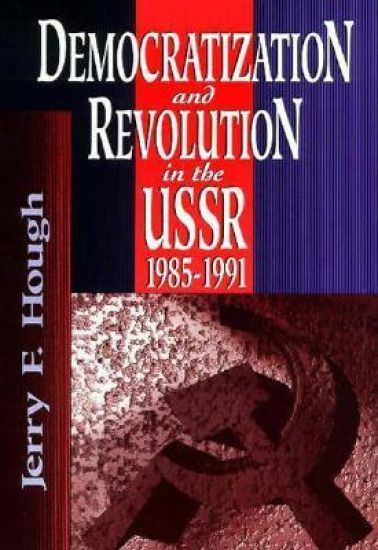
Democratization and Revolution in the USSR, 1985-91

Democratization and Revolution in the USSR, 1985-91

Jerry F. Hough

Brookings Institution
1997
nidottu
" Democratization and Revolution in the USSR, 1985-91 presents a strikingly new view of the Gorbachev era and the reasons for the collapse of the Soviet Union. Written by one of America's most distinguished specialists on the former Soviet Union, this is the first comprehensive overview of the Gorbachev period and describes it as a real revolution, not mere ""reform.""According to Hough, despite Mikhail Gorbachev's talk of a regulated market, he never understood that a market must be created on a solid institutional and legal base. He was determined to use democratization to free himself from party control, but he saw democracy as a way of achieving near- universal consensus, not a mechanism for forcing through difficult choices. The many memoirs that have become available in the last few years, including those of Gorbachev himself, show that Premier Nikolai Ryzhkov and the ""bureaucrats"" in his government actually were the serious economic reformers in the leadership. Gorbachev opposed the key transitional steps at every stage and was far closer to the assumptions of shock therapy than he or his opponents ever recognized. Hough explains that Gorbachev was not alone in thinking that the destruction of old institutions was enough to unleash a market. Westerners also talked of leaping a chasm in a single jump as if democratic and market institutions existed pre-created on the other side. But, precisely because Gorbachev (and later Boris Yeltsin) was encouraged in all his worst mistakes by Western advice, his failure has crucial implications for Western thinking about the process of democratization and marketization. This unprecedented book explores those implications in depth. Selected by Choice as an Outstanding Book for 1998"
How the Soviet Union Is Governed

How the Soviet Union Is Governed

Jerry F. Hough; Merle Fainsod

Harvard University Press
1979
sidottu
This is a new and thorough revision of a recognized classic whose first edition was hailed as the most authoritative account in English of the governing of the Soviet Union. Now, with historical material rearranged in chronological order, and with seven new chapters covering most of the last fifteen years, this edition brings the Soviet Union fully into the light of modern history and political science. The purposes of Fainsod's earlier editions were threefold: to explain the techniques used by the Bolsheviks and Stalin to gain control of the Russian political system; to describe the methods they employed to maintain command; and to speculate upon the likelihood oftheir continued control in the future. This new edition increases very substantially the attention paid to another aspect of the political process—how policy is formed, how the Soviet Union is governed. Whenever possible, Mr. Hough attempts to analyze the alignments and interrelationships between Soviet policy institutions. Moreover, he constantly moves beyond a description of these institutions to probe the way they work. Two chapters are devoted to the questions of individual political participation. Other chapters examine the internal organization of institutions and explore the ways in which the backgrounds of their officials influence their policy positions and alliances. The picture that emerges is an unprecedented account of the distribution of power in the Soviet Union.