

Kirjojen hintavertailu – 12 859 819 kirjaa ja 27 kauppaa

Kirjailija

Jessy Grizzle

Kirjat ja teokset yhdessä paikassa: 2 kirjaa, julkaisuja vuosilta 2021–2026, suosituimpiin kuuluu Calculus for the Modern Engineer. Vertaile teosten hintoja ja tarkista saatavuus suomalaisista kirjakaupoista.

2 kirjaa

Kirjojen julkaisuvuodet: 2021–2026.

Calculus for the Modern Engineer

Calculus for the Modern Engineer

Jessy Grizzle

Michigan Publishing Services
2026
Sidottu
In the ever-evolving landscape of engineering education, calculus stands as a foundational pillar, yet its teaching methods have remained largely unchanged for decades. This textbook is born out of a deep-seated need for reform. Traditional calculus courses struggle to incorporate relevant, real-world examples. The disconnect between mathematical theory and its real-world uses hinders the learning process and fails to fully engage students in the practical applications of calculus. A second core issue lies not in the examples used but in the selection of material and the overemphasis on lengthy, manual calculations that lack meaningful context. This book represents a radical departure from conventional approaches, inspired by Prof. Grizzle’s experience developing and teaching the first-semester course ROB 101 Computational Linear Algebra. Its goal is to breathe life into mathematics through programming and realistic examples. It begins by placing integration at the beginning of the learning process, starting with sums and progressing to integration, which is not only more intuitive but also lends itself well to programming applications, such as calculating the change in position of mobile robots from velocity curves. Following integration, the book delves into differentiation (both single-variable and multivariable) and its myriad applications. Traditional methods of computing integrals, such as antiderivatives and substitution methods, are then introduced and framed within the context of both manual calculations and modern symbolic tools. The journey continues through improper integrals, ordinary differential equations (ODEs), Laplace Transforms, and Feedback Control, encompassing a breadth of topics rarely seen in a single calculus course.
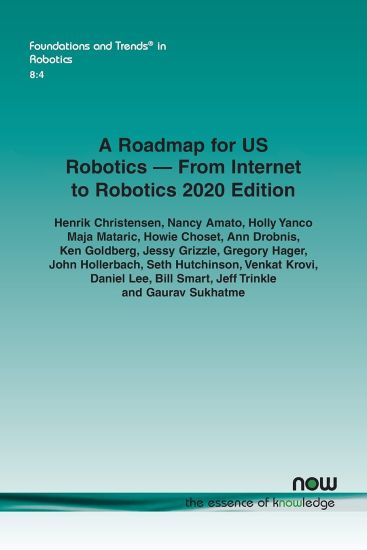
A Roadmap for US Robotics – From Internet to Robotics 2020 Edition

A Roadmap for US Robotics – From Internet to Robotics 2020 Edition

Henrik Christensen; Nancy Amato; Holly Yanco; Maja Mataric; Howie Choset; Ann Drobnis; Ken Goldberg; Jessy Grizzle; Gregory Hager; John Hollerbach; Seth Hutchinson; Venkat Krovi; Daniel Lee; Bill Smart; Jeff Trinkle; Gaurav Sukhatme

Now Publishers Inc
2021
nidottu
Recently the robotics industry celebrated its 60-year anniversary. We have used robots for more than six decades to empower people to do things that are typically dirty, dull and/or dangerous. The industry has progressed significantly over the period from basic mechanical assist systems to fully autonomous cars, environmental monitoring and exploration of outer space. We have seen tremendous adoption of IT technology in our daily lives for a diverse set of support tasks. Through use of robots we are starting to see a new revolution, as we not only will have IT support from tablets, phones, computers but also systems that can physically interact with the world and assist with daily tasks, work, and leisure activities. The “old” robot systems were largely mechanical support systems. Through the gradual availability of inexpensive computing, user interfaces, and sensors it is possible to build robot systems that were difficult to imagine before. The confluence of technologies is enabling a revolution in use and adoption of robot technologies for all aspects of daily life. Thirteen years ago, the process to formulate a roadmap was initiated at the Robotics Science and Systems (RSS) conference in Atlanta. Through support from the Computing Community Consortium (CCC) a roadmap was produced by a group of 120 people from industry and academia. The roadmap has been updated 2013 and 2016 prior to this update. The present document is a summary of the main societal opportunities identified, the associated challenges to deliver desired solutions and a presentation of efforts to be undertaken to ensure that US will continue to be a leader in robotics both in terms of research innovation, adoption of the latest technology, and adoption of appropriate policy frameworks that ensure that the technology is utilized in a responsible fashion.