
Kirjojen hintavertailu – 12 859 828 kirjaa ja 27 kauppaa

Kirjailija

Jia Yan

Kirjat ja teokset yhdessä paikassa: 3 kirjaa, julkaisuja vuosilta 2021–2023, suosituimpiin kuuluu Revitalizing a Nation. Vertaile teosten hintoja ja tarkista saatavuus suomalaisista kirjakaupoista.

3 kirjaa

Kirjojen julkaisuvuodet: 2021–2023.

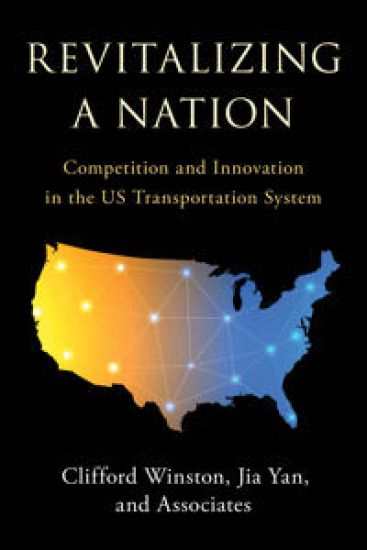
Revitalizing a Nation

Revitalizing a Nation

Clifford Winston; Jia Yan

BLOOMSBURY PUBLISHING PLC
2023
nidottu
The US transportation system is composed of interconnected sub-systems that provide urban and intercity passenger and freight service and that operate by using infrastructure that facilitates surface, water, and air transportation. Transportation reduces the cost of distance, which includes the monetary cost, travel or shipping time, and safety consequences of moving people and goods from their origins to their destinations. An efficient transportation system provides the foundation for the development and growth of selected industries as well as an entire economy by enabling individuals and firms to be more productive at their destinations. As the US emerged from World War II, the evolution of the transportation system was spurred by large taxpayer-funded investments to build the Interstate Highway System, construct new airports to accommodate the longer takeoff distances of jets, and design new suburban rail transit systems. At first blush, it appeared that the US was on its way to building the best transportation system money could buy. However, by the 1960s, economists began to take issue with the so-called engineering approach to improving a transportation system, which involved increasing government spending and investment without considering efficient policies to optimize the system’s performance that could reduce public spending and investment. Yet, as evidenced by the $1 trillion Infrastructure Investment and Jobs Act signed by President Biden in November 2021, large government expenditures continue to be prioritized as the primary way to improve transportation. In our book, Revitalizing A Nation: Competition and Innovation in the US Transportation System, we argue that it would be far more efficient and equitable if US policymakers prioritized greater competition and innovation instead of relying on taxpayer-funded spending to significantly improve the transportation system. Beginning in the mid-1970s, deregulation demonstrated that efficient policies could significantly improve the intercity passenger and freight transportation system by increasing competition among airlines, railroads, and trucks and by stimulating technological and operating innovations that reduced the modes’ costs and prices and improved service quality. We provide evidence that ridesharing has stimulated competition in urban transportation and greatly benefited travelers and we call on policymakers to withdraw any obstacles that prevent ridesharing companies from competing in urban areas. We also present evidence that policymakers could generate greater competition in all forms of transportation that would benefit travelers and shippers by:—Negotiating open skies airline pricing and service agreements on US international routes with all countries.—Granting foreign airlines cabotage rights to serve US domestic routes, which could spur global deregulation that would facilitate seamless international air travel.—Privatizing airports and air traffic control so both airports and airlines could operate more effectively and compete more intensely.—Privatizing ports so they could operate more efficiently and compete more intensely.—Fully deregulating freight railroads and ocean shipping by eliminating the Surface Transportation Board and by repealing the Jones Act and Foreign Dredge Act and eliminating ocean rate conferences. —Conducting highway privatization experiments to explore the potential benefits and feasibility of private highway competition in the United States. Government also has a critical role to play in the transportation system’s future adoption of innovations by preparing and upgrading infrastructure to facilitate its use by autonomous electric cars, trucks, buses, railroads, ships, as well as air taxis and airborne drones. We provide preliminary evidence that autonomous modes have the potential to provide enormous benefits to travelers, shippers, and the overall economy by improving service times and service time reliability and safety. The most disadvantaged members of society will especially benefit from automation because their accessibility to transportation will be greatly improved. In the final analysis, by creating a stronger culture of competition and innovation in the US transportation system, policymakers can revitalize the nation without spending enormous sums of public funds to do so.
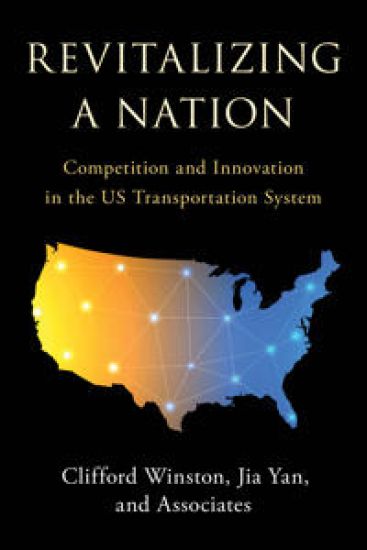
Revitalizing a Nation

Revitalizing a Nation

Clifford Winston; Jia Yan

BLOOMSBURY PUBLISHING PLC
2023
sidottu
The US transportation system is composed of interconnected sub-systems that provide urban and intercity passenger and freight service and that operate by using infrastructure that facilitates surface, water, and air transportation. Transportation reduces the cost of distance, which includes the monetary cost, travel or shipping time, and safety consequences of moving people and goods from their origins to their destinations. An efficient transportation system provides the foundation for the development and growth of selected industries as well as an entire economy by enabling individuals and firms to be more productive at their destinations. As the US emerged from World War II, the evolution of the transportation system was spurred by large taxpayer-funded investments to build the Interstate Highway System, construct new airports to accommodate the longer takeoff distances of jets, and design new suburban rail transit systems. At first blush, it appeared that the US was on its way to building the best transportation system money could buy. However, by the 1960s, economists began to take issue with the so-called engineering approach to improving a transportation system, which involved increasing government spending and investment without considering efficient policies to optimize the system’s performance that could reduce public spending and investment. Yet, as evidenced by the $1 trillion Infrastructure Investment and Jobs Act signed by President Biden in November 2021, large government expenditures continue to be prioritized as the primary way to improve transportation. In our book, Revitalizing A Nation: Competition and Innovation in the US Transportation System, we argue that it would be far more efficient and equitable if US policymakers prioritized greater competition and innovation instead of relying on taxpayer-funded spending to significantly improve the transportation system. Beginning in the mid-1970s, deregulation demonstrated that efficient policies could significantly improve the intercity passenger and freight transportation system by increasing competition among airlines, railroads, and trucks and by stimulating technological and operating innovations that reduced the modes’ costs and prices and improved service quality. We provide evidence that ridesharing has stimulated competition in urban transportation and greatly benefited travelers and we call on policymakers to withdraw any obstacles that prevent ridesharing companies from competing in urban areas. We also present evidence that policymakers could generate greater competition in all forms of transportation that would benefit travelers and shippers by:—Negotiating open skies airline pricing and service agreements on US international routes with all countries.—Granting foreign airlines cabotage rights to serve US domestic routes, which could spur global deregulation that would facilitate seamless international air travel.—Privatizing airports and air traffic control so both airports and airlines could operate more effectively and compete more intensely.—Privatizing ports so they could operate more efficiently and compete more intensely.—Fully deregulating freight railroads and ocean shipping by eliminating the Surface Transportation Board and by repealing the Jones Act and Foreign Dredge Act and eliminating ocean rate conferences. —Conducting highway privatization experiments to explore the potential benefits and feasibility of private highway competition in the United States. Government also has a critical role to play in the transportation system’s future adoption of innovations by preparing and upgrading infrastructure to facilitate its use by autonomous electric cars, trucks, buses, railroads, ships, as well as air taxis and airborne drones. We provide preliminary evidence that autonomous modes have the potential to provide enormous benefits to travelers, shippers, and the overall economy by improving service times and service time reliability and safety. The most disadvantaged members of society will especially benefit from automation because their accessibility to transportation will be greatly improved. In the final analysis, by creating a stronger culture of competition and innovation in the US transportation system, policymakers can revitalize the nation without spending enormous sums of public funds to do so.
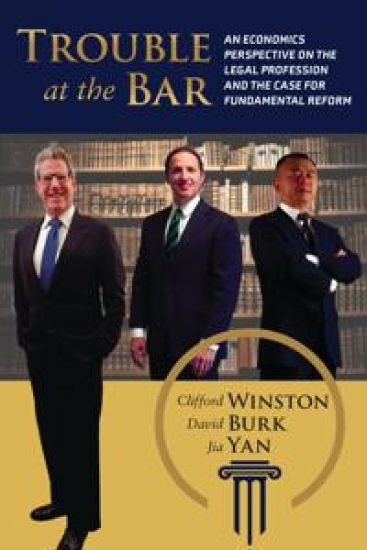
Trouble at the Bar

Trouble at the Bar

Clifford Winston; David Burk; Jia Yan

Brookings Institution
2021
nidottu
Deregulating the legal profession will benefit society by improving access to legal services and the efficacy of public policies. Lawyers dominate a judicial system that has come under fire for limiting access to its services to primarily the most affluent members of society. Lawyers also have a pervasive influence throughout other parts of government. This is the first book offering a critical comprehensive overview of the legal profession's role in failing to serve the majority of the public and in contributing to the formation of inefficient public policies that reduce public welfare. In Trouble at the Bar, the authors use an economic approach to provide empirical support for legal reformers who are concerned about their own profession. The authors highlight the adverse effects of the legal profession's self-regulation, which raises the cost of legal education, decreases the supply of lawyers, and limits the public's access to justice to the point where, in general, only certified lawyers can execute even simple contracts. At the same time, barriers to entry that limit competition create a closed environment that inhibits valid approaches to analyzing and solving legal problems that are at the heart of effective public policy. Deregulating the legal profession, the authors argue, would allow more people to provide a variety of legal services without jeopardizing their quality, reduce the cost of those services, spur competition and innovation in the private sector, and increase the quality of lawyers who pursue careers in the public sector. Legal practitioners would enjoy more fulfilling careers, and society in general and its most vulnerable members in particular would benefit greatly.