Kirjojen hintavertailu – 12 903 725 kirjaa ja 27 kauppaa

Kirjailija

Jill Jäger

Kirjat ja teokset yhdessä paikassa: 5 kirjaa, julkaisuja vuosilta 2004–2022, suosituimpiin kuuluu Global Change and the Earth System. Vertaile teosten hintoja ja tarkista saatavuus suomalaisista kirjakaupoista.

5 kirjaa

Kirjojen julkaisuvuodet: 2004–2022.

Global Change and the Earth System

Global Change and the Earth System

Will Steffen; Regina Angelina Sanderson; Peter D. Tyson; Jill Jäger; Pamela A. Matson; Berrien Moore III; Frank Oldfield; Katherine Richardson; Hans-Joachim Schellnhuber; Billie L. Turner; Robert J. Wasson

Springer-Verlag Berlin and Heidelberg GmbH Co. K
2005
sidottu
The interactions between environmental change and human societies have a long, complex history spanning many millennia, but these have changed fundamentally in the last century. Human activities are now so pervasive and profound that they are altering the Earth in ways which threaten the very life support system upon which humans depend. This book describes what is known about the Earth System and the impact of changes caused by humans. It considers the consequences of these changes with respect to the stability of the Earth System and the well-being of humankind; as well as exploring future paths towards Earth System science in support of global sustainability.
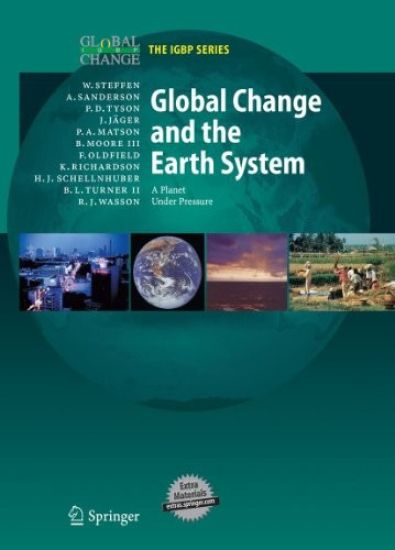
Global Change and the Earth System

Global Change and the Earth System

Will Steffen; Regina Angelina Sanderson; Peter D. Tyson; Jill Jäger; Pamela A. Matson; Berrien Moore III; Frank Oldfield; Katherine Richardson; Hans-Joachim Schellnhuber; Billie L. Turner; Robert J. Wasson

Springer-Verlag Berlin and Heidelberg GmbH Co. KG
2004
nidottu
The interactions between environmental change and human societies have a long, complex history spanning many millennia, but these have changed fundamentally in the last century. Human activities are now so pervasive and profound that they are altering the Earth in ways which threaten the very life support system upon which humans depend. This book describes what is known about the Earth System and the impact of changes caused by humans. It considers the consequences of these changes with respect to the stability of the Earth System and the well-being of humankind; as well as exploring future paths towards Earth System science in support of global sustainability.

Our Planet – How much more can Earth take?
For more than thirty years, scientists from various disciplines have warned that the constant increase in world population and exponential world economic growth are seriously threatening our ecosystems. The vision on which this book is based is of an ongoing, adaptable societal process which leads the world down the path towards sustainability. In this vision, the speed of global environmental changes will be drastically reduced without forgoing the good life; at the same time prosperity will be distributed more fairly.
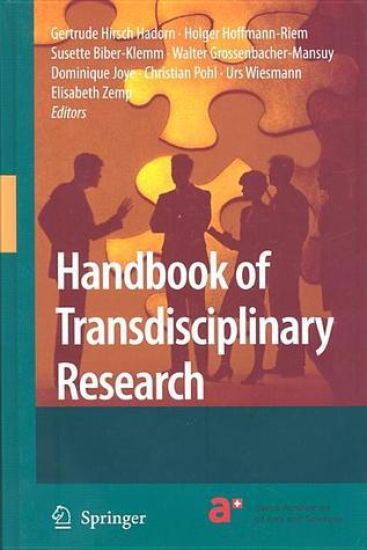
Handbook of Transdisciplinary Research

Handbook of Transdisciplinary Research

Jill Jäger

Springer-Verlag New York Inc.
2008
sidottu
In a world characterised by rapid change, uncertainty and increasing interconnectedness there is a growing need for science to contribute to the solution of persistent, complex problems. These problems include not only some of the now broadly known environmental issues such as climate change and biodiversity loss, but also related issues such as poverty, security and governance. For all of these problems, progress in nding and implementing solutions has been very slow. The increase in availability of scienti c knowledge has not been re ected in decisive action. It is this mismatch between knowledge and action that lies behind the need for a Handbook of Transdisciplinary Research. As the editors point out in their introduction, a transdisciplinary orientation in research, education and institutions aims to overcome the disconnection between knowledge production, on the one hand, and the demand for knowledge to contribute to the solution of societal pr- lems, on the other hand. This is achieved through transdisciplinary approaches in which researchers from a wide range of disciplines work together with sta- holders. Internationally the term ‘transdisciplinary research’ is de ned in diff- ent ways, ranging from a diffuse conceptual term located above individual dis- plines, to any research that involves stakeholders. The Handbook contributes to a clari cation of both the concept and the term, and shows that the uniqueness of the approach lies in the partnership between members of different disciplines and stakeholders.
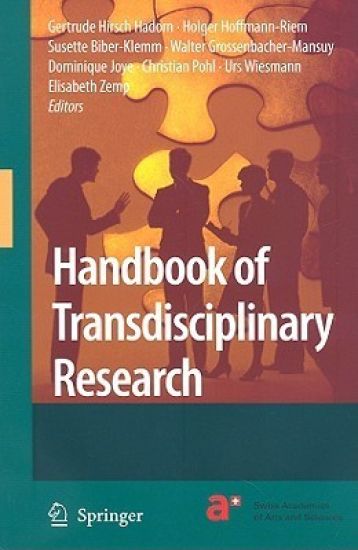
Handbook of Transdisciplinary Research

Handbook of Transdisciplinary Research

Jill Jäger

Springer-Verlag New York Inc.
2007
nidottu
In a world characterised by rapid change, uncertainty and increasing interconnectedness there is a growing need for science to contribute to the solution of persistent, complex problems. These problems include not only some of the now broadly known environmental issues such as climate change and biodiversity loss, but also related issues such as poverty, security and governance. For all of these problems, progress in nding and implementing solutions has been very slow. The increase in availability of scienti c knowledge has not been re ected in decisive action. It is this mismatch between knowledge and action that lies behind the need for a Handbook of Transdisciplinary Research. As the editors point out in their introduction, a transdisciplinary orientation in research, education and institutions aims to overcome the disconnection between knowledge production, on the one hand, and the demand for knowledge to contribute to the solution of societal pr- lems, on the other hand. This is achieved through transdisciplinary approaches in which researchers from a wide range of disciplines work together with sta- holders. Internationally the term ‘transdisciplinary research’ is de ned in diff- ent ways, ranging from a diffuse conceptual term located above individual dis- plines, to any research that involves stakeholders. The Handbook contributes to a clari cation of both the concept and the term, and shows that the uniqueness of the approach lies in the partnership between members of different disciplines and stakeholders.