Kirjojen hintavertailu – 12 903 735 kirjaa ja 27 kauppaa

Kirjailija

Jillian Kinzie

Kirjat ja teokset yhdessä paikassa: 8 kirjaa, julkaisuja vuosilta 2005–2016, suosituimpiin kuuluu Using Evidence of Student Learning to Improve Higher Education. Vertaile teosten hintoja ja tarkista saatavuus suomalaisista kirjakaupoista.

8 kirjaa

Kirjojen julkaisuvuodet: 2005–2016.

Using Evidence of Student Learning to Improve Higher Education

Using Evidence of Student Learning to Improve Higher Education

George D. Kuh; Stanley O. Ikenberry; Natasha A. Jankowski; Timothy Reese Cain; Peter T. Ewell; Pat Hutchings; Jillian Kinzie

John Wiley Sons Inc
2015
sidottu
American higher education needs a major reframing of student learning outcomes assessment Dynamic changes are underway in American higher education. New providers, emerging technologies, cost concerns, student debt, and nagging doubts about quality all call out the need for institutions to show evidence of student learning. From scholars at the National Institute for Learning Outcomes Assessment (NILOA), Using Evidence of Student Learning to Improve Higher Education presents a reframed conception and approach to student learning outcomes assessment. The authors explain why it is counterproductive to view collecting and using evidence of student accomplishment as primarily a compliance activity. Today's circumstances demand a fresh and more strategic approach to the processes by which evidence about student learning is obtained and used to inform efforts to improve teaching, learning, and decision-making. Whether you're in the classroom, an administrative office, or on an assessment committee, data about what students know and are able to do are critical for guiding changes that are needed in institutional policies and practices to improve student learning and success. Use this book to: Understand how and why student learning outcomes assessment can enhance student accomplishment and increase institutional effectivenessShift the view of assessment from being externally driven to internally motivatedLearn how assessment results can help inform decision-makingUse assessment data to manage change and improve student success Gauging student learning is necessary if institutions are to prepare students to meet the 21st century needs of employers and live an economically independent, civically responsible life. For assessment professionals and educational leaders, Using Evidence of Student Learning to Improve Higher Education offers both a compelling rationale and practical advice for making student learning outcomes assessment more effective and efficient.
Assessment in Student Affairs

Assessment in Student Affairs

John H. Schuh; J. Patrick Biddix; Laura A. Dean; Jillian Kinzie

Jossey-Bass Inc.,U.S.
2016
sidottu
A practical, comprehensive manual for assessment design and implementation Assessment in Student Affairs, Second Edition offers a contemporary look at the foundational elements and practical application of assessment in student affairs. Higher education administration is increasingly called upon to demonstrate organizational effectiveness and engage in continuous improvement based on information generated through systematic inquiry. This book provides a thorough primer on all stages of the assessment process. From planning to reporting and beyond, you'll find valuable assessment strategies to help you produce meaningful information and improve your program. Combining and updating the thoroughness and practicality of Assessment in Student Affairs and Assessment Practice in Student Affairs, this new edition covers design of assessment projects, ethical practice, student learning outcomes, data collection and analysis methods, report writing, and strategies to implement change based on assessment results. Case studies demonstrate real-world application to help you clearly see how these ideas are used effectively every day, and end-of-chapter discussion questions stimulate deeper investigation and further thinking about the ideas discussed. The instructor resources will help you seamlessly integrate this new resource into existing graduate-level courses. Student affairs administrators understand the importance of assessment, but many can benefit from additional direction when it comes to designing and implementing evaluations that produce truly useful information. This book provides field-tested approaches to assessment, giving you a comprehensive how-to manual for demonstrating—and improving—the work you do every day. Build your own assessment to demonstrate organizational effectivenessUtilize quantitative and qualitative techniques and dataIdentify metrics and methods for measuring student learningReport and implement assessment findings effectively Accountability and effectiveness are the hallmarks of higher education administration today, and they are becoming the metrics by which programs and services are evaluated. Strong assessment skills have never been more important. Assessment in Student Affairs gives you the knowledge base and skill set you need to shine a spotlight on what you and your organization are able to achieve.
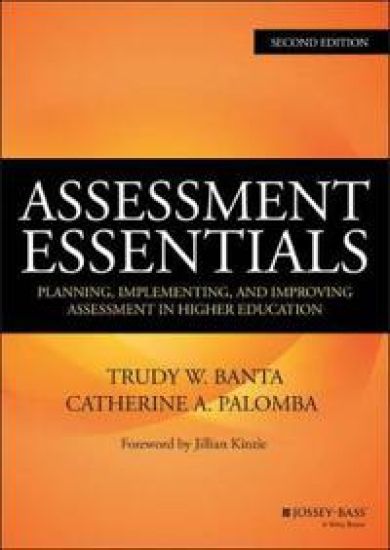
Assessment Essentials

Assessment Essentials

Trudy W. Banta; Catherine A. Palomba; Jillian Kinzie

John Wiley Sons Inc
2014
sidottu
A comprehensive expansion to the essential higher education assessment text This second edition of Assessment Essentials updates the bestselling first edition, the go-to resource on outcomes assessment in higher education. In this thoroughly revised edition, you will find, in a familiar framework, nearly all new material, examples from more than 100 campuses, and indispensable descriptions of direct and indirect assessment methods that have helped to educate faculty, staff, and students about assessment. Outcomes assessment is of increasing importance in higher education, especially as new technologies and policy proposals spotlight performance-based success measures. Leading authorities Trudy Banta and Catherine Palomba draw on research, standards, and best practices to address the timeless and timeliest issues in higher education accountability. New topics include: Using electronic portfolios in assessmentRubrics and course-embedded assessmentAssessment in student affairsAssessing institutional effectiveness As always, the step-by-step approach of Assessment Essentials will guide you through the process of developing an assessment program, from the research and planning phase to implementation and beyond, with more than 100 examples along the way. Assessment data are increasingly being used to guide everything from funding to hiring to curriculum decisions, and all faculty and staff will need to know how to use them effectively. Perfect for anyone new to the assessment process, as well as for the growing number of assessment professionals, this expanded edition of Assessment Essentials will be an essential resource on every college campus.
One Size Does Not Fit All

One Size Does Not Fit All

Kathleen Manning; Jillian Kinzie; John Schuh

Routledge
2013
sidottu
In the second edition of this influential book, leading scholars Kathleen Manning, Jillian Kinzie, and John H. Schuh advocate an original approach by presenting 11 models of student affairs practice, including both traditional and innovative programs. Based on a qualitative, multi-institutional research project, One Size Does Not Fit All explores a variety of policies, practices, and programs that contribute to increased student engagement, success, and learning. This book is a must read for all higher education administrators and student affairs professionals. New to this Revised Edition: Refinement of models in light of recent NSSE data and current developments in higher education, including budget cuts and the economic crisis, Updated information throughout about model assessment and techniques to renew divisions of student affairs, A deeper analysis of how models of student affairs practice relate to institutional mission and purposes, End-of-chapter discussion questions to guide thinking about ways to incorporate models in one’s own context, An entirely new Part IV, including chapters on "Catalysts and Tools for Change" and "Redesigning Your Student Affairs Division."
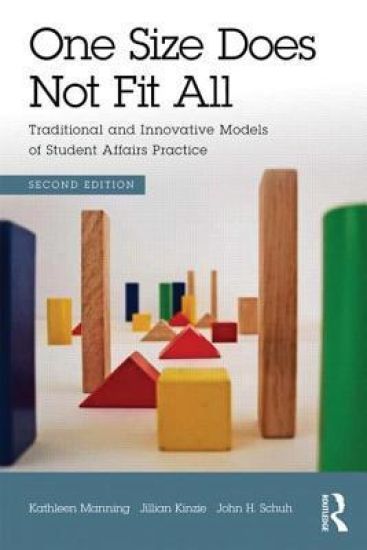
One Size Does Not Fit All

One Size Does Not Fit All

Kathleen Manning; Jillian Kinzie; John Schuh

Routledge
2013
nidottu
In the second edition of this influential book, leading scholars Kathleen Manning, Jillian Kinzie, and John H. Schuh advocate an original approach by presenting 11 models of student affairs practice, including both traditional and innovative programs. Based on a qualitative, multi-institutional research project, One Size Does Not Fit All explores a variety of policies, practices, and programs that contribute to increased student engagement, success, and learning. This book is a must read for all higher education administrators and student affairs professionals. New to this Revised Edition: Refinement of models in light of recent NSSE data and current developments in higher education, including budget cuts and the economic crisis, Updated information throughout about model assessment and techniques to renew divisions of student affairs, A deeper analysis of how models of student affairs practice relate to institutional mission and purposes, End-of-chapter discussion questions to guide thinking about ways to incorporate models in one’s own context, An entirely new Part IV, including chapters on "Catalysts and Tools for Change" and "Redesigning Your Student Affairs Division."
Student Success in College, (Includes New Preface and Epilogue)

Student Success in College, (Includes New Preface and Epilogue)

George D. Kuh; Jillian Kinzie; John H. Schuh; Elizabeth J. Whitt

John Wiley Sons Inc
2010
nidottu
Student Success in College describes policies, programs, and practices that a diverse set of institutions have used to enhance student achievement. This book clearly shows the benefits of student learning and educational effectiveness that can be realized when these conditions are present. Based on the Documenting Effective Educational Practice (DEEP) project from the Center for Postsecondary Research at Indiana University, this book provides concrete examples from twenty institutions that other colleges and universities can learn from and adapt to help create a success-oriented campus culture and learning environment.
Assessing Conditions to Enhance Educational Effectiveness

Assessing Conditions to Enhance Educational Effectiveness

George D. Kuh; Jillian Kinzie; John H. Schuh; Elizabeth J. Whitt

Jossey-Bass Inc.,U.S.
2005
nidottu
From the authors of Student Success in College—the book that describes the policies, programs, and practices of twenty colleges and universities that have created success-oriented campus cultures and learning environments—comes the next-step resource to help an institution assess whether these conditions exist. The authors present the Inventory for Student Engagement and Success (ISES), a self-guided framework for conducting a comprehensive, systematic, institutionwide analysis. The process also can be applied to areas within an institution, such as a school or college within a university, an academic or student affairs division, or a department or program. The ISES includes sets of diagnostic queries that focus on the six properties and conditions common to high-performing schools as well as the five clusters of effective educational practices featured on the National Survey of Student Engagement. Suggestions are offered to illustrate how the information generated from the ISES process can be used for various purposes including accreditation self-studies, program reviews, staff development, faculty and governing board retreats, and strategic planning.