Kirjojen hintavertailu – 12 903 724 kirjaa ja 27 kauppaa

Kirjailija

Joachim Cuntz

Kirjat ja teokset yhdessä paikassa: 4 kirjaa, julkaisuja vuosilta 2003–2011, suosituimpiin kuuluu Cyclic Homology in Non-Commutative Geometry. Vertaile teosten hintoja ja tarkista saatavuus suomalaisista kirjakaupoista.

4 kirjaa

Kirjojen julkaisuvuodet: 2003–2011.

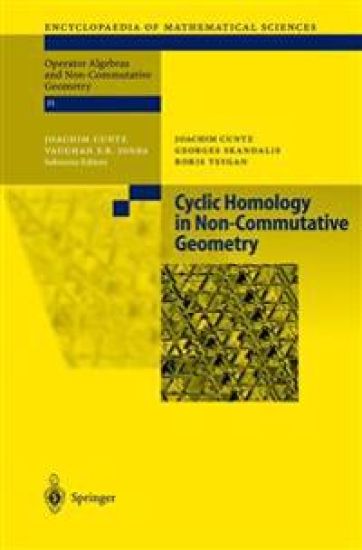
Cyclic Homology in Non-Commutative Geometry

Cyclic Homology in Non-Commutative Geometry

Joachim Cuntz; Georges Skandalis; Boris Tsygan

Springer-Verlag Berlin and Heidelberg GmbH Co. K
2011
nidottu
Cyclic homology was introduced in the early eighties independently by Connes and Tsygan. They came from different directions. Connes wanted to associate homological invariants to K-homology classes and to describe the index pair­ ing with K-theory in that way, while Tsygan was motivated by algebraic K-theory and Lie algebra cohomology. At the same time Karoubi had done work on characteristic classes that led him to study related structures, without however arriving at cyclic homology properly speaking. Many of the principal properties of cyclic homology were already developed in the fundamental article of Connes and in the long paper by Feigin-Tsygan. In the sequel, cyclic homology was recognized quickly by many specialists as a new intriguing structure in homological algebra, with unusual features. In a first phase it was tried to treat this structure as well as possible within the traditional framework of homological algebra. The cyclic homology groups were computed in many examples and new important properties such as prod­ uct structures, excision for H-unital ideals, or connections with cyclic objects and simplicial topology, were established. An excellent account of the state of the theory after that phase is given in the book of Loday.
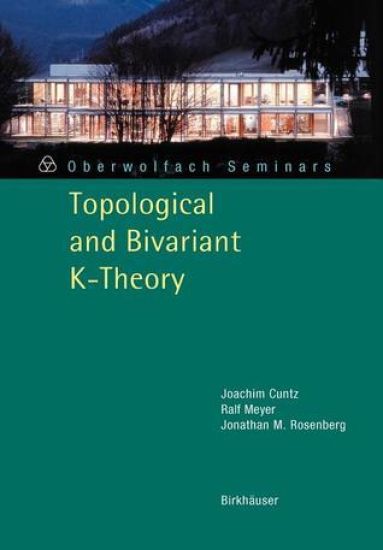
Topological and Bivariant K-Theory

Topological and Bivariant K-Theory

Joachim Cuntz; Jonathan M. Rosenberg

Birkhauser Verlag AG
2007
nidottu
Topological K-theory is one of the most important invariants for noncommutative algebras. Bott periodicity, homotopy invariance, and various long exact sequences distinguish it from algebraic K-theory. This book describes a bivariant K-theory for bornological algebras, which provides a vast generalization of topological K-theory. In addition, it details other approaches to bivariant K-theories for operator algebras. The book studies a number of applications, including K-theory of crossed products, the Baum-Connes assembly map, twisted K-theory with some of its applications, and some variants of the Atiyah-Singer Index Theorem.
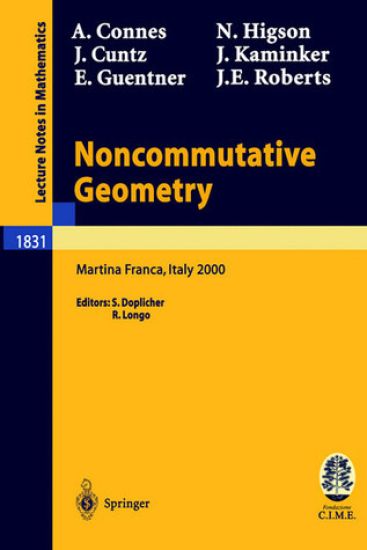
Noncommutative Geometry

Noncommutative Geometry

Alain Connes; Joachim Cuntz; Erik G. Guentner; Nigel Higson; Jerome Kaminker; John E. Roberts

Springer-Verlag Berlin and Heidelberg GmbH Co. K
2003
nidottu
Noncommutative Geometry is one of the most deep and vital research subjects of present-day Mathematics. Its development, mainly due to Alain Connes, is providing an increasing number of applications and deeper insights for instance in Foliations, K-Theory, Index Theory, Number Theory but also in Quantum Physics of elementary particles. The purpose of the Summer School in Martina Franca was to offer a fresh invitation to the subject and closely related topics; the contributions in this volume include the four main lectures, cover advanced developments and are delivered by prominent specialists.
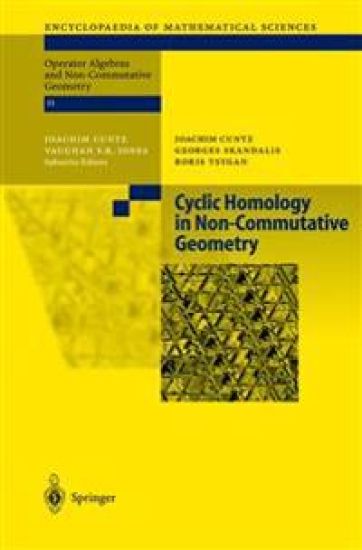
Cyclic Homology in Non-Commutative Geometry

Cyclic Homology in Non-Commutative Geometry

Joachim Cuntz; Georges Skandalis; Boris Tsygan

Springer-Verlag Berlin and Heidelberg GmbH Co. K
2003
sidottu
Cyclic homology was introduced in the early eighties independently by Connes and Tsygan. They came from different directions. Connes wanted to associate homological invariants to K-homology classes and to describe the index pair­ ing with K-theory in that way, while Tsygan was motivated by algebraic K-theory and Lie algebra cohomology. At the same time Karoubi had done work on characteristic classes that led him to study related structures, without however arriving at cyclic homology properly speaking. Many of the principal properties of cyclic homology were already developed in the fundamental article of Connes and in the long paper by Feigin-Tsygan. In the sequel, cyclic homology was recognized quickly by many specialists as a new intriguing structure in homological algebra, with unusual features. In a first phase it was tried to treat this structure as well as possible within the traditional framework of homological algebra. The cyclic homology groups were computed in many examples and new important properties such as prod­ uct structures, excision for H-unital ideals, or connections with cyclic objects and simplicial topology, were established. An excellent account of the state of the theory after that phase is given in the book of Loday.