Kirjojen hintavertailu – 12 903 724 kirjaa ja 27 kauppaa

Kirjailija

Joachim Kupsch

Kirjat ja teokset yhdessä paikassa: 3 kirjaa, julkaisuja vuosilta 2003–2018, suosituimpiin kuuluu Decoherence and the Appearance of a Classical World in Quantum Theory. Vertaile teosten hintoja ja tarkista saatavuus suomalaisista kirjakaupoista.

3 kirjaa

Kirjojen julkaisuvuodet: 2003–2018.

Quantum Fields and Processes

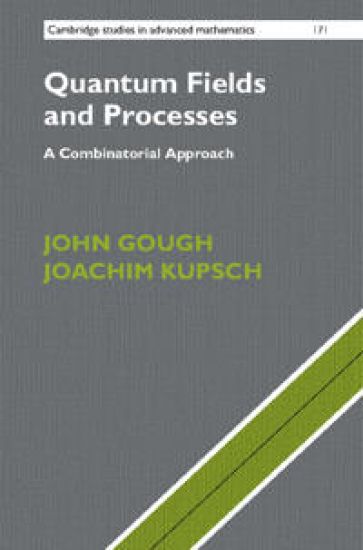
Quantum Fields and Processes

John Gough; Joachim Kupsch

Cambridge University Press
2018
sidottu
Wick ordering of creation and annihilation operators is of fundamental importance for computing averages and correlations in quantum field theory and, by extension, in the Hudson–Parthasarathy theory of quantum stochastic processes, quantum mechanics, stochastic processes, and probability. This book develops the unified combinatorial framework behind these examples, starting with the simplest mathematically, and working up to the Fock space setting for quantum fields. Emphasizing ideas from combinatorics such as the role of lattice of partitions for multiple stochastic integrals by Wallstrom–Rota and combinatorial species by Joyal, it presents insights coming from quantum probability. It also introduces a 'field calculus' which acts as a succinct alternative to standard Feynman diagrams and formulates quantum field theory (cumulant moments, Dyson–Schwinger equation, tree expansions, 1-particle irreducibility) in this language. Featuring many worked examples, the book is aimed at mathematical physicists, quantum field theorists, and probabilists, including graduate and advanced undergraduate students.
Decoherence and the Appearance of a Classical World in Quantum Theory

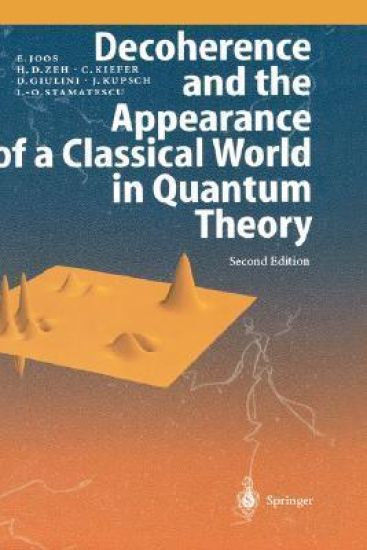
Decoherence and the Appearance of a Classical World in Quantum Theory

Erich Joos; H. Dieter Zeh; Claus Kiefer; Domenico J. W. Giulini; Joachim Kupsch; Ion-Olimpiu Stamatescu

Springer-Verlag Berlin and Heidelberg GmbH Co. K
2010
nidottu
When we were preparing the first edition of this book, the concept of de­ coherence was known only to a minority of physicists. In the meantime, a wealth of contributions has appeared in the literature - important ones as well as serious misunderstandings. The phenomenon itself is now experimen­ tally clearly established and theoretically well understood in principle. New fields of application, discussed in the revised book, are chaos theory, informa­ tion theory, quantum computers, neuroscience, primordial cosmology, some aspects of black holes and strings, and others. While the first edition arose from regular discussions between the authors, thus leading to a clear" entanglement" of their otherwise quite different chap­ ters, the latter have thereafter evolved more or less independently. While this may broaden the book's scope as far as applications and methods are con­ cerned, it may also appear confusing to the reader wherever basic assumptions and intentions differ (as they do). For this reason we have rearranged the or­ der of the authors: they now appear in the same order as the chapters, such that those most closely related to the "early" and most ambitious concept of decoherence are listed first. The first three authors (Joos, Zeh, Kiefer) agree with one another that decoherence (in contradistinction to the Copen­ hagen interpretation) allows one to eliminate primary classical concepts, thus neither relying on an axiomatic concept of observables nor on a probability interpretation of the wave function in terms of classical concepts.
Decoherence and the Appearance of a Classical World in Quantum Theory

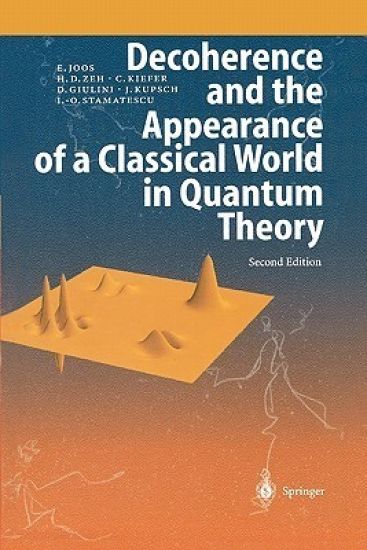
Decoherence and the Appearance of a Classical World in Quantum Theory

Erich Joos; H. Dieter Zeh; Claus Kiefer; Domenico J. W. Giulini; Joachim Kupsch; Ion-Olimpiu Stamatescu

Springer-Verlag Berlin and Heidelberg GmbH Co. K
2003
sidottu
When we were preparing the first edition of this book, the concept of de­ coherence was known only to a minority of physicists. In the meantime, a wealth of contributions has appeared in the literature - important ones as well as serious misunderstandings. The phenomenon itself is now experimen­ tally clearly established and theoretically well understood in principle. New fields of application, discussed in the revised book, are chaos theory, informa­ tion theory, quantum computers, neuroscience, primordial cosmology, some aspects of black holes and strings, and others. While the first edition arose from regular discussions between the authors, thus leading to a clear" entanglement" of their otherwise quite different chap­ ters, the latter have thereafter evolved more or less independently. While this may broaden the book's scope as far as applications and methods are con­ cerned, it may also appear confusing to the reader wherever basic assumptions and intentions differ (as they do). For this reason we have rearranged the or­ der of the authors: they now appear in the same order as the chapters, such that those most closely related to the "early" and most ambitious concept of decoherence are listed first. The first three authors (Joos, Zeh, Kiefer) agree with one another that decoherence (in contradistinction to the Copen­ hagen interpretation) allows one to eliminate primary classical concepts, thus neither relying on an axiomatic concept of observables nor on a probability interpretation of the wave function in terms of classical concepts.