Kirjojen hintavertailu – 12 859 819 kirjaa ja 27 kauppaa

Kirjailija

Joakim Sundnes

Kirjat ja teokset yhdessä paikassa: 6 kirjaa, julkaisuja vuosilta 2006–2025, suosituimpiin kuuluu Computing the Electrical Activity in the Heart. Vertaile teosten hintoja ja tarkista saatavuus suomalaisista kirjakaupoista.

6 kirjaa

Kirjojen julkaisuvuodet: 2006–2025.

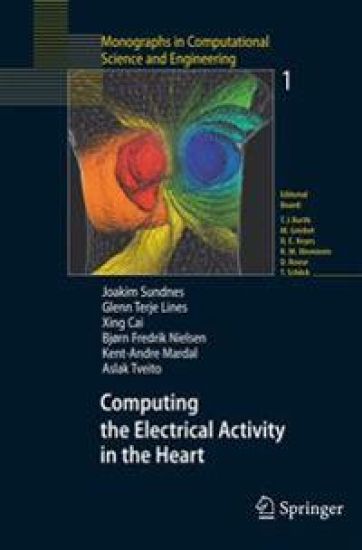
Computing the Electrical Activity in the Heart

Computing the Electrical Activity in the Heart

Joakim Sundnes; Glenn Terje Lines; Xing Cai; Bjørn Frederik Nielsen; Kent-Andre Mardal; Aslak Tveito

Springer-Verlag Berlin and Heidelberg GmbH Co. K
2010
nidottu
The heart is a fantastic machine; during a normal lifetime it beats about 2.5 billion times and pumps 200.000 tons of blood through an enormous system of vessels extending 160.000 kilometres throughout the body. For centuries, man has tried to understand how the heart works, but there remain many unsolved problems, problems that have captured the attention of thousands of researchers worldwide. There is, for example, a huge amount of research being devoted to the analysis of single heart cells. Other areas of research include trying to understand how it works as a complete muscle, and how blood ows through the heart. The entire process is extremely complex. The history of bioelectricity can be traced back to the late eighteenth century and the experiments of Luigi Galvani. A century later, in 1887, Augustus Wallers managed to measure the electrical signal generated by the heart at the surface of the body [142]. His dog Jimmy earned a place in history by being the rst to have his heart measured in this way; see Figure 1.1. In 1903 Willem Einthoven [34] - veloped the rst commercial device for recording electrocardiograms (ECGs); see Figure 1.2.
Programmering for naturvitenskap og matematikk

Programmering for naturvitenskap og matematikk

Andreas Drolsum Haraldsrud; Joakim Sundnes

Universitetsforlaget
2025
nidottu
«Programmering for naturvitenskap og matematikk» er en innføringsbok i programmering som retter seg mot studenter i matematiske og naturvitenskapelige fag på universiteter og høgskoler. Boka bruker eksempler og teori fra fag som kjemi, biologi, geofag, fysikk og matematikk for å vise hvordan programmering kan være et nyttig verktøy innenfor ulike fagdisipliner. Gjennom å arbeide med boka lærer du grunnleggende programmering, datahåndtering, statistikk, numeriske metoder og naturvitenskapelig modellering. Boka forbereder deg for videre studier innenfor matematikk og naturvitenskap, der datamaskinen er et uvurderlig verktøy.
Hva tror du på, egentlig?

Hva tror du på, egentlig?

Joakim Sundnes

Sambåndet Forlag
2025
nidottu
Har du lyst til å få bedre samtaler med andre om troen din? Har du lyst til å lære mer om hvorfor du tror? Joakim er lærer på Lyngdal KVS og har skrevet en bok til ungdom om gode samtaler og grunner til å tro. Han skriver blant annet om Guds eksistens, evangelienes troverdighet og oppstandelsen. I slutten av hvert kapittel får du både spørsmål til samtale og mange gode tips til både YouTube-filmer og videre lesning. Sett deg rundt leirbålet og bli med på samtalen.
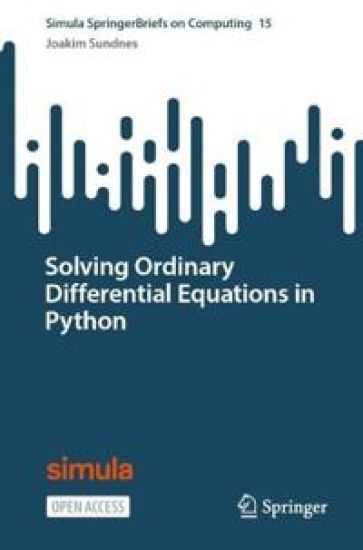
Solving Ordinary Differential Equations in Python

Solving Ordinary Differential Equations in Python

Joakim Sundnes

Springer International Publishing AG
2023
nidottu
This open access volume explains the foundations of modern solvers for ordinary differential equations (ODEs). Formulating and solving ODEs is an essential part of mathematical modeling and computational science, and numerous solvers are available in commercial and open source software. However, no single ODE solver is the best choice for every single problem, and choosing the right solver requires fundamental insight into how the solvers work. This book will provide exactly that insight, to enable students and researchers to select the right solver for any ODE problem of interest, or implement their own solvers if needed. The presentation is compact and accessible, and focuses on the large and widely used class of solvers known as Runge-Kutta methods. Explicit and implicit methods are motivated and explained, as well as methods for error control and automatic time step selection, and all the solvers are implemented as a class hierarchy in Python.
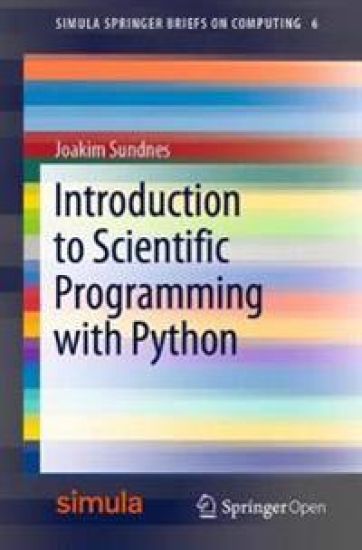
Introduction to Scientific Programming with Python

Introduction to Scientific Programming with Python

Joakim Sundnes

Springer Nature Switzerland AG
2020
nidottu

Halvin toimitettuna 40,70 €

This open access book offers an initial introduction to programming for scientific and computational applications using the Python programming language. The presentation style is compact and example-based, making it suitable for students and researchers with little or no prior experience in programming. The book uses relevant examples from mathematics and the natural sciences to present programming as a practical toolbox that can quickly enable readers to write their own programs for data processing and mathematical modeling. These tools include file reading, plotting, simple text analysis, and using NumPy for numerical computations, which are fundamental building blocks of all programs in data science and computational science. At the same time, readers are introduced to the fundamental concepts of programming, including variables, functions, loops, classes, and object-oriented programming. Accordingly, the book provides a sound basis for further computer science and programming studies.
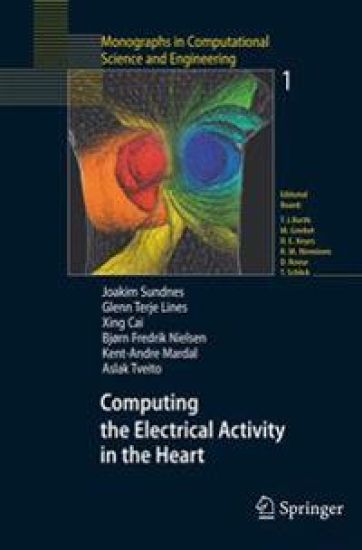
Computing the Electrical Activity in the Heart

Computing the Electrical Activity in the Heart

Joakim Sundnes; Glenn Terje Lines; Xing Cai; Bjørn Frederik Nielsen; Kent-Andre Mardal; Aslak Tveito

Springer-Verlag Berlin and Heidelberg GmbH Co. K
2006
sidottu
The heart is a fantastic machine; during a normal lifetime it beats about 2.5 billion times and pumps 200.000 tons of blood through an enormous system of vessels extending 160.000 kilometres throughout the body. For centuries, man has tried to understand how the heart works, but there remain many unsolved problems, problems that have captured the attention of thousands of researchers worldwide. There is, for example, a huge amount of research being devoted to the analysis of single heart cells. Other areas of research include trying to understand how it works as a complete muscle, and how blood ows through the heart. The entire process is extremely complex. The history of bioelectricity can be traced back to the late eighteenth century and the experiments of Luigi Galvani. A century later, in 1887, Augustus Wallers managed to measure the electrical signal generated by the heart at the surface of the body [142]. His dog Jimmy earned a place in history by being the rst to have his heart measured in this way; see Figure 1.1. In 1903 Willem Einthoven [34] - veloped the rst commercial device for recording electrocardiograms (ECGs); see Figure 1.2.