Kirjojen hintavertailu – 12 903 725 kirjaa ja 27 kauppaa

Kirjailija

Joan Fitzgerald

Kirjat ja teokset yhdessä paikassa: 12 kirjaa, julkaisuja vuosilta 2002–2025, suosituimpiin kuuluu Death in a Cold City. Vertaile teosten hintoja ja tarkista saatavuus suomalaisista kirjakaupoista.

12 kirjaa

Kirjojen julkaisuvuodet: 2002–2025.

Learning from COVID-19 for Climate-Ready Urban Transformation

Learning from COVID-19 for Climate-Ready Urban Transformation

Darshini Mahadevia; Gian C. Delgado-Ramos; Janice Barnes; Joan Fitzgerald; Miho Kamei; Kevin Lanza

Cambridge University Press
2025
sidottu
Cities have suffered from three years of the COVID-19 pandemic and are increasingly experiencing exacerbated heatwaves, floods, and droughts due to climate change. Going forward, cities need to address both climate and public health crises effectively while reducing poverty and inequity, often in the context of economic pressure and declining levels of trust in government. The COVID-19 pandemic has revealed gaps in city readiness for simultaneous responses to pandemics and climate change, particularly in the Global South. However, these concurrent challenges to cities present an opportunity to reformulate current urbanization patterns and the economies and dynamics they enable. This Element focuses on understanding COVID-19's impact on city systems related to climate change mitigation and adaptation, and vice versa, in terms of warnings, lessons learned, and calls to action. This title is also available as open access on Cambridge Core.
Learning from COVID-19 for Climate-Ready Urban Transformation

Learning from COVID-19 for Climate-Ready Urban Transformation

Darshini Mahadevia; Gian C. Delgado-Ramos; Janice Barnes; Joan Fitzgerald; Miho Kamei; Kevin Lanza

Cambridge University Press
2025
pokkari
Cities have suffered from three years of the COVID-19 pandemic and are increasingly experiencing exacerbated heatwaves, floods, and droughts due to climate change. Going forward, cities need to address both climate and public health crises effectively while reducing poverty and inequity, often in the context of economic pressure and declining levels of trust in government. The COVID-19 pandemic has revealed gaps in city readiness for simultaneous responses to pandemics and climate change, particularly in the Global South. However, these concurrent challenges to cities present an opportunity to reformulate current urbanization patterns and the economies and dynamics they enable. This Element focuses on understanding COVID-19's impact on city systems related to climate change mitigation and adaptation, and vice versa, in terms of warnings, lessons learned, and calls to action. This title is also available as open access on Cambridge Core.
Greenovation

Greenovation

Joan Fitzgerald

OXFORD UNIVERSITY PRESS INC
2023
nidottu
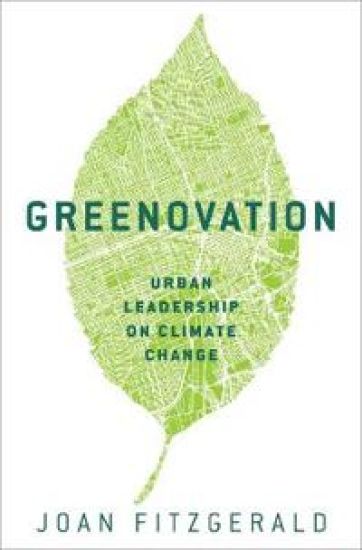
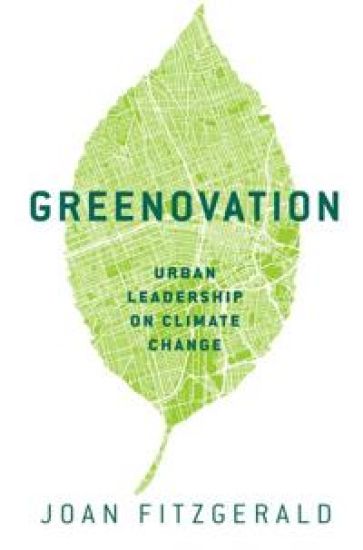
Collectively, cities take up a relatively tiny amount of land on the earth, yet they emit 72 percent of greenhouse gas emissions. Clearly, cities need to be at the center of any broad effort to reduce climate change. In Greenovation, the eminent urban policy scholar Joan Fitzgerald argues that too many cities are only implementing random acts of greenness that will do little to address the climate crisis. She instead calls for "greenovation"--using the city as a test bed for adopting and perfecting green technologies for more energy--efficient buildings, transportation, and infrastructure more broadly. Fitzgerald contends that while many city mayors cite income inequality as a pressing problem, few cities are connecting climate action and social justice-another aspect of greenovation. Focusing on the biggest producers of greenhouse gases in cities, buildings, energy and transportation, Fitzgerald examines how greenovating cities are reducing emissions overall and lays out an agenda for fostering and implementing urban innovations that can help reverse the path toward irrevocable climate damage. Drawing on interviews with practitioners in more than 20 North American and European cities, she identifies the strategies and policies they are employing and how support from state, provincial and national governments has supported or thwarted their efforts. A uniquely urban-focused appraisal of the economic, political, and social debates that underpin the drive to "go green," Greenovation helps us understand what is arguably the toughest policy problem of our era: the increasing impact of anthropocentric climate change on modern social life.
There's a Moose in My Juice

There's a Moose in My Juice

Joan Fitzgerald

Createspace Independent Publishing Platform
2023
pokkari
An author of four previous books for children, this is the latest of Joan Fitzgerald's works. Focused on children under the age of 6, the current volume is illustrated (by the author) with 16 images that, together with the narrative, present Robert, a little boy who likes nothing but pizza, ...and his mother, who deftly resolves the dilemma.
Death's Cold Harvest

Death's Cold Harvest

Joan Fitzgerald

Buffalo Arts Publishing
2021
pokkari
Ben Friedlander hopes to start an urban farm on some trash-strewn acres in the Port City, but he is facing many problems. The mayor refuses to convince the city council to provide funding for the project. and Jack D'Angelo, powerful slum lord and drug czar, wants the land in order to build condos and a plaza with his partner, Rex Ricigliano. and will stop at nothing to get it. His wife Mary Jean and his children, Alanna and Chris, hate him for uprooting them. Now, his assistant, a homeless man named Jonah, has been murdered. Can detectives, McCallister and Aronica find Jonah's killer? What part does Carolina Ventura, a drag queen entertainer who works for D'Angelo, play in the assault on the farm? Will Ben's life dream of an urban farm, be destroyed? Little does he know that more disasters await.
Greenovation

Greenovation

Joan Fitzgerald

Oxford University Press Inc
2020
sidottu
Collectively, cities take up a relatively tiny amount of land on the earth, yet emit 72 percent of greenhouse gas emissions. Clearly, cities need to be at the center of any broad effort to reduce climate change. In Greenovation, the eminent urban policy scholar Joan Fitzgerald argues that too many cities are only implementing random acts of greenness that will do little to address the climate crisis. She instead calls for "greenovation"--using the city as a test bed for adopting and perfecting green technologies for more energy--efficient buildings, transportation, and infrastructure more broadly. Further, Fitzgerald contends that while many city mayors cite income inequality as a pressing problem, few cities are connecting climate action and social justice-another aspect of greenovation. Focusing on the biggest producers of greenhouse gases in cities, buildings, energy and transportation, Fitzgerald examines how greenovating cities are reducing emissions overall and lays out an agenda for fostering and implementing urban innovations that can help reverse the path toward irrevocable climate damage. Drawing on interviews with practitioners in more than 20 North American and European cities, she identifies the strategies and policies they are employing and how support from state, provincial and national governments has supported or thwarted their efforts. A uniquely urban-focused appraisal of the economic, political, and social debates that underpin the drive to "go green," Greenovation helps us understand what is arguably the toughest policy problem of our era: the increasing impact of anthropocentric climate change on modern social life.
Emerald Cities

Emerald Cities

Joan Fitzgerald

Oxford University Press Inc
2010
sidottu
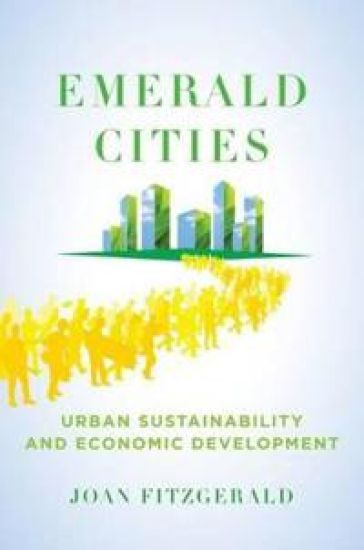
Here is a refreshing look at how American cities are leading the way toward greener, cleaner, and more sustainable forms of economic development. In Emerald Cities, Joan Fitzgerald shows how in the absence of a comprehensive national policy, cities like Chicago, New York, Portland, San Francisco, and Seattle have taken the lead in addressing the interrelated environmental problems of global warming, pollution, energy dependence, and social justice. Cities are major sources of pollution but because of their population density, reliance on public transportation, and other factors, Fitzgerald argues that they are uniquely suited to promote and benefit from green economic development. For cities facing worsening budget constraints, investing in high-paying green jobs in renewable energy technology, construction, manufacturing, recycling, and other fields will solve two problems at once, sparking economic growth while at the same time dramatically improving quality of life. Fitzgerald also examines how investing in green research and technology may help to revitalize older industrial cities and offers examples of cities that don't make the top-ten green lists such as Toledo and Cleveland, Ohio and Syracuse, New York. And for cities wishing to emulate those already engaged in developing greener economic practices, Fitzgerald shows which strategies will be most effective according to each city's size, economic history, geography, and other unique circumstances. But cities cannot act alone, and Fitzgerald analyzes the role of state and national government policy in helping cities create the next wave of clean technology growth. Lucid, forward-looking, and guided by a level-headed optimism that clearly distinguishes between genuine progress and exaggerated claims, Emerald Cities points the way toward a sustainable future for the American city.
Moving Up in the New Economy

Moving Up in the New Economy

Joan Fitzgerald

Cornell University Press
2006
sidottu
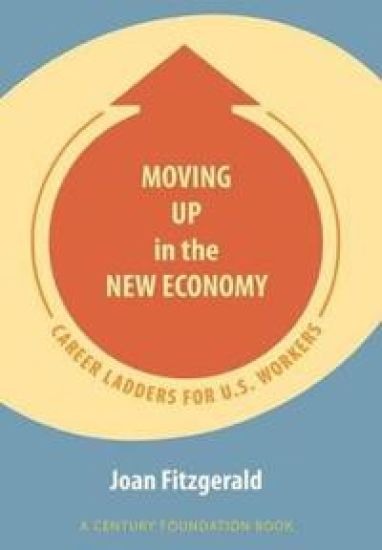
"The United States used to be a country where ordinary people could expect to improve their economic condition as they moved through life. For millions of us, this is no longer the case. Many Americans today have a lower standard of living as adults than they had in their parents' homes as children.... This book is about restoring the upward mobility of U. S. workers. Specifically, it addresses the workforce-development strategy of creating not just jobs, but career ladders."—from Moving Up in the New Economy Career-ladder strategies create opportunities for low-wage workers to learn new skills and advance through a progression of higher-skilled and better-paid jobs. For example, nurses' aides can become licensed practical nurses, administrative assistants can become information technology workers, and bank tellers can become loan officers. Career-ladder programs could provide opportunities for upward mobility and also stave off impending national shortages of skilled workers. But there are a variety of obstacles that must be faced candidly if career-ladder programs are to succeed. In Moving Up in the New Economy, Joan Fitzgerald explores specific programs in different sectors of the economy—health care, child care, education, manufacturing, and biotechnology—to offer a comprehensive analysis of this innovative approach to job training. Addressing the successes achieved—and the problems faced—by career-ladder programs, this timely book will be of interest to anyone interested in career development, workforce training, and employment issues, especially those that affect low-wage workers.
Economic Revitalization

Economic Revitalization

Joan Fitzgerald; Nancey G. Leigh

SAGE Publications Inc
2002
sidottu
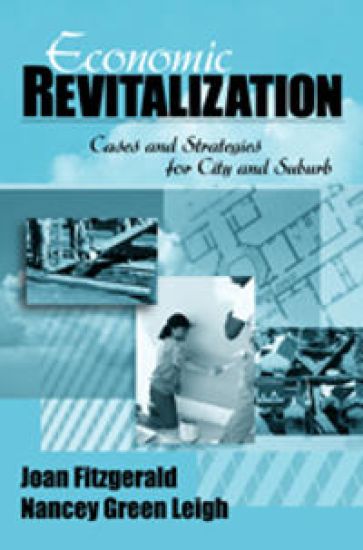
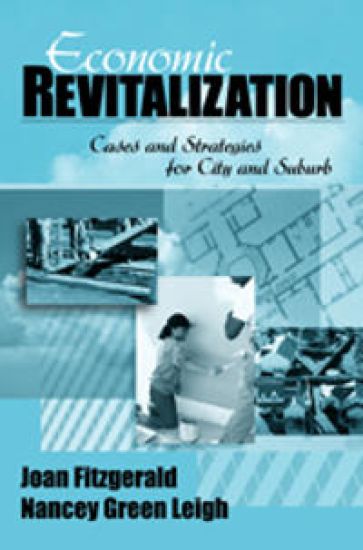
Economic Revitalization is unique in that it discusses leading revitalization strategies in the context of both city and suburban settings, offering case studies of program development and implementation. In Economic Revitalization: Cases and Strategies for City and Suburb Fitzgerald and Leigh answer the need for a text that incorporates social justice and sustainability into how we think about and practice economic development. It is one of the first to talk about how revitalization strategies are implemented in both cities and suburbs, particularly inner-ring suburbs that are experiencing decline previously associated only with inner-city neighborhoods. After setting the context with a brief history of economic development practice and its shortcomings, Fitzgerald and Leigh focus on six economic development strategies: sectoral strategies, Brownfield redevelopment, industrial retention, commercial revitalization, industrial and office property reuse, and workforce development. Each of these chapters begins with an overview of the strategy and then presents cases of how it is being implemented. The cases draw from Atlanta, Chicago and its suburbs, Emeryville, Kalamazoo, Louisville, New Haven, Portland, Sandy Springs, and Seattle (and suburban King County). They illustrate the tradeoffs often made in achieving one goal at the expense of another. Although they admit that some of the cases come up short in illustrating a more equitable and sustainable economic development practice, Fitzgerald and Leigh conclude with an optimistic view that the field is changing. The book is aimed at students and practitioners of economic development planning who seek to foster stronger economies and greater opportunity in inner cites and older suburbs. It is also meant to assist planners in thriving new towns and suburban communities seeking to avoid future economic decline as their communities mature. Economic Revitalization: Discusses practice in both suburban and inner-city settings Integrates the planning values of social justice and sustainability into the discussion of implementation strategies Includes cases that reveal the political nature of the planning process and the types of tradeoffs that often must be made Provides insights for planners seeking to adopt "best practice" programs from other localities
Economic Revitalization

Economic Revitalization

Joan Fitzgerald; Nancey G. Leigh

SAGE Publications Inc
2002
nidottu
Economic Revitalization is unique in that it discusses leading revitalization strategies in the context of both city and suburban settings, offering case studies of program development and implementation. In Economic Revitalization: Cases and Strategies for City and Suburb Fitzgerald and Leigh answer the need for a text that incorporates social justice and sustainability into how we think about and practice economic development. It is one of the first to talk about how revitalization strategies are implemented in both cities and suburbs, particularly inner-ring suburbs that are experiencing decline previously associated only with inner-city neighborhoods. After setting the context with a brief history of economic development practice and its shortcomings, Fitzgerald and Leigh focus on six economic development strategies: sectoral strategies, Brownfield redevelopment, industrial retention, commercial revitalization, industrial and office property reuse, and workforce development. Each of these chapters begins with an overview of the strategy and then presents cases of how it is being implemented. The cases draw from Atlanta, Chicago and its suburbs, Emeryville, Kalamazoo, Louisville, New Haven, Portland, Sandy Springs, and Seattle (and suburban King County). They illustrate the tradeoffs often made in achieving one goal at the expense of another. Although they admit that some of the cases come up short in illustrating a more equitable and sustainable economic development practice, Fitzgerald and Leigh conclude with an optimistic view that the field is changing. The book is aimed at students and practitioners of economic development planning who seek to foster stronger economies and greater opportunity in inner cites and older suburbs. It is also meant to assist planners in thriving new towns and suburban communities seeking to avoid future economic decline as their communities mature. Economic Revitalization: Discusses practice in both suburban and inner-city settings Integrates the planning values of social justice and sustainability into the discussion of implementation strategies Includes cases that reveal the political nature of the planning process and the types of tradeoffs that often must be made Provides insights for planners seeking to adopt "best practice" programs from other localities