Kirjojen hintavertailu – 12 859 819 kirjaa ja 27 kauppaa

Kirjailija

Joan Michelson

Kirjat ja teokset yhdessä paikassa: 4 kirjaa, julkaisuja vuosilta 2017–2019, suosituimpiin kuuluu The Family Kitchen. Vertaile teosten hintoja ja tarkista saatavuus suomalaisista kirjakaupoista.

4 kirjaa

Kirjojen julkaisuvuodet: 2017–2019.

The Superwoman and Other Writings by Miriam Michelson

The Superwoman and Other Writings by Miriam Michelson

Miriam Michelson; Joan Michelson

Wayne State University Press
2019
nidottu
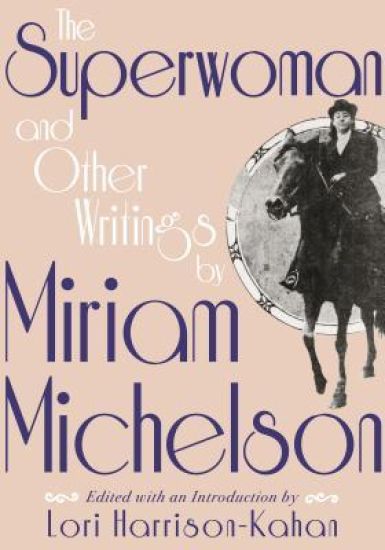
The Superwoman and Other Writings by Miriam Michelson is the first collection of newspaper articles and fiction written by Miriam Michelson (1870-1942), best-selling novelist, revolutionary journalist, and early feminist activist. Editor Lori Harrison-Kahan introduces readers to a writer who broke gender barriers in journalism, covering crime and politics for San Francisco's top dailies throughout the 1890s, an era that consigned most female reporters to writing about fashion and society events. In the book's foreword, Joan Michelson-Miriam Michelson's great-great niece, herself a reporter and advocate for women's equality and advancement-explains that in these trying political times, we need the reminder of how a ""girl reporter"" leveraged her fame and notoriety to keep the suffrage movement on the front page of the news. In her introduction, Harrison-Kahan draws on a variety of archival sources to tell the remarkable story of a brazen, single woman who grew up as the daughter of Jewish immigrants in a Nevada mining town during the Gold Rush. The Superwoman and Other Writings by Miriam Michelson offers a cross-section of Michelson's eclectic career as a reporter by showcasing a variety of topics she covered, including the treatment of Native Americans, profiles of suffrage leaders such as Susan B. Anthony and Charlotte Perkins Gilman, and police corruption. The book also traces Michelson's evolution from reporter to fiction writer, reprinting stories such as ""In the Bishop's Carriage"" (1904), a scandalous picaresque about a female pickpocket; excerpts from the Saturday Evening Post series, ""A Yellow Journalist"" (1905), based on Michelson's own experiences as a reporter in the era of Hearst and Pulitzer; and the title novella, The Superwoman, a trailblazing work of feminist utopian fiction that has been unavailable since its publication in The Smart Set in 1912. Readers will see how Michelson's newspaper work fueled her imagination as a fiction writer and how she adapted narrative techniques from fiction to create a body of journalism that informs, provokes, and entertains, even a century after it was written.
The Superwoman and Other Writings by Miriam Michelson

The Superwoman and Other Writings by Miriam Michelson

Miriam Michelson; Joan Michelson

Wayne State University Press
2019
sidottu
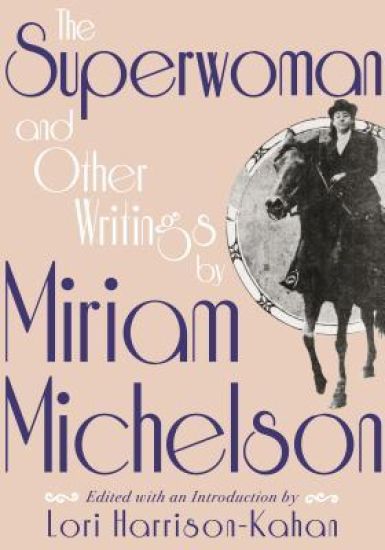
The Superwoman and Other Writings by Miriam Michelson is the first collection of newspaper articles and fiction written by Miriam Michelson (1870-1942), best-selling novelist, revolutionary journalist, and early feminist activist. Editor Lori Harrison-Kahan introduces readers to a writer who broke gender barriers in journalism, covering crime and politics for San Francisco's top dailies throughout the 1890s, an era that consigned most female reporters to writing about fashion and society events. In the book's foreword, Joan Michelson-Miriam Michelson's great-great niece, herself a reporter and advocate for women's equality and advancement-explains that in these trying political times, we need the reminder of how a ""girl reporter"" leveraged her fame and notoriety to keep the suffrage movement on the front page of the news. In her introduction, Harrison-Kahan draws on a variety of archival sources to tell the remarkable story of a brazen, single woman who grew up as the daughter of Jewish immigrants in a Nevada mining town during the Gold Rush. The Superwoman and Other Writings by Miriam Michelson offers a cross-section of Michelson's eclectic career as a reporter by showcasing a variety of topics she covered, including the treatment of Native Americans, profiles of suffrage leaders such as Susan B. Anthony and Charlotte Perkins Gilman, and police corruption. The book also traces Michelson's evolution from reporter to fiction writer, reprinting stories such as ""In the Bishop's Carriage"" (1904), a scandalous picaresque about a female pickpocket; excerpts from the Saturday Evening Post series, ""A Yellow Journalist"" (1905), based on Michelson's own experiences as a reporter in the era of Hearst and Pulitzer; and the title novella, The Superwoman, a trailblazing work of feminist utopian fiction that has been unavailable since its publication in The Smart Set in 1912. Readers will see how Michelson's newspaper work fueled her imagination as a fiction writer and how she adapted narrative techniques from fiction to create a body of journalism that informs, provokes, and entertains, even a century after it was written.
The Family Kitchen

The Family Kitchen

Joan Michelson

Finishing Line Press
2018
pokkari
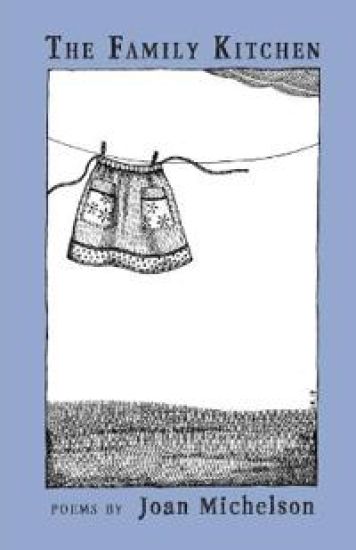
The Family Kitchen is an album of story and portrait poems drawing on three generations of a family that emigrated from Eastern Europe to America. It travels from a 19th century forest shtetl village outside Vilnius to Boston, Massachusetts. The poems advance into the 21st century when the narrator's parents return in the dream poem, 'The Family Kitchen.' Wearing mother's apron, father is cooking breakfast. 'Dead so much longer, mother hovers.' Other family members come to life with their stories: those who fulfil traditional roles like great-grandmother and grandmother, mother to many, household managers and business women supporting religious scholar husbands; and radicals like Great Aunt Hero who crossed China to teach birth control to peasants, joined the workers building the Moscow subway and, after giving each child a musical instrument to master, created a travelling family orchestra which she conducted. In the transition from the Old Country to the New World, orthodox religion gives way to American reform and detractors. The illiterate immigrant mother sees all of her children through college. But links to the Old World remain. After the war, a cousin who survived Auschwitz joins the family. He does not talk about the Camp until years later at a funeral. When he tells his story it is to school age grandchildren. Half a century after the Holocaust, describing how he survived is as unbelievable to him as to the new generation. Other poems offer a lighter, even humorous note. In 'Apron', grandma, whose childhood was hardship and work, is jumped into the air like a child by her laughing, dancing son-in-law. In 'Love Song for My Father', the same son-in-law pulls his trousers on backwards in his rush to get to the hospital to greet his first-born. And in 'Mother the Storyteller, squeezed into a 1920s Ford jalopy which has broken down on the road to Tip Top House on Mt Washington, the family spills out like circus clowns. The poems are open, intimate, tender, lyrical, unsentimental, by turns, moving, playful and celebratory. They touch on the universal themes of birth, living, death and dying. The collection is in the tradition of Robert Lowell's Life Studies. In its narrative of extended family like Life Studies, The Family Kitchen portrays American social history through the personal and familiar. In 'Storyteller', a two-section narrative about the poet's father as a child street-storyteller in Boston's Jewish ghetto and as an eighty year old recalling a different side of his child self, his story-telling with its recreations of self enlivens him. A day with uncomfortable dark-shadowed memories transforms through his emotive telling into something wondrous. In conversation with the past, in the dialogue narrative, 'A Gift of Going', the poet argues with her mother 'as if you has not gone'. British critic and poet Martyn Crucifix remarked that these poems are a distillation of our disputes with the past that - try as we might - we can never lay aside. British critic and poet Susan Wicks, 'This is one of the most poignant poems I have read.' Of the collection as a whole, American critic and poet Andrea Carter Brown writes, 'this spare but eloquent collection stands out: for its telling details, its lyrical vision, its hard-won generosity of spirit, of affection. Poem after poem, while speaking quietly, astounds, moves. This is one family's saga, particular in its heartbreak, universal in its bounty. Read. Think. Remember. Feel.'
Jack the Cat in Florida

Jack the Cat in Florida

Joan Michelson; Debora Emmert

Rhymetime
2017
nidottu
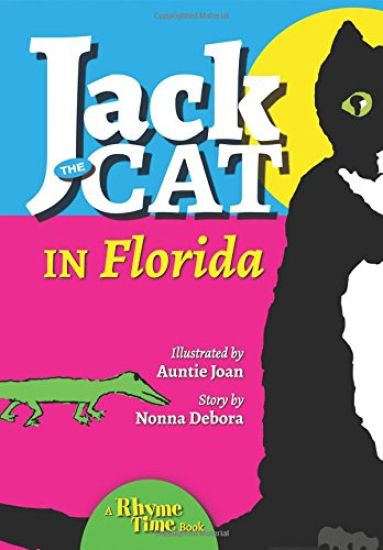
Who knew that one day in the life of a cat could make you chuckle? This funny RhymeTime story about Jack tracks a slightly jealous lizard friend (morning), Jack's desire for a hot fudge sundae (lunch), a flowerpot incident (afternoon), and Jack blocking Joan's view of the "Jacques Catseau" documentary on TV (night). This humorous rhyming tale is illustrated with bold, elemental drawings that appeal to toddlers and young children. Other RhymeTime storybooks include "Jack the Cat on Chicory Ridge" and "Jack the Cat: Christmas in Florida", as well as "Willie: I Know You Are My Friend" and "Willie: Does it matter?"