Kirjojen hintavertailu – 12 859 818 kirjaa ja 27 kauppaa
Kirjailija
Joe Harris
Kirjat ja teokset yhdessä paikassa: 45 kirjaa, julkaisuja vuosilta 1991–2026, suosituimpiin kuuluu Ghost Projekt (New Edition). Vertaile teosten hintoja ja tarkista saatavuus suomalaisista kirjakaupoista.
Grothendieck's beautiful theory of schemes permeates modern algebraic geometry and underlies its applications to number theory, physics, and applied mathematics. This simple account of that theory emphasizes and explains the universal geometric concepts behind the definitions. In the book, concepts are illustrated with fundamental examples, and explicit calculations show how the constructions of scheme theory are carried out in practice.
The aim of this book is to provide a guide to a rich and fascinating subject: algebraic curves, and how they vary in families. The revolution that the field of algebraic geometry has undergone with the introduction of schemes, together with new ideas, techniques and viewpoints introduced by Mumford and others, have made it possible for us to understand the behavior of curves in ways that simply were not possible a half-century ago. This in turn has led, over the last few decades, to a burst of activity in the area, resolving longstanding problems and generating new and unforeseen results and questions. We hope to acquaint you both with these results and with the ideas that have made them possible. The book isn’t intended to be a definitive reference: the subject is developing too rapidly for that to be a feasible goal, even if we had the expertise necessary for the task. Our preference has been to focus on examples and applications rather than on foundations. When discussing techniqueswe’ve chosen to sacrifice proofs of some, even basic,results—particularly where we can provide a good reference— in order to show how the methods are used to study moduli of curves. Likewise, we often prove results in special cases which we feel bring out the important ideas with a minimum of technical complication.
This book is based on one-semester courses given at Harvard in 1984, at Brown in 1985, and at Harvard in 1988. It is intended to be, as the title suggests, a first introduction to the subject. Even so, a few words are in order about the purposes of the book. Algebraic geometry has developed tremendously over the last century. During the 19th century, the subject was practiced on a relatively concrete, down-to-earth level; the main objects of study were projective varieties, and the techniques for the most part were grounded in geometric constructions. This approach flourished during the middle of the century and reached its culmination in the work of the Italian school around the end of the 19th and the beginning of the 20th centuries. Ultimately, the subject was pushed beyond the limits of its foundations: by the end of its period the Italian school had progressed to the point where the language and techniques of the subject could no longer serve to express or carry out the ideas of its best practitioners.
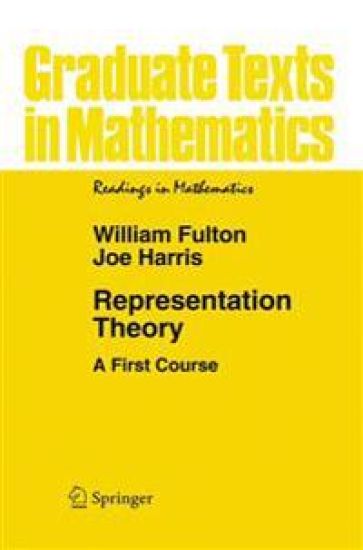
The main goal of these lectures is to introduce the beginner to the finite-dimensional representations of Lie groups and Lie algebras. Intended to serve non-specialists, the concentration of the text is on examples. The general theory is developed mainly as a useful and unifying language to describe phenomena already encountered in concrete cases.
The primary goal of these lectures is to introduce a beginner to the finite dimensional representations of Lie groups and Lie algebras. Since this goal is shared by quite a few other books, we should explain in this Preface how our approach differs, although the potential reader can probably see this better by a quick browse through the book. Representation theory is simple to define: it is the study of the ways in which a given group may act on vector spaces. It is almost certainly unique, however, among such clearly delineated subjects, in the breadth of its interest to mathematicians. This is not surprising: group actions are ubiquitous in 20th century mathematics, and where the object on which a group acts is not a vector space, we have learned to replace it by one that is {e. g. , a cohomology group, tangent space, etc. }. As a consequence, many mathematicians other than specialists in the field {or even those who think they might want to be} come in contact with the subject in various ways. It is for such people that this text is designed. To put it another way, we intend this as a book for beginners to learn from and not as a reference. This idea essentially determines the choice of material covered here. As simple as is the definition of representation theory given above, it fragments considerably when we try to get more specific.