Kirjojen hintavertailu – 12 903 735 kirjaa ja 27 kauppaa

Kirjailija

Joel Spencer

Kirjat ja teokset yhdessä paikassa: 7 kirjaa, julkaisuja vuosilta 1987–2014, suosituimpiin kuuluu Finite Model Theory and Its Applications. Vertaile teosten hintoja ja tarkista saatavuus suomalaisista kirjakaupoista.

7 kirjaa

Kirjojen julkaisuvuodet: 1987–2014.

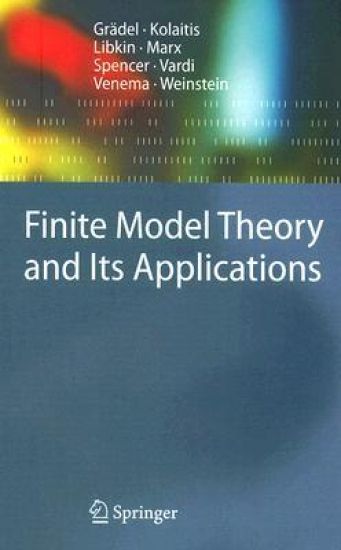
Finite Model Theory and Its Applications

Finite Model Theory and Its Applications

Erich Grädel; Phokion G. Kolaitis; Leonid Libkin; Maarten Marx; Joel Spencer; Moshe Y. Vardi; Yde Venema; Scott Weinstein

Springer-Verlag Berlin and Heidelberg GmbH Co. K
2014
nidottu
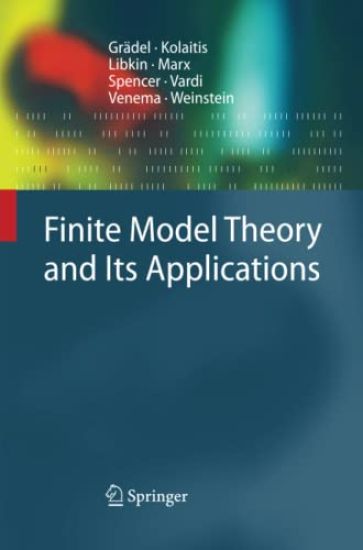
Finite model theory,as understoodhere, is an areaof mathematicallogic that has developed in close connection with applications to computer science, in particular the theory of computational complexity and database theory. One of the fundamental insights of mathematical logic is that our understanding of mathematical phenomena is enriched by elevating the languages we use to describe mathematical structures to objects of explicit study. If mathematics is the science of patterns, then the media through which we discern patterns, as well as the structures in which we discern them, command our attention. It isthis aspect oflogicwhichis mostprominentin model theory,“thebranchof mathematical logic which deals with the relation between a formal language and its interpretations”. No wonder, then, that mathematical logic, and ?nite model theory in particular, should ?nd manifold applications in computer science: from specifying programs to querying databases, computer science is rife with phenomena whose understanding requires close attention to the interaction between language and structure. This volume gives a broadoverviewof some central themes of ?nite model theory: expressive power, descriptive complexity, and zero–one laws, together with selected applications to database theory and arti?cial intelligence, es- cially constraint databases and constraint satisfaction problems. The ?nal chapter provides a concise modern introduction to modal logic,which emp- sizes the continuity in spirit and technique with ?nite model theory.
Asymptopia

Asymptopia

Joel Spencer

American Mathematical Society
2014
nidottu
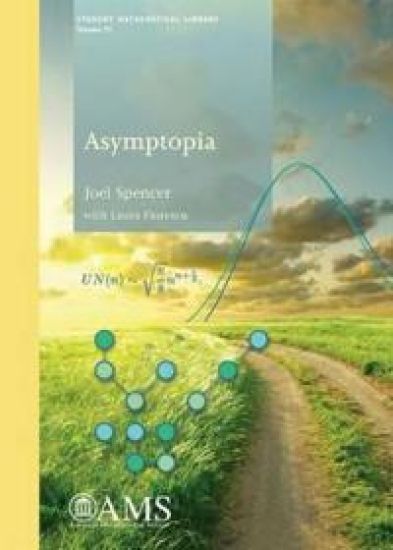
Asymptotics in one form or another are part of the landscape for every mathematician. The objective of this book is to present the ideas of how to approach asymptotic problems that arise in discrete mathematics, analysis of algorithms, and number theory. A broad range of topics is covered, including distribution of prime integers, Erdos Magic, random graphs, Ramsey numbers, and asymptotic geometry. The author is a disciple of Paul Erdos, who taught him about Asymptopia. Primes less than n , graphs with v vertices, random walks of t steps - Erdos was fascinated by the limiting behavior as the variables approached, but never reached, infinity. Asymptotics is very much an art. The various functions nlnn , n 2 , lnn n , lnn ? ? ? ? , 1 nlnn all have distinct personalities. Erdos knew these functions as personal friends. It is the author's hope that these insights may be passed on, that the reader may similarly feel which function has the right temperament for a given task. This book is aimed at strong undergraduates, though it is also suitable for particularly good high school students or for graduates wanting to learn some basic techniques. Asymptopia is a beautiful world. Enjoy!
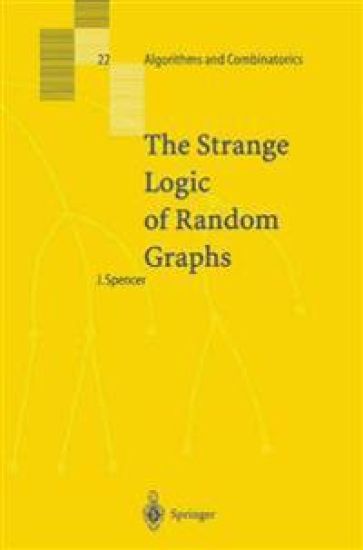
The Strange Logic of Random Graphs

The Strange Logic of Random Graphs

Joel Spencer

Springer-Verlag Berlin and Heidelberg GmbH Co. K
2010
nidottu
The study of random graphs was begun by Paul Erdos and Alfred Renyi in the 1960s and now has a comprehensive literature. A compelling element has been the threshold function, a short range in which events rapidly move from almost certainly false to almost certainly true. This book now joins the study of random graphs (and other random discrete objects) with mathematical logic. The possible threshold phenomena are studied for all statements expressible in a given language. Often there is a zero-one law, that every statement holds with probability near zero or near one. The methodologies involve probability, discrete structures and logic, with an emphasis on discrete structures. The book will be of interest to graduate students and researchers in discrete mathematics.
Finite Model Theory and Its Applications

Finite Model Theory and Its Applications

Erich Grädel; Phokion G. Kolaitis; Leonid Libkin; Maarten Marx; Joel Spencer; Moshe Y. Vardi; Yde Venema; Scott Weinstein

Springer-Verlag Berlin and Heidelberg GmbH Co. K
2007
sidottu
Finite model theory,as understoodhere, is an areaof mathematicallogic that has developed in close connection with applications to computer science, in particular the theory of computational complexity and database theory. One of the fundamental insights of mathematical logic is that our understanding of mathematical phenomena is enriched by elevating the languages we use to describe mathematical structures to objects of explicit study. If mathematics is the science of patterns, then the media through which we discern patterns, as well as the structures in which we discern them, command our attention. It isthis aspect oflogicwhichis mostprominentin model theory,“thebranchof mathematical logic which deals with the relation between a formal language and its interpretations”. No wonder, then, that mathematical logic, and ?nite model theory in particular, should ?nd manifold applications in computer science: from specifying programs to querying databases, computer science is rife with phenomena whose understanding requires close attention to the interaction between language and structure. This volume gives a broadoverviewof some central themes of ?nite model theory: expressive power, descriptive complexity, and zero–one laws, together with selected applications to database theory and arti?cial intelligence, es- cially constraint databases and constraint satisfaction problems. The ?nal chapter provides a concise modern introduction to modal logic,which emp- sizes the continuity in spirit and technique with ?nite model theory.
The Strange Logic of Random Graphs

The Strange Logic of Random Graphs

Joel Spencer

Springer-Verlag Berlin and Heidelberg GmbH Co. K
2001
sidottu
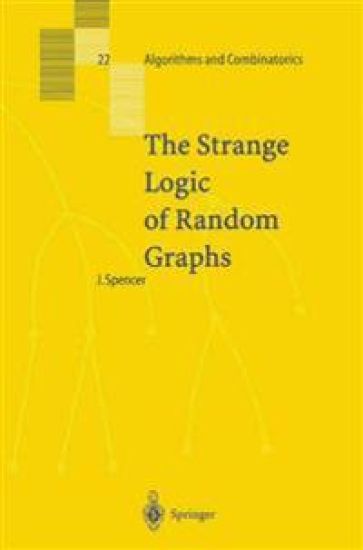
The study of random graphs was begun by Paul Erdos and Alfred Renyi in the 1960s and now has a comprehensive literature. A compelling element has been the threshold function, a short range in which events rapidly move from almost certainly false to almost certainly true. This book now joins the study of random graphs (and other random discrete objects) with mathematical logic. The possible threshold phenomena are studied for all statements expressible in a given language. Often there is a zero-one law, that every statement holds with probability near zero or near one. The methodologies involve probability, discrete structures and logic, with an emphasis on discrete structures. The book will be of interest to graduate students and researchers in discrete mathematics.
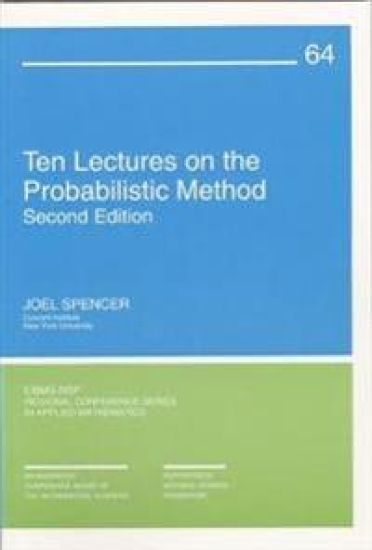
Ten Lectures on the Probabilistic Method

Ten Lectures on the Probabilistic Method

Joel Spencer

Society for Industrial and Applied Mathematic
1987
nidottu
This update of the 1987 title of the same name is an examination of what is currently known about the probabilistic method, written by one of its principal developers. Based on the notes from Spencer's 1986 series of ten lectures, this new edition contains an additional lecture: The Janson Inequalities.