Kirjojen hintavertailu – 12 903 725 kirjaa ja 27 kauppaa

Kirjailija

Johan A K Suykens

Kirjat ja teokset yhdessä paikassa: 4 kirjaa, julkaisuja vuosilta 1995–2010, suosituimpiin kuuluu Artificial Neural Networks for Modelling and Control of Non-Linear Systems. Vertaile teosten hintoja ja tarkista saatavuus suomalaisista kirjakaupoista.

Nimi esiintyy myös muodoissa: Johan A.K. Suykens

4 kirjaa

Kirjojen julkaisuvuodet: 1995–2010.

Artificial Neural Networks for Modelling and Control of Non-Linear Systems

Artificial Neural Networks for Modelling and Control of Non-Linear Systems

Johan A.K. Suykens; Joos P.L. Vandewalle; B.L. de Moor

Springer-Verlag New York Inc.
2010
nidottu
Artificial neural networks possess several properties that make them particularly attractive for applications to modelling and control of complex non-linear systems. Among these properties are their universal approximation ability, their parallel network structure and the availability of on- and off-line learning methods for the interconnection weights. However, dynamic models that contain neural network architectures might be highly non-linear and difficult to analyse as a result. Artificial Neural Networks for Modelling and Control of Non-Linear Systems investigates the subject from a system theoretical point of view. However the mathematical theory that is required from the reader is limited to matrix calculus, basic analysis, differential equations and basic linear system theory. No preliminary knowledge of neural networks is explicitly required. The book presents both classical and novel network architectures and learning algorithms for modelling and control. Topics include non-linear system identification, neural optimal control, top-down model based neural control design and stability analysis of neural control systems. A major contribution of this book is to introduce NLq Theory as an extension towards modern control theory, in order to analyze and synthesize non-linear systems that contain linear together with static non-linear operators that satisfy a sector condition: neural state space control systems are an example. Moreover, it turns out that NLq Theory is unifying with respect to many problems arising in neural networks, systems and control. Examples show that complex non-linear systems can be modelled and controlled within NLq theory, including mastering chaos. The didactic flavor of this book makes it suitable for use as a text for a course on Neural Networks. In addition, researchers and designers will find many important new techniques, in particular NLqTheory, that have applications in control theory, system theory, circuit theory and Time Series Analysis.
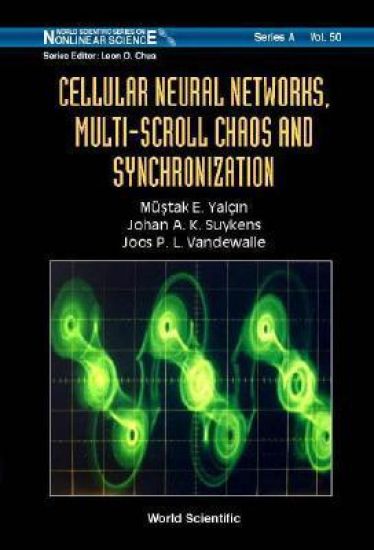
Cellular Neural Networks, Multi-scroll Chaos And Synchronization

Cellular Neural Networks, Multi-scroll Chaos And Synchronization

Johan A K Suykens; Mustak E Yalcin; Joos P L Vandewalle

World Scientific Publishing Co Pte Ltd
2005
sidottu
For engineering applications that are based on nonlinear phenomena, novel information processing systems require new methodologies and design principles. This perspective is the basis of the three cornerstones of this book: cellular neural networks, chaos and synchronization. Cellular neural networks and their universal machine implementations offer a well-established platform for processing spatial-temporal patterns and wave computing. Multi-scroll circuits are generalizations to the original Chua's circuit, leading to chip implementable circuits with increasingly complex attractors. Several applications make use of synchronization techniques for nonlinear systems. A systematic overview is given for Lur'e representable systems with global synchronization criteria for master-slave and mutual synchronization, robust synchronization, H8 synchronization, time-delayed systems and impulsive synchronization.
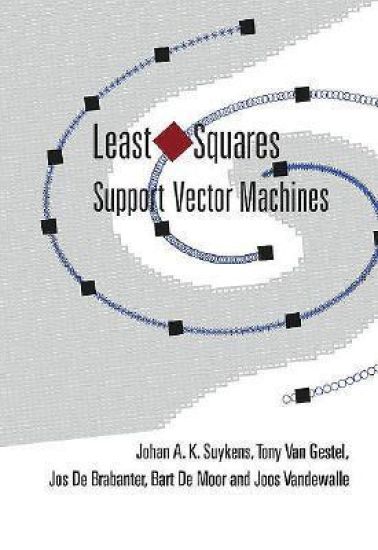
Least Squares Support Vector Machines

Least Squares Support Vector Machines

Johan A K Suykens; Tony Van Gestel; Joseph De Brabanter; Bart De Moor; Joos P L Vandewalle

World Scientific Publishing Co Pte Ltd
2002
sidottu
This book focuses on Least Squares Support Vector Machines (LS-SVMs) which are reformulations to standard SVMs. LS-SVMs are closely related to regularization networks and Gaussian processes but additionally emphasize and exploit primal-dual interpretations from optimization theory. The authors explain the natural links between LS-SVM classifiers and kernel Fisher discriminant analysis. Bayesian inference of LS-SVM models is discussed, together with methods for imposing sparseness and employing robust statistics. The framework is further extended towards unsupervised learning by considering PCA analysis and its kernel version as a one-class modelling problem. This leads to new primal-dual support vector machine formulations for kernel PCA and kernel CCA analysis. Furthermore, LS-SVM formulations are given for recurrent networks and control. In general, support vector machines may pose heavy computational challenges for large data sets. For this purpose, a method of fixed size LS-SVM is proposed where the estimation is done in the primal space in relation to a Nyström sampling with active selection of support vectors. The methods are illustrated with several examples.
Artificial Neural Networks for Modelling and Control of Non-Linear Systems

Artificial Neural Networks for Modelling and Control of Non-Linear Systems

Johan A.K. Suykens; Joos P.L. Vandewalle; B.L. de Moor

Springer
1995
sidottu
Artificial neural networks possess several properties that make them particularly attractive for applications to modelling and control of complex non-linear systems. Among these properties are their universal approximation ability, their parallel network structure and the availability of on- and off-line learning methods for the interconnection weights. However, dynamic models that contain neural network architectures might be highly non-linear and difficult to analyse as a result. Artificial Neural Networks for Modelling and Control of Non-Linear Systems investigates the subject from a system theoretical point of view. However the mathematical theory that is required from the reader is limited to matrix calculus, basic analysis, differential equations and basic linear system theory. No preliminary knowledge of neural networks is explicitly required. The book presents both classical and novel network architectures and learning algorithms for modelling and control. Topics include non-linear system identification, neural optimal control, top-down model based neural control design and stability analysis of neural control systems. A major contribution of this book is to introduce NLq Theory as an extension towards modern control theory, in order to analyze and synthesize non-linear systems that contain linear together with static non-linear operators that satisfy a sector condition: neural state space control systems are an example. Moreover, it turns out that NLq Theory is unifying with respect to many problems arising in neural networks, systems and control. Examples show that complex non-linear systems can be modelled and controlled within NLq theory, including mastering chaos. The didactic flavor of this book makes it suitable for use as a text for a course on Neural Networks. In addition, researchers and designers will find many important new techniques, in particular NLqTheory, that have applications in control theory, system theory, circuit theory and Time Series Analysis.