Kirjojen hintavertailu – 12 859 828 kirjaa ja 27 kauppaa

Kirjailija

Johan Schot

Kirjat ja teokset yhdessä paikassa: 6 kirjaa, julkaisuja vuosilta 2002–2018, suosituimpiin kuuluu Experimenting for Sustainable Transport. Vertaile teosten hintoja ja tarkista saatavuus suomalaisista kirjakaupoista.

6 kirjaa

Kirjojen julkaisuvuodet: 2002–2018.

Writing the Rules for Europe

Writing the Rules for Europe

Wolfram Kaiser; Johan Schot

Palgrave Macmillan
2018
nidottu
Drawing on fresh archival evidence, this book tells the story of how experts, cartels and international organizations have written the rules for Europe since around 1850. It shows that the present-day European Union was a latecomer in European integration, which is embedded in a long-term technocratic internationalist tradition.
Writing the Rules for Europe

Writing the Rules for Europe

Wolfram Kaiser; Johan Schot

Palgrave Macmillan
2014
sidottu
Drawing on fresh archival evidence, this book tells the story of how experts, cartels and international organizations have written the rules for Europe since around 1850. It shows that the present-day European Union was a latecomer in European integration, which is embedded in a long-term technocratic internationalist tradition.
Transitions to Sustainable Development

Transitions to Sustainable Development

John Grin; Jan Rotmans; Johan Schot

Routledge
2011
nidottu
Over the past few decades, there has been a growing concern about the social and environmental risks which have come along with the progress achieved through a variety of mutually intertwined modernization processes. In recent years these concerns are transformed into a widely-shared sense of urgency, partly due to events such as the various pandemics threatening livestock, and increasing awareness of the risks and realities of climate change, and the energy and food crises. This sense of urgency includes an awareness that our entire social system is in need of fundamental transformation. But like the earlier transition between the 1750's and 1890's from a pre-modern to a modern industrial society, this second transition is also a contested one. Sustainable development is only one of many options. This book addresses the issue on how to understand the dynamics and governance of the second transition dynamics in order to ensure sustainable development. It will be necessary reading for students and scholars with an interest in sustainable development and long-term transformative change.
Transitions to Sustainable Development

Transitions to Sustainable Development

John Grin; Jan Rotmans; Johan Schot

Routledge
2010
sidottu
Over the past few decades, there has been a growing concern about the social and environmental risks which have come along with the progress achieved through a variety of mutually intertwined modernization processes. In recent years these concerns are transformed into a widely-shared sense of urgency, partly due to events such as the various pandemics threatening livestock, and increasing awareness of the risks and realities of climate change, and the energy and food crises. This sense of urgency includes an awareness that our entire social system is in need of fundamental transformation. But like the earlier transition between the 1750's and 1890's from a pre-modern to a modern industrial society, this second transition is also a contested one. Sustainable development is only one of many options. This book addresses the issue on how to understand the dynamics and governance of the second transition dynamics in order to ensure sustainable development. It will be necessary reading for students and scholars with an interest in sustainable development and long-term transformative change.
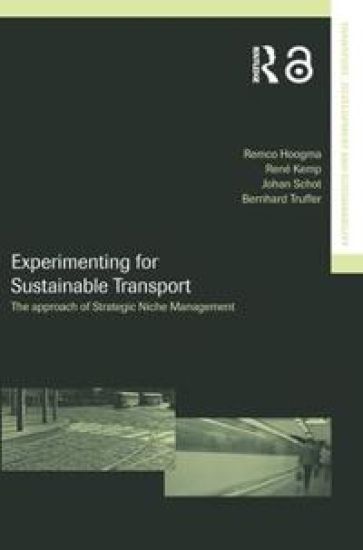
Experimenting for Sustainable Transport

Experimenting for Sustainable Transport

Remco Hoogma; Rene Kemp; Johan Schot; Bernhard Truffer

Routledge
2002
nidottu
Technological change is a central feature of modern societies and a powerful source for social change. There is an urgent task to direct these new technologies towards sustainability, but society lacks perspectives, instruments and policies to accomplish this. There is no blueprint for a sustainable future, and it is necessary to experiment with alternative paths that seem promising. Various new transport technologies promise to bring sustainability benefits. But as this book shows, important lessons are often overlooked because the experiments are not designed to challenge the basic assumptions about established patterns of transport choices. Learning how to organise the process of innovation implementation is essential if the maximum impact is to be achieved - it is here that strategic niche management offers new perspectives. The book uses a series of eight recent experiments with electric vehicles, carsharing schemes, bicycle pools and fleet management to illustrate the means by which technological change must be closely linked to social change if successful implementation is to take place. The basic divide between proponents of technological fixes and those in favour of behavioural change needs to be bridged, perhaps indicating a third way.

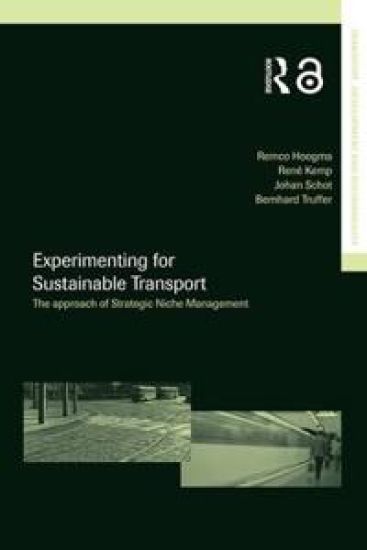
Experimenting for Sustainable Transport

Experimenting for Sustainable Transport

Remco Hoogma; Rene Kemp; Johan Schot; Bernhard Truffer

Routledge
2002
sidottu
Technological change is a central feature of modern societies and a powerful source for social change. There is an urgent task to direct these new technologies towards sustainability, but society lacks perspectives, instruments and policies to accomplish this. There is no blueprint for a sustainable future, and it is necessary to experiment with alternative paths that seem promising. Various new transport technologies promise to bring sustainability benefits. But as this book shows, important lessons are often overlooked because the experiments are not designed to challenge the basic assumptions about established patterns of transport choices. Learning how to organise the process of innovation implementation is essential if the maximum impact is to be achieved - it is here that strategic niche management offers new perspectives. The book uses a series of eight recent experiments with electric vehicles, carsharing schemes, bicycle pools and fleet management to illustrate the means by which technological change must be closely linked to social change if successful implementation is to take place. The basic divide between proponents of technological fixes and those in favour of behavioural change needs to be bridged, perhaps indicating a third way.