Kirjojen hintavertailu – 12 903 724 kirjaa ja 27 kauppaa

Kirjailija

Johannes Lenhard

Kirjat ja teokset yhdessä paikassa: 32 kirjaa, julkaisuja vuosilta 2010–2024, suosituimpiin kuuluu The Laws of the Phenomena of Society. How Would Weber and Durkheim Have Responded to John Stuart Mill's Famous Quote?. Vertaile teosten hintoja ja tarkista saatavuus suomalaisista kirjakaupoista.

32 kirjaa

Kirjojen julkaisuvuodet: 2010–2024.

The Laws of the Phenomena of Society. How Would Weber and Durkheim Have Responded to John Stuart Mill's Famous Quote?
Essay aus dem Jahr 2012 im Fachbereich P dagogik - Wissenschaft, Theorie, Anthropologie, Note: 66, University of Cambridge, Sprache: Deutsch, Abstract: 'The Laws of the phenomena of society are, and can be, nothing but the laws of the actions and passions of human beings . . . Men are not, when brought together, converted into another kind of substance' (John Stuart Mill). Compare and contrast how Weber and Durkheim might have responded to this statement. What John Stuart Mill means seems straightforward: society functions as a unidirectional interplay of individuals. The rules, that govern those individuals in isolation also dominate in situations of collective character. Mill expresses a deep belief in the overarching importance of the individual in comparison to collectives that in turn do not change the actor's behaviour. When we place Mill in his liberal and utilitarian context, this opinion does not surprise; for him, self-interest seemed to rule both the individual and society. To put it crudely: individual > society. Contrasting the 'laws of the phenomena of society' with 'the laws of the actions and passions of human beings', the main difference lies in the society-individual dichotomy, i.e. the level of analysis. The former refers to situations in which more than one actor participates, such as religion, economy or administration. The latter alludes to the personal behaviour, feelings and ideas of a human being, almost to psychology. Without questioning this dichotomy in its foundation, both Weber and Durkheim, differ widely from the view that both spheres of law are approximately congruent. For both scholars, society has a life on its own, rules on its own that are at least partly independent from the individual. Durkheim much more than Weber even ascribes an influence to society that is able to dominate the individual behaviour. For Weber, the overarching force of capitalist society is a particular condition in modern society that he reveals and criti

Cultures of Prediction

Cultures of Prediction

Ann Johnson; Johannes Lenhard

MIT PRESS LTD
2024
nidottu
A probing examination of the dynamic history of predictive methods and values in science and engineering that helps us better understand today's cultures of prediction. The ability to make reliable predictions based on robust and replicable methods is a defining feature of the scientific endeavor, allowing engineers to determine whether a building will stand up or where a cannonball will strike. Cultures of Prediction, which bridges history and philosophy, uncovers the dynamic history of prediction in science and engineering over four centuries. Ann Johnson and Johannes Lenhard identify four different cultures, or modes, of prediction in the history of science and engineering: rational, empirical, iterative-numerical, and exploratory-iterative. They show how all four develop together and interact with one another while emphasizing that mathematization is not a single unitary process, but one that has taken many forms. The story is not one of the triumph of abstract mathematics or technology, but of how different modes of prediction, complementary concepts of mathematization, and technology coevolved, building what the authors call "cultures of prediction." The first part of the book examines prediction from early modernity up to the computer age. The second part probes computer-related cultures of prediction, which focus on making things and testing their performance, often in computer simulations. This new orientation challenges basic tenets of the philosophy of science, in which scientific theories and models are predominantly seen as explanatory rather than predictive. It also influences the types of research projects that scientists and engineers undertake, as well as which ones receive support from funding agencies.
Making Better Lives

Making Better Lives

Johannes Lenhard

BERGHAHN BOOKS
2024
nidottu
In this ethnographic study, Johannes Lenhard observes the daily practices, routines and techniques of people who are sleeping rough on the streets of Paris. The book focusses on their survival practises, their short-term desires and hopes, how they earn money through begging, how they choose the best place to sleep at night and what role drugs and alcohol play in their lives. The book also follows people through different institutional settings, including a homeless day centre, a needle exchange, a centre for people with alcohol problems and a homeless shelter.
Making Better Lives

Making Better Lives

Johannes Lenhard

BERGHAHN BOOKS
2022
sidottu
In this ethnographic study, Johannes Lenhard observes the daily practices, routines and techniques of people who are sleeping rough on the streets of Paris. The book focusses on their survival practises, their short-term desires and hopes, how they earn money through begging, how they choose the best place to sleep at night and what role drugs and alcohol play in their lives. The book also follows people through different institutional settings, including a homeless day centre, a needle exchange, a centre for people with alcohol problems and a homeless shelter.
Better Venture

Better Venture

Erika Brodnock; Johannes Lenhard

Holloway, Inc.
2020
pokkari
Better Venture is a first-of-its-kind guide to diversity and inclusion in startups and venture capital-who funds, who gets funded, and how the industry can change. The industry's lack of diversity and inclusion not only compromises moral standing-it means overlooking profitable businesses and talented founders. That costs hundreds of millions of dollars a year, and neglects ideas that could serve the needs of many more people. In this collection of interviews, stories, and research, we use the momentum that has been building in recent years to expand the conversation about DEI, venture capital, and the startup ecosystem, and to inspire more concrete action. Highlights: 43 in-depth conversations with leading investors, entrepreneurs, and researchers, making it one of the most comprehensive and diverse sets of perspectives on the startup ecosystem ever assembled in one place. An economic history of venture capital through a diversity lens. On-the-ground stories from founders and VCs that explore ways to create a more diverse, inclusive, equitable, and profitable venture ecosystem. No blog post can give the deep understanding and vision needed to address the complexity of the topic. That's why we came together to write this book and are bringing in so many voices to clarify the picture of what is and what could be. Over the course of two years of research and discussion with almost 100 experts, we set out to answer four questions: Why has the industry been so slow to change? We map the economic origins and history of venture capital to understand how the economics of VC has contributed to the glacial pace of diversifying the industry. What barriers are founders and investors facing now? We draw on contributions from investors, operators, founders, and journalists to help catalog the barriers for founders seeking funding, and for investors seeking entry and influence in the industry. Can diversity really lead to higher returns? We bring in new research and data to help us understand how betting on underrepresented founders and investors is really the better venture. Why does diversifying the industry matter, and to whom? How is it linked to financial performance and better decision making? How will it improve innovation across industries? What can be done for positive change? We discuss cost effective and evidence-based interventions, tools, and solutions that can help to make the VC and startup worlds more diverse and inclusive-and result in higher returns. We hope this book and the conversations it contains help fulfill the vision of a more diverse, inclusive, and profitable ecosystem. It's time venture got better." Better Venture is a fantastically comprehensive guide to the critical subject of inclusion in venture capital, packed full of practical advice from leaders in the field."- Check Warner (Ada Ventures)"Change-when it comes to diversity and inclusion in VC and startups-hasn't come quickly enough. This comprehensive guide has great concrete examples and best practices that are illuminating and can hopefully affect change."- Elizabeth Yin (Hustle Fund)"Better Venture is the definitive guide on DEI in VC-a must read with practical tips for making changes in the industry."- Maren Bannon (January Ventures)
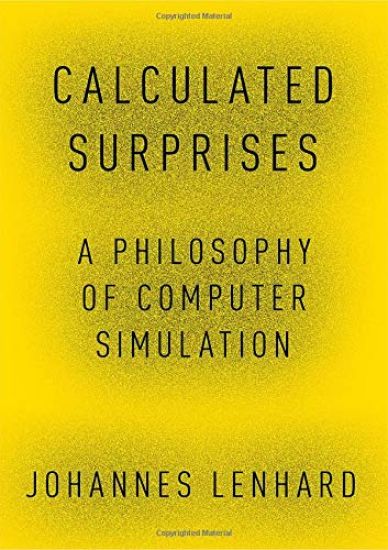
Calculated Surprises

Calculated Surprises

Johannes Lenhard

Oxford University Press Inc
2019
sidottu
If all philosophy starts with wondering, then Calculated Surprises starts with wondering about how computers are changing the face and inner workings of science. In this book, Lenhard concentrates on the ways in which computers and simulation are transforming the established conception of mathematical modeling. His core thesis is that simulation modeling constitutes a new mode of mathematical modeling that rearranges and inverts key features of the established conception. Although most of these new key features--such as experimentation, exploration, or epistemic opacity--have their precursors, the new ways in which they are being combined is generating a distinctive style of scientific reasoning. Lenhard also documents how simulation is affecting fundamental concepts of solution, understanding, and validation. He feeds these transformations back into philosophy of science, thereby opening up new perspectives on longstanding oppositions. By combining historical investigations with practical aspects, Calculated Surprises is accessible for a broad audience of readers. Numerous case studies covering a wide range of simulation techniques are balanced with broad reflections on science and technology. Initially, what computers are good at is calculating with a speed and accuracy far beyond human capabilities. Lenhard goes further and investigates the emerging characteristics of computer-based modeling, showing how this simple observation is creating a number of surprising challenges for the methodology and epistemology of science. These calculated surprises will attract both philosophers and scientific practitioners who are interested in reflecting on recent developments in science and technology.
Mit allem rechnen - zur Philosophie der Computersimulation
The new series of Ideen&Argumente subscribes to the ideal of a pluralist and open culture of argument and debate and presents well-produced volumes on topics and questions which make substantive or methodologically important contributions to contemporary philosophy. The publications are designed to effect a productive synergy between the Anglo-Saxon and Continental European philosophical traditions. Ideen&Argumente provides a platform for outstanding systematically oriented original editions and German first editions from all areas of Theoretical and Practical Philosophy. A welcome is extended to programmatic monographs from whatever philosophical direction. The aim is to highlight anew the thematic and methodological richness of contemporary philosophy.
The use of the concept of 'practice' in anthropology. Theoretical Problems
Essay aus dem Jahr 2013 im Fachbereich P dagogik - Wissenschaft, Theorie, Anthropologie, Note: 2:1, University of Cambridge, Sprache: Deutsch, Abstract: Born out of critique on structuralism and its forbearers, practice theory arises in the late 1970s and early 1980s with Giddens in the UK, Bourdieu in France and Sahlins in the States. It most ardently argues for the relevance of intentional subjects in social and cultural process and similarly the impact of history or event upon the wider social structure (Ortner, 1984:137f). Focusing in the following on the work of Bourdieu (1977), Sahlins (1987, 1994, 2000) and later Ortner (1984, 1989, 2006a, 2006b), I argue that practice does mainly aim at solving one major theoretical problem: how do actors and structure interact in order to 'make' the world? How can (intentional) individuals be reconciled with the influence of an overarching system of presumptions? Or as Sahlins puts it (2000:295): "how shall we reconcile structure that are logical and durable with events that are emotional and ephemeral." The common ground most authors build shall also serve as a starting point for the more detailed account as expressed by Ortner (2006:2): practice theories "conceptualise the articulations between the practices of social actors on the ground and the big structures and systems that both constrain those practices and yet are ultimately susceptible to being transformed by them." In essence, practice theory proposes a dialectical relationship as the solution for the dilemma stated above. As part of this overall-endeavour, practice theory in its various forms has several sub-arguments that are concerned with the notions of structure and actor, the possibility of change as well as the importance of history respectively.