Kirjojen hintavertailu – 12 903 725 kirjaa ja 27 kauppaa

Kirjailija

Johannes Martens

Kirjat ja teokset yhdessä paikassa: 4 kirjaa, julkaisuja vuosilta 2018–2024, suosituimpiin kuuluu Analytische Prüfungshandlungen in der Abschlussprüfung. Vertaile teosten hintoja ja tarkista saatavuus suomalaisista kirjakaupoista.

4 kirjaa

Kirjojen julkaisuvuodet: 2018–2024.

Analytische Prüfungshandlungen in der Abschlussprüfung

Analytische Prüfungshandlungen in der Abschlussprüfung

Johannes Martens

Springer-Verlag Berlin and Heidelberg GmbH Co. KG
2024
nidottu
In der Abschlussprüfung werden neben Informationen aus der traditionellen Analyse von finanziellen Daten zunehmend Informationen aus der Analyse von nicht-finanziellen Daten berücksichtigt. Die Nutzung von nicht-finanziellen Informationen ist hierbei kein neues Phänomen, jedoch ermöglichen jüngere datenanalytische Verfahren, wie z. B. Text-Data-Mining, die Auswertung bisher wenig beachteter, unkonventioneller Datenquellen, die zunehmend in die prüferische Urteilsfindung Eingang finden. In diesem Zusammenhang wird in dieser Arbeit aus einer verhaltenswissenschaftlichen Perspektive untersucht, welche Bedeutung nicht-finanzielle Informationen aus der Analyse von Wetter-, Strom- und Internetdaten zur Plausibilisierung der Umsatzerlöse im Rahmen einer analytischen Prüfungshandlung für Prüfer besitzen. Hierfür wird eine experimentelle Untersuchung mit Prüfern durchgeführt, die drei wesentliche Faktoren bei der Verarbeitung der nicht-finanziellen Informationen fokussiert: das Bedürfnis nach kognitiver Geschlossenheit, die Informationskonsistenz und der fraud-Risiko-Kontext. Die Ergebnisse deuten unter anderem auf einen Einfluss des Bedürfnisses nach kognitiver Geschlossenheit und der Informationskonsistenz hin. Die Befunde liefern interessante Einsichten für Prüfungspraxis und -forschung.
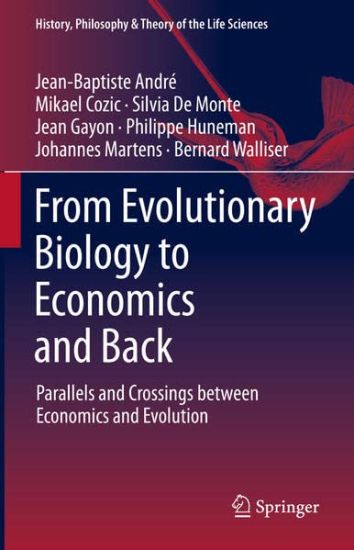
From Evolutionary Biology to Economics and Back

From Evolutionary Biology to Economics and Back

Jean-Baptiste André; Mikael Cozic; Silvia De Monte; Jean Gayon; Philippe Huneman; Johannes Martens; Bernard Walliser

Springer International Publishing AG
2024
nidottu
This book offers a comprehensive exploration of the major key concepts common to economics and evolutionary biology. Written by a group of philosophers of science, biologists and economists, it proposes analyses of the meaning of twenty-five concepts from the viewpoint respectively of economics and of evolutionary biology –each followed by a short synthesis emphasizing major discrepancies and commonalities. This analysis is surrounded by chapters exploring the nature of the analogy that connects evolution and economics, and chapters that summarize the major teachings of the analyses of the keywords. Most scholars in biology and in economics know that their science has something in common with the other one, for instance the notions of competition and resources. Textbooks regularly acknowledge that the two fields share some history – Darwin borrowing from Malthus the insistence on scarcity of resources, and then behavioral ecologists adapting and transforming game theory into evolutionary game theory in the 1980s, while Friedman famously alluded to a Darwinian process yielding the extant firms. However, the real extent of the similarities, the reasons why they are so close, and the limits and even the nature of the analogy connecting economics and biological evolution, remain inexplicit. This book proposes basis analyses that can sustain such explication. It is intended for researchers, grad students and master students in evolutionary and in economics, as well as in philosophy of science.
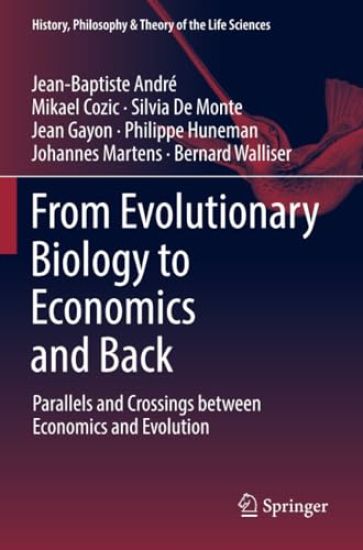
From Evolutionary Biology to Economics and Back

From Evolutionary Biology to Economics and Back

Jean-Baptiste André; Mikael Cozic; Silvia De Monte; Jean Gayon; Philippe Huneman; Johannes Martens; Bernard Walliser

Springer International Publishing AG
2023
sidottu
This book offers a comprehensive exploration of the major key concepts common to economics and evolutionary biology. Written by a group of philosophers of science, biologists and economists, it proposes analyses of the meaning of twenty-five concepts from the viewpoint respectively of economics and of evolutionary biology –each followed by a short synthesis emphasizing major discrepancies and commonalities. This analysis is surrounded by chapters exploring the nature of the analogy that connects evolution and economics, and chapters that summarize the major teachings of the analyses of the keywords. Most scholars in biology and in economics know that their science has something in common with the other one, for instance the notions of competition and resources. Textbooks regularly acknowledge that the two fields share some history – Darwin borrowing from Malthus the insistence on scarcity of resources, and then behavioral ecologists adapting and transforming game theory into evolutionary game theory in the 1980s, while Friedman famously alluded to a Darwinian process yielding the extant firms. However, the real extent of the similarities, the reasons why they are so close, and the limits and even the nature of the analogy connecting economics and biological evolution, remain inexplicit. This book proposes basis analyses that can sustain such explication. It is intended for researchers, grad students and master students in evolutionary and in economics, as well as in philosophy of science.