Kirjojen hintavertailu – 12 859 819 kirjaa ja 27 kauppaa

Kirjailija

John A. Vasquez

Kirjat ja teokset yhdessä paikassa: 12 kirjaa, julkaisuja vuosilta 1999–2025, suosituimpiin kuuluu Contagion and War. Vertaile teosten hintoja ja tarkista saatavuus suomalaisista kirjakaupoista.

12 kirjaa

Kirjojen julkaisuvuodet: 1999–2025.

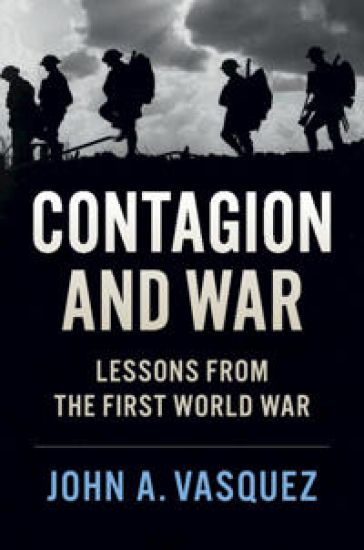
Contagion and War

Contagion and War

John A. Vasquez

Cambridge University Press
2018
sidottu
John A. Vasquez explains the processes that cause the spread of interstate war by looking at how contagion worked to bring countries into the First World War. Analysing all the key states that declared war, the book is comprised of three parts. Part I lays out six models of contagion: alliances, contiguity, territorial rivalry, opportunity, 'brute force' and economic dependence. Part II then analyses in detail the decision making of every state that entered the war from Austria-Hungary in 1914 to the United States and Greece in 1917. Part III has two chapters - the first considers the neutral countries, and the second concludes the book with an overarching theoretical analysis, including major lessons of the war and new hypotheses about contagion. This book will be of great interest to students and scholars of international relations, conflict studies and international history, especially those interested in the spread of conflict, or the First World War.
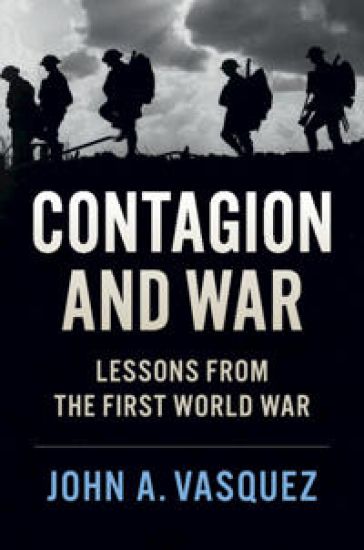
Contagion and War

Contagion and War

John A. Vasquez

Cambridge University Press
2018
pokkari
John A. Vasquez explains the processes that cause the spread of interstate war by looking at how contagion worked to bring countries into the First World War. Analysing all the key states that declared war, the book is comprised of three parts. Part I lays out six models of contagion: alliances, contiguity, territorial rivalry, opportunity, 'brute force' and economic dependence. Part II then analyses in detail the decision making of every state that entered the war from Austria-Hungary in 1914 to the United States and Greece in 1917. Part III has two chapters - the first considers the neutral countries, and the second concludes the book with an overarching theoretical analysis, including major lessons of the war and new hypotheses about contagion. This book will be of great interest to students and scholars of international relations, conflict studies and international history, especially those interested in the spread of conflict, or the First World War.
Territory, War, and Peace

Territory, War, and Peace

John A. Vasquez; Marie T. Henehan

Routledge
2010
sidottu
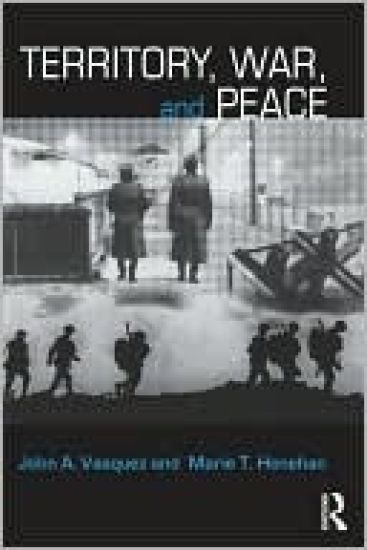
This book presents a collection of new and updated essays on what has come to be known as the territorial explanation of war. The book argues that a key both to peace and to war lies in understanding the role territory plays as a source of conflict and inter-group violence. Of all the issues that spark conflict, territorial disputes have the highest probability of escalating to war. War, however, is hardly inevitable; much depends on how territorial issues are handled. More importantly, settling territorial disputes and establishing mutually recognized boundaries can produce long periods of peace between neighbors, even if other salient issues arise. While territory is not the only cause of war and wars arise from other issues, territory is one of the main causes of war, and learning how to manage it, can, in principle, eliminate an entire class of wars. This book will be of great interest to all students of war and conflict studies, causes of war and peace, international security and strategic studies. John A. Vasquez is Thomas B. Mackie Scholar in International Relations at the University of Illinois, Urbana-Champaign. He is author of The Steps to War (2008) (with Paul Senese) and The War Puzzle Revisited (2009). He has been president of the Peace Science Society (International) and the International Studies Association. Marie T. Henehan is Director of Internships and Lecturer, Department of Political Science at the University of Illinois, Urbana-Champaign. She is author of Foreign Policy and Congress: An International Relations Perspective and co-editor of The Scientific Study of Peace and War.

Territory, War, and Peace

Territory, War, and Peace

John A. Vasquez; Marie T. Henehan

Routledge
2010
nidottu
This book presents a collection of new and updated essays on what has come to be known as the territorial explanation of war. The book argues that a key both to peace and to war lies in understanding the role territory plays as a source of conflict and inter-group violence. Of all the issues that spark conflict, territorial disputes have the highest probability of escalating to war. War, however, is hardly inevitable; much depends on how territorial issues are handled. More importantly, settling territorial disputes and establishing mutually recognized boundaries can produce long periods of peace between neighbors, even if other salient issues arise. While territory is not the only cause of war and wars arise from other issues, territory is one of the main causes of war, and learning how to manage it, can, in principle, eliminate an entire class of wars. This book will be of great interest to all students of war and conflict studies, causes of war and peace, international security and strategic studies. John A. Vasquez is Thomas B. Mackie Scholar in International Relations at the University of Illinois, Urbana-Champaign. He is author of The Steps to War (2008) (with Paul Senese) and The War Puzzle Revisited (2009). He has been president of the Peace Science Society (International) and the International Studies Association. Marie T. Henehan is Director of Internships and Lecturer, Department of Political Science at the University of Illinois, Urbana-Champaign. She is author of Foreign Policy and Congress: An International Relations Perspective and co-editor of The Scientific Study of Peace and War.
The War Puzzle Revisited

The War Puzzle Revisited

John A. Vasquez

Cambridge University Press
2009
pokkari
John A. Vasquez's The War Puzzle provided one of the most important scientific analyses of the causes of war of the last two decades. The War Puzzle Revisited updates and extends his groundbreaking work, reviewing research on the onset and expansion of war and the conditions of peace. Vasquez describes systematically those factors associated with wars to see if there is a pattern that suggests why war occurs, and how it might be avoided, delineating the typical path by which relatively equal states have become embroiled in wars in the modern global system. The book uses the large number of empirical findings generated s the basis of its theorizing, and integrates these research findings so as to advance the scientific knowledge of war and peace.
The War Puzzle Revisited

The War Puzzle Revisited

John A. Vasquez

Cambridge University Press
2009
sidottu
John A. Vasquez's The War Puzzle provided one of the most important scientific analyses of the causes of war of the last two decades. The War Puzzle Revisited updates and extends his groundbreaking work, reviewing research on the onset and expansion of war and the conditions of peace. Vasquez describes systematically those factors associated with wars to see if there is a pattern that suggests why war occurs, and how it might be avoided, delineating the typical path by which relatively equal states have become embroiled in wars in the modern global system. The book uses the large number of empirical findings generated s the basis of its theorizing, and integrates these research findings so as to advance the scientific knowledge of war and peace.
The Steps to War

The Steps to War

Paul D. Senese; John A. Vasquez

Princeton University Press
2008
pokkari
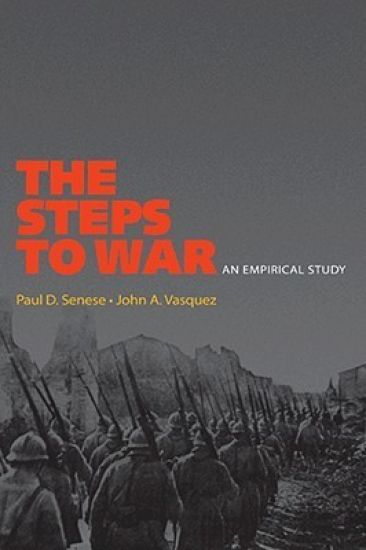
The question of what causes war has concerned statesmen since the time of Thucydides. The Steps to War utilizes new data on militarized interstate disputes from 1816 to 2001 to identify the factors that increase the probability that a crisis will escalate to war. In this book, Paul Senese and John Vasquez test one of the major behavioral explanations of war--the steps to war--by identifying the various factors that put two states at risk for war. Focusing on the era of classic international politics from 1816 to 1945, the Cold War, and the post-Cold War period, they look at the roles of territorial disputes, alliances, rivalry, and arms races and show how the likelihood of war increases significantly as these risk factors are combined. Senese and Vasquez argue that war is more likely in the presence of these factors because they increase threat perception and put both sides into a security dilemma. The Steps to War calls into question certain prevailing realist beliefs, like peace through strength, demonstrating how threatening to use force and engaging in power politics is more likely to lead to war than to peace.
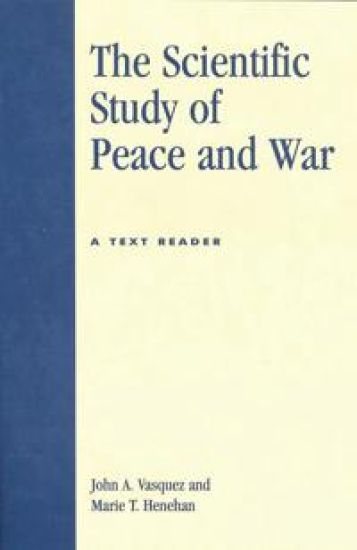
The Scientific Study of Peace and War

The Scientific Study of Peace and War

John A. Vasquez; Marie T. Henehan

Lexington Books
1999
pokkari
This widely used and acclaimed text reader brings together some of the best work on the onset of war, the expansion of war, the conditions of peace, and the termination and impact of war. Editorial commentary on the major findings and the statistical analysis used in each study teaches students how to read the article so that they can become literate in social science methods. A learning package in the appendix provides a programmed text to teach students how to interpret tables, read basic statistics, and conduct elementary data analysis. Correlates of War data on European countries is provided, and a methodological table of contents allows instructors to assign articles from the easiest (simple percentages) to the most advanced (time series and formal modeling).
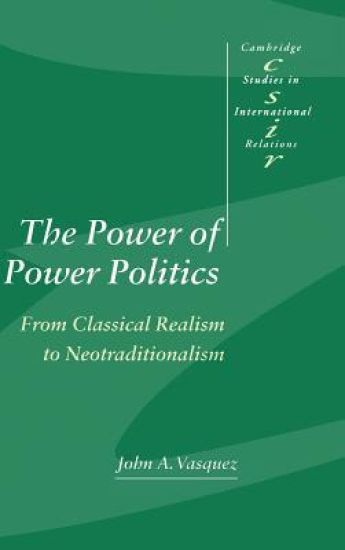
The Power of Power Politics

The Power of Power Politics

John A. Vasquez

Cambridge University Press
1999
sidottu
In this new and much-expanded edition of his classic study, John Vasquez examines the power of the power politics perspective to dominate inquiry, and evaluates its ability to provide accurate explanations of the fundamental forces underlying world politics. Part I of the book reprints the original 1983 text of The Power of Power Politics. It examines classical realism and quantitative international politics, providing an intellectual history of the discipline and an evaluation of statistical research guided by the realist paradigm. The second part provides six new chapters covering neorealism, post-modernism, the neotraditional research program on balancing, Mearsheimer’s analysis of multipolarity and institutionalism, the debate on the end of the Cold War, and neoliberalism. Through the use of comparative case studies these chapters analyse the extent to which the realist paradigm has been progressive (or degenerating), empirically accurate, and remains a relevant and explanatorily powerful theoretical approach for our current era.
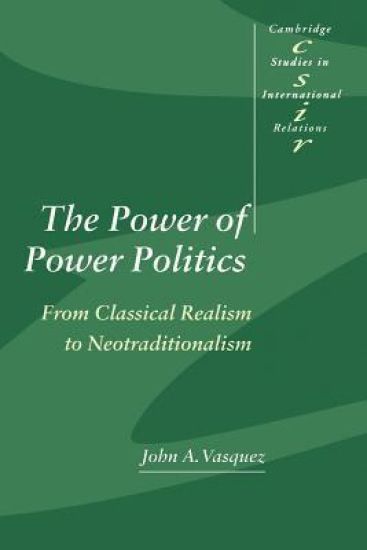
The Power of Power Politics

The Power of Power Politics

John A. Vasquez

Cambridge University Press
1999
pokkari
In this new and much-expanded edition of his classic study, John Vasquez examines the power of the power politics perspective to dominate inquiry, and evaluates its ability to provide accurate explanations of the fundamental forces underlying world politics. Part I of the book reprints the original 1983 text of The Power of Power Politics. It examines classical realism and quantitative international politics, providing an intellectual history of the discipline and an evaluation of statistical research guided by the realist paradigm. The second part provides six new chapters covering neorealism, post-modernism, the neotraditional research program on balancing, Mearsheimer’s analysis of multipolarity and institutionalism, the debate on the end of the Cold War, and neoliberalism. Through the use of comparative case studies these chapters analyse the extent to which the realist paradigm has been progressive (or degenerating), empirically accurate, and remains a relevant and explanatorily powerful theoretical approach for our current era.