

Kirjailija
John Abraham
Kirjat ja teokset yhdessä paikassa: 12 kirjaa, julkaisuja vuosilta 1995–2026, suosituimpiin kuuluu The Olive Trees Remember. Vertaile teosten hintoja ja tarkista saatavuus suomalaisista kirjakaupoista.
12 kirjaa
Kirjojen julkaisuvuodet: 1995–2026.
Controlling Pharmaceutical Risks is a case study of changes in drug testing since the late 1990s, specifically geneticization of carcinogenic risk assessment and regulation of pharmaceuticals. Radically new ways of determining whether medical drugs might cause cancer have been established world-wide since the turn of the century. At the heart of these transformations is the geneticization of drug testing and explanations for cancer induction. The most dramatic change in toxicology for over 30 years, geneticization is poised to revolutionize this life science by abolishing long-term animal testing. This situation has come about by a combination of technical and socio-political transmutations. At stake are issues fundamental to bio-science, medical treatment and patients’ health in wider society, such as what kind of knowledge is judged necessary to decide whether or not a drug is a carcinogen and when does a drug pose a significant carcinogenic risk to humans? Given that all new drugs, many with prospective world-wide markets, are potential carcinogens, this is an extremely important socio-political issue, but has been largely neglected in social science and indeed medicine. This is the first social science/policy book on the geneticization of international pharmaceutical testing and pharmaceutical toxicology. The book challenges the idea that the geneticization of carcinogenic risk assessment is simply a reflection of inevitable progress in laboratory science. Rather, a basic contention of this book is that such developments are framed and constituted by discursive and non-discursive practices, involving confluence of technical manipulations and socio-political accomplishments. The in-depth empirical research forms the basis for explaining the social shaping of carcinogenic risk assessment, the social meaning of its geneticization and the public health implications of the consequent ‘reduction’ in this regulatory science for society.

Not everyone is lucky when it comes to Love. Stephen was one such unlucky guy. He had always been rejected by every girl that came in his life. But fortune favours the bold. As if contrived by destiny, one evening Stephen met the beautiful and charming Clara. He knew her from his childhood but she was forgotten with the passage of time. Though much older to him, Clara was the person who saw right through his soul. She comforted him and always stood by his side. Stephen wanted to marry her but she was reluctant. She knew that society and their families would outcast them for such a decision. Amidst the social pressure, family chaos, and intense heat of the scorching desert, they shared their pains and sorrows, and it changed their lives forever

The post-modern society is longing for "freedom" and "liberty". Apparently, the law was not given until Moses. It was a lawless society and it grieved the heart of God. There was no knowledge of sin and the consequences of sin. God gave the law in the written form as "The Ten Commandments" through Moses. Although by conscious mankind knew what is good and what is evil. But they chose and continued to do evil in the sight of God. "God saw the wickedness of man was great in the earth and that every imagination of the thoughts of his heart was only evil continually." (Genesis 6:5) Bible defines 'sin' is transgression of the law. (1 John 3:4) Any transgression is punishable under law. Without the law no punishment could be executed. The normal physical death is not the punishment to sin. It is the wages of sin (Romans 6:23). It is appointed unto men once to die and after this the judgment (Hebrews 9:27). Death is not punishment to sin, but all transgressions are punishable under the law. Everyone must face judgment according to his deeds while he was living on The Great White Throne Judgment. Grace on the other hand, does not save you from physical death, but saves you from condemnation due to transgressions of the law. The law condemns you but grace saves you from condemnation due to your transgressions. Jesus the only begotten Son of God came into the world full of grace and truth (John 1:14) not to condemn the world but to save all those who believe in Him. (John 3:16-18). Therefore, now no condemnation to them who are in Christ Jesus, who walk not after the flesh, but after the Spirit. For the law of the Spirit of life in Christ Jesus has made me free from the law of sin and death. (Romans 8:1-2) Grace does not provide you freedom and liberty to continue to commit transgression of the law, nor living without the law. When we are under the grace, by obedience to the truth, believing in the finished work of Jesus Christ on the Cross of Calvary, we are saved from the condemnation of the transgression of the law and not from the final Great White Throne Judgment. Jesus Christ came not to destroy the law but to fulfill it (the requirement of the law for righteousness) (Romans 8:10) Christ is the end of the law for righteousness to everyone that believes (Romans 10:4). This book throws complete light and explanation on the teachings on The Doctrine of Law and Grace, which is needed in these days to identify the deceptive and seducing teachings out there.

Who Rules the World? God or Satan? The title may surprise many readers. The center theme is to clarify the real situation of the world today. There are a lot of questions that are unanswered. Even if anybody tries to answer them, it doesn't really satisfy the people. The best example could be the most commonly asked question, "Why are there so many sufferings if God is ruling the world and is in full control of the present situation of the world?" The real situation is whether God is trying to deliver people from the bondage of Satan or Satan is trying to take away people from God. If God is trying to deliver people from the rule of Satan, the question will be, "Is Satan greater than God?" The answer is a big no But then, how is Satan having an easy way in controlling mankind? If God is ruling mankind, is He allowing Satan to have his way in controlling the entire mankind? You can find answers to all such questions in this book. This book is the need of the hour.

This book elaborately covers all topics of swine management like breeding, feeding, housing, health management and pork production technology. The book is well supported by a large number of illustrations and tables which makes the understanding of the text very simple and easy. It will be very useful for all students as well as professionals. Note: T& F does not sell or distribute the Hardback in India, Pakistan, Nepal, Bhutan, Bangladesh and Sri Lanka.

First published in 1995. This book is concerned with how comprehensive schooling can act as a social system of class and gender differentiation. Based on a critical synthesis of feminist and sociological literature on secondary education, Abraham develops a theoretical and methodological framework for ethnographic research into the central gender and class dynamic of a comprehensive school.
How do drugs get to the market? What controls are there and what procedures for monitoring their effects? And how adequate are the regulators in protecting public health when new drugs have serious side effects? The Therapeutic Nightmare tells the story of the sleeping pill Halcion - a story which is far from over. First marketed in the 1970s, Halcion has been taken by millions of patients around the world. For many years it has been associated with serious adverse effects such as amnesia, hallucinations, aggression and, in extreme cases, homicide. Thirteen years after its first release, it was banned by the British government. It remains on sale in the United States and many other countries. This book explains why patients have come to be exposed to Halcion's risks and examines the corporate interests of the manufacturers, the professional interests of the scientists and medical researchers and the interests of patients in safe and effective medication. It reveals how these contending forces shape the regulatory decision-making process about drug safety. As the number of new drugs and health products grows, a major challenge facing regulators and the medical profession is how to put the interests of public health decisively and consistently above the commercial interests of the drugs industry, while becoming more accountable to patient and consumer organizations.
This Book explains and investigates how medicines are controlled in Europe, especially the EU. Based on penetrating documentary and interview research with the pharmaceutical industry, regulators and consumer organisations,it provides the first major critical examination of the new Europeanised systems of medicine regulation. The authors argue that the drive to produce and approve more drugs more quickly for a single European market dominates other considerations, such as improvements in democratic accountability, the independence of regulators and scientific expertise from commercial interests, and drug safety testing and surveillance.
How do drugs get to the market? What controls are there and what procedures for monitoring their effects? And how adequate are the regulators in protecting public health when new drugs have serious side effects? The Therapeutic Nightmare tells the story of the sleeping pill Halcion - a story which is far from over. First marketed in the 1970s, Halcion has been taken by millions of patients around the world. For many years it has been associated with serious adverse effects such as amnesia, hallucinations, aggression and, in extreme cases, homicide. Thirteen years after its first release, it was banned by the British government. It remains on sale in the United States and many other countries. This book explains why patients have come to be exposed to Halcion's risks and examines the corporate interests of the manufacturers, the professional interests of the scientists and medical researchers and the interests of patients in safe and effective medication. It reveals how these contending forces shape the regulatory decision-making process about drug safety. As the number of new drugs and health products grows, a major challenge facing regulators and the medical profession is how to put the interests of public health decisively and consistently above the commercial interests of the drugs industry, while becoming more accountable to patient and consumer organizations.
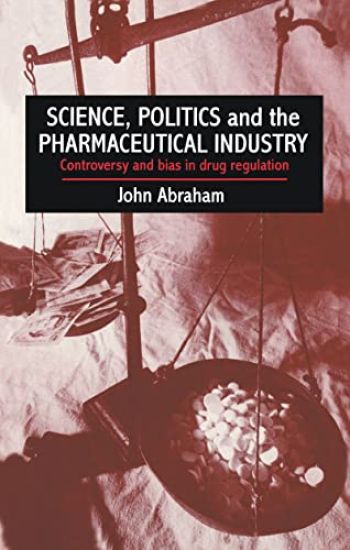
Science, Politics And The Pharmaceutical Industry
John Abraham; John Abraham University of Reading.
Routledge
1995
nidottu
Drug disasters from Thalidomide to Opren, and other less dramatic cases of drug injury, raise questions about whether the testing and control of medicines provides satisfactory protection for the public. In this revealing study, John Abrahan develops a theoretically challenging realist approach, in order to probe deeply into the work of scientists in the pharmaceutical industry and governmental drug regulatory authorities on both sides of the Atlantic. Through the examination of contemporary controversial case studies, he exposes how the commercial interest of drug manufacturers are consistently given the benefit of the scientific doubts about medicine safety and effectiveness, over and above the best interests of patients.; A highly original combination of philosophical rigour, historical sensitivity and empirical depth enables the "black box" of industrial and government science to be opened up to critical scrutiny much more than in previous social scientific study. All major aspects of drug testing and regulation are considered, including pre- clinical animal tests, clinical trials and postmarketing surveillance of adverse drug reactions. The author argues that drug regulators are too dependent on pharmaceutical industry resources and expertise, and too divorced from public accountability. The problem of corporate bias is particularly severe in the UK, where regulatory decisions about medicine safety are shrouded in greater secrecy than in the US.; Since the purpose of drug regulation should be to maximize the safety and effectiveness of medicines for patients, the public needs and deserves policies to counteract corporate bias in drug testing and evaluation. John Abraham's realist analysis provides a robust basis for policy interventions at the institutional and legislative levels. He proposes that corporate bias could be reduced by more extensive freedom of information, greater autonomy of government scientists from pharmaceutical industry, the development of independent drug testing by the regulatory authority, increased patient representation on regulatory committees, and more frequent and thorough oversight of regulatory performance by the legislature. This book should be of interest to anyone who cares about how medicines should be controlled in modern society. It should prove particularly rewarding for students and researchers in the sociology of science and technology, science and medicines policy, medical sociologists, the medical and pharmaceutical professions, and consumer organizations.

First published in 1995. This book is concerned with how comprehensive schooling can act as a social system of class and gender differentiation. Based on a critical synthesis of feminist and sociological literature on secondary education, Abraham develops a theoretical and methodological framework for ethnographic research into the central gender and class dynamic of a comprehensive school.