Kirjojen hintavertailu – 12 903 725 kirjaa ja 27 kauppaa

Kirjailija

John Agnew

Kirjat ja teokset yhdessä paikassa: 18 kirjaa, julkaisuja vuosilta 1987–2022, suosituimpiin kuuluu Globalization and Sovereignty. Vertaile teosten hintoja ja tarkista saatavuus suomalaisista kirjakaupoista.

18 kirjaa

Kirjojen julkaisuvuodet: 1987–2022.

Hidden Geopolitics

Hidden Geopolitics

John Agnew

BLOOMSBURY PUBLISHING PLC
2022
sidottu
Geopolitics is not dead, but nor does it involve the same old logic of a world determined by physical geography in a competition between Great Powers. Hidden Geopolitics recaptures the term to explore how the geography of power works both globally and nationally to structure and govern the workings of the global political economy. Globalization, far from its antithesis, is tightly wound up in the assumptions and practices of geopolitics, relating to the scope of regulatory authority, state sponsorship, and the political power of businesses to operate worldwide. Agnew shows how this “hidden” geopolitics and globalization have been vitally connected. He focuses on three moments: the origins of contemporary globalization in the policies pursued by successive US governments and allies after 1945 and its continued relevance even as the US role in the world changes; the close connection between geopolitical history and status of different countries and their relative capacities to exploit the possibilities and limit the costs of globalization; and new regulatory and standard-setting agencies which emerged under the sponsorship of major geopolitical powers but have grown in power and authority as the dominant states have become limited in their ability to manage the explosion of transnational transactions on their own. Agnew argues that it is time to move on from the narrow inter-imperial cast of geopolitics and the foolish policy advice it produces. The old perspective on geopolitics has taken on new life with the rise of national-populist movements in Europe and the United States and the reinvigoration of territorial-authoritarian regimes in Russia and China. Notwithstanding this trend, we must see the contemporary world through the lens of these complex, “hidden” geopolitical underpinnings that Agnew seeks to expose.
Hidden Geopolitics

Hidden Geopolitics

John Agnew

BLOOMSBURY PUBLISHING PLC
2022
nidottu
Geopolitics is not dead, but nor does it involve the same old logic of a world determined by physical geography in a competition between Great Powers. Hidden Geopolitics recaptures the term to explore how the geography of power works both globally and nationally to structure and govern the workings of the global political economy. Globalization, far from its antithesis, is tightly wound up in the assumptions and practices of geopolitics, relating to the scope of regulatory authority, state sponsorship, and the political power of businesses to operate worldwide. Agnew shows how this “hidden” geopolitics and globalization have been vitally connected. He focuses on three moments: the origins of contemporary globalization in the policies pursued by successive US governments and allies after 1945 and its continued relevance even as the US role in the world changes; the close connection between geopolitical history and status of different countries and their relative capacities to exploit the possibilities and limit the costs of globalization; and new regulatory and standard-setting agencies which emerged under the sponsorship of major geopolitical powers but have grown in power and authority as the dominant states have become limited in their ability to manage the explosion of transnational transactions on their own. Agnew argues that it is time to move on from the narrow inter-imperial cast of geopolitics and the foolish policy advice it produces. The old perspective on geopolitics has taken on new life with the rise of national-populist movements in Europe and the United States and the reinvigoration of territorial-authoritarian regimes in Russia and China. Notwithstanding this trend, we must see the contemporary world through the lens of these complex, “hidden” geopolitical underpinnings that Agnew seeks to expose.
Mapping Populism

Mapping Populism

John Agnew; Michael Shin

Rowman Littlefield
2019
nidottu
Brexit. Trump. LePen. The Five Star Movement. The recent success of populist movements and politicians is extraordinary, though the rise of populism is understandable in light of increasing political polarization, disappointing politicians, and exhausting election campaigns. With the future trajectory of democracy uncertain, two important questions remain unanswered. How did we get here? And why did we get here? Exploring how and why populism succeeded, John Agnew and Michael Shin consider the reasons for the Brexit vote, who voted—and who did not vote —for Donald Trump and Marine Le Pen, and the rise of an Italian populist government, Through comparative geographical analyses, the authors literally and figuratively map the rise of populism across the United Kingdom, the United States, France, and Italy. Geography tells us who the people are who have supported populism and the limits and possibilities of its claim to represent all of “the people,” wherever they are. Organized around recurring central themes of turnout, leadership, and media, and using compelling maps, their book encourages thought and discussion on an increasingly important topic—and on the future of democracy itself.
Mapping Populism

Mapping Populism

John Agnew; Michael Shin

Rowman Littlefield
2019
sidottu
Brexit. Trump. LePen. The Five Star Movement. The recent success of populist movements and politicians is extraordinary, though the rise of populism is understandable in light of increasing political polarization, disappointing politicians, and exhausting election campaigns. With the future trajectory of democracy uncertain, two important questions remain unanswered. How did we get here? And why did we get here? Exploring how and why populism succeeded, John Agnew and Michael Shin consider the reasons for the Brexit vote, who voted—and who did not vote —for Donald Trump and Marine Le Pen, and the rise of an Italian populist government, Through comparative geographical analyses, the authors literally and figuratively map the rise of populism across the United Kingdom, the United States, France, and Italy. Geography tells us who the people are who have supported populism and the limits and possibilities of its claim to represent all of “the people,” wherever they are. Organized around recurring central themes of turnout, leadership, and media, and using compelling maps, their book encourages thought and discussion on an increasingly important topic—and on the future of democracy itself.
Globalization and Sovereignty

Globalization and Sovereignty

John Agnew

Rowman Littlefield
2017
nidottu
This provocative and important text offers a new way of thinking about sovereignty, both past and present. Distinguished geographer John Agnew boldly challenges the widely popular story that state sovereignty is in worldwide eclipse in the face of the overwhelming processes of globalization. He argues that this perception relies on ideas about sovereignty and globalization that are both overstated and misleading. Agnew contends that sovereignty-state control and authority over space is not necessarily neatly contained in state-by-state territories, nor has it ever been so. Yet the dominant image of globalization is the replacement of a territorialized world by one of networks and flows that know no borders other than those that define the Earth itself. In challenging this image, Agnew first traces the ways in which it has become commonplace. He then develops a new way of thinking about the geography of effective sovereignty and the various geographical forms in which sovereignty actually operates in the world, offering an exciting intellectual framework that breaks with the either/or thinking of state sovereignty versus globalization.
Globalization and Sovereignty

Globalization and Sovereignty

John Agnew

Rowman Littlefield
2017
sidottu
This provocative and important text offers a new way of thinking about sovereignty, both past and present. Distinguished geographer John Agnew boldly challenges the widely popular story that state sovereignty is in worldwide eclipse in the face of the overwhelming processes of globalization. He argues that this perception relies on ideas about sovereignty and globalization that are both overstated and misleading. Agnew contends that sovereignty-state control and authority over space is not necessarily neatly contained in state-by-state territories, nor has it ever been so. Yet the dominant image of globalization is the replacement of a territorialized world by one of networks and flows that know no borders other than those that define the Earth itself. In challenging this image, Agnew first traces the ways in which it has become commonplace. He then develops a new way of thinking about the geography of effective sovereignty and the various geographical forms in which sovereignty actually operates in the world, offering an exciting intellectual framework that breaks with the either/or thinking of state sovereignty versus globalization.
Mastering Space

Mastering Space

John Agnew; Stuart Crobridge

Routledge
2016
sidottu
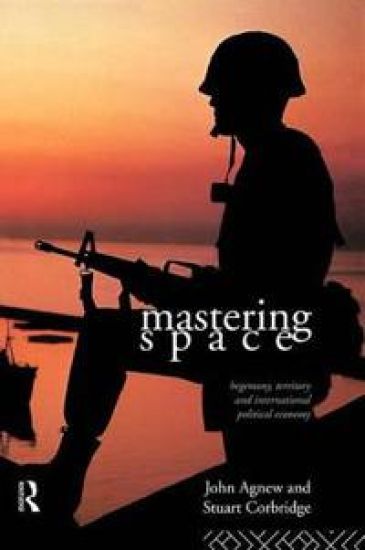
For over two hundred years the domination of some countries by others has been intrinsic to international relations, with national economic and political strength viewed as essential to a nation's survival and global position. Mastering Space identifies the essential features of this "state-centredness" and suggests an optimistic alternative more in keeping with the contemporary post-Cold War climate. Drawing on recent geopolitical thinking, the authors claim that the dynamism of the international political economy has been obscured through excessive attention on the state as an unchanging actor. Dealing with such topical issues as Japan's rise to economic dominance and America's perceived decline, as well as the global impact of continued geographical change, the book discusses the role of geographical organization in the global political economy, and the impact of increasing economic globalisation and political fragmentation in future international relations. The authors identify the present time as crucial to the global political economy, and explore the possibilities of moving the world from mastering space to real reciprocity between peoples and places. John Agnew is a Professor of Geography at the Maxwell School of Citizenship and Public Affairs, Syracuse University. Stuart Corbridge is a lecturer in Geography at the University of Cambridge and a Fellow of Sidney Sussex College.
The Geography of the World Economy

The Geography of the World Economy

Paul Knox; John Agnew; Linda Mccarthy

Routledge
2014
sidottu
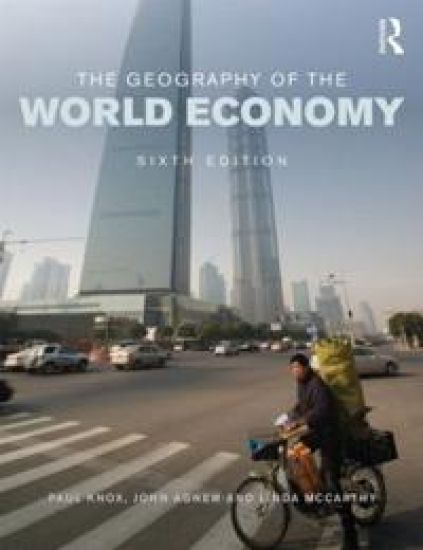
The Geography of the World Economy provides an in-depth and stimulating introduction to the globalization of the world economy. The book offers a consideration of local, regional, national and global economic development over the long historical term. The theory and practice of economic and political geography provide a basis for understanding the interactions within and among the developed and developing countries of the world. Illustrated in color throughout, this new edition has been completely reworked and updated to take account of recent significant changes in the world economy. A new companion website also accompanies the book, with additional resources for each chapter including multiple choice and short essay questions and links to relevant websites. Figures and tables are also available for download located at www.routledge.com/cw/knoxThe text is signposted throughout with an glossary of key terms, and is richly illustrated with full-color maps, diagrams and illustrations. It is ideal for upper level university undergraduates and for post-graduates in a variety of specializations including geography, economics, political science, international relations and global studies.
The Geography of the World Economy

The Geography of the World Economy

Paul Knox; John Agnew; Linda Mccarthy

Routledge
2014
nidottu
The Geography of the World Economy provides an in-depth and stimulating introduction to the globalization of the world economy. The book offers a consideration of local, regional, national and global economic development over the long historical term. The theory and practice of economic and political geography provide a basis for understanding the interactions within and among the developed and developing countries of the world. Illustrated in color throughout, this new edition has been completely reworked and updated to take account of recent significant changes in the world economy. A new companion website also accompanies the book, with additional resources for each chapter including multiple choice and short essay questions and links to relevant websites. Figures and tables are also available for download located at www.routledge.com/cw/knoxThe text is signposted throughout with an glossary of key terms, and is richly illustrated with full-color maps, diagrams and illustrations. It is ideal for upper level university undergraduates and for post-graduates in a variety of specializations including geography, economics, political science, international relations and global studies.
Making Political Geography

Making Political Geography

John Agnew; Luca Muscarà

Rowman Littlefield
2012
nidottu
Dating from its inception in the late nineteenth century, political geography as a field has been heavily influenced by global events of the time. Thus, rather than trying to impose a single “fashionable” theory, leading geographers John Agnew and Luca Muscarà consider the underlying role of changing geopolitical context as their framework for understanding the evolution of the discipline. The authors trace the development of key thinkers and theories during three distinct periods—1875–1945, the Cold War, and the post–Cold War—emphasizing the ongoing struggle between theoretical “monism” and “pluralism,” or one path to knowledge versus many. The world has undergone dramatic shifts since the book’s first publication in 2002, and this thoroughly revised and updated second edition focuses especially on reinterpretations of the post–Cold War period. Agnew and Muscarà explore the renewed questioning of international borders, the emergence of the Middle East and displacement of Europe as the center of global geopolitics, the rise of China and other new powers, the reappearance of environmental issues, and the development of critical geopolitics. With its deeply knowledgeable and balanced history and overview of the field, this concise work will be a valuable and flexible text for all courses in political geography.
Making Political Geography

Making Political Geography

John Agnew; Luca Muscarà

Rowman Littlefield
2012
sidottu
Dating from its inception in the late nineteenth century, political geography as a field has been heavily influenced by global events of the time. Thus, rather than trying to impose a single “fashionable” theory, leading geographers John Agnew and Luca Muscarà consider the underlying role of changing geopolitical context as their framework for understanding the evolution of the discipline. The authors trace the development of key thinkers and theories during three distinct periods—1875–1945, the Cold War, and the post–Cold War—emphasizing the ongoing struggle between theoretical “monism” and “pluralism,” or one path to knowledge versus many. The world has undergone dramatic shifts since the book’s first publication in 2002, and this thoroughly revised and updated second edition focuses especially on reinterpretations of the post–Cold War period. Agnew and Muscarà explore the renewed questioning of international borders, the emergence of the Middle East and displacement of Europe as the center of global geopolitics, the rise of China and other new powers, the reappearance of environmental issues, and the development of critical geopolitics. With its deeply knowledgeable and balanced history and overview of the field, this concise work will be a valuable and flexible text for all courses in political geography.
Hegemony

Hegemony

John Agnew

Temple University Press,U.S.
2005
pokkari
Hegemony tells the story of the drive to create consumer capitalism abroad through political pressure and the promise of goods for mass consumption. In contrast to the recent literature on America as empire, it explains that the primary goal of the foreign and economic policies of the United States is a world which increasingly reflects the American way of doing business, not the formation or management of an empire. Contextualizing both the Iraq war and recent plant closings in the U. S., noted author John Agnew shows how American hegemony has created a world in which power is no longer only shaped territorially. He argues in a sobering conclusion that we are consequently entering a new era of global power, one in which the world the US has made no longer works to its singular advantage.
Hegemony

Hegemony

John Agnew

Temple University Press,U.S.
2005
sidottu
Hegemony tells the story of the drive to create consumer capitalism abroad through political pressure and the promise of goods for mass consumption. In contrast to the recent literature on America as empire, it explains that the primary goal of the foreign and economic policies of the United States is a world which increasingly reflects the American way of doing business, not the formation or management of an empire. Contextualizing both the Iraq war and recent plant closings in the U. S., noted author John Agnew shows how American hegemony has created a world in which power is no longer only shaped territorially. He argues in a sobering conclusion that we are consequently entering a new era of global power, one in which the world the US has made no longer works to its singular advantage.
Geopolitics

Geopolitics

John Agnew

Routledge
2003
nidottu
Despite challenges to its domination, the way modern-world politics is conducted is structured by a set of understandings dating back to the rise of the European powers. Here, John Agnew systematically explores how Europeans in a position of global power imposed their ways and views on others through visualizing the world as a whole, defining world regions as modern or backward, seeing the nation statehood as the highest and best form of political organization, and viewing world politics as the outcome of the pursuit of primacy by competing states. Exploring the elements of geographical imagination and how they have come together in different historical and modern epochs, this updated new edition examines:the implications of recent world events such as September 11th continued expansion of the EU and NATOthe near bankruptcy and failure of various statesthe re-ignition of the Israeli-Palestine conflict. Providing a lucid analysis of how world politics has come to be practised in its present form, Agnew identifies and argues for an alternative, given the costs visited on the world in twentieth century by the practice of the modern geographical imagination.
Geopolitics

Geopolitics

John Agnew

Routledge
2003
sidottu
Despite challenges to its domination, the way modern-world politics is conducted is structured by a set of understandings dating back to the rise of the European powers. Here, John Agnew systematically explores how Europeans in a position of global power imposed their ways and views on others through visualiZing the world as a whole, defining world regions as modern or backward, seeing the nation statehood as the highest and best form of political organization, and viewing world politics as the outcome of the pursuit of primacy by competing states. Exploring the elements of geographical imagination and how they have come together in different historical and modern epochs, this updated new edition examines:the implications of recent world events such as September 11thcontinued expansion of the EU and NATOthe near bankruptcy and failure of various statesthe re-ignition of the Israeli-Palestine conflict. Providing a lucid analysis of how world politics has come to be practised in its present form, Agnew identifies and argues for an alternative, given the costs visited on the world in twentieth century by the practice of the modern geographical imagination.
Mastering Space

Mastering Space

John Agnew; Stuart Crobridge

Routledge
1995
nidottu
For over two hundred years the domination of some countries by others has been intrinsic to international relations, with national economic and political strength viewed as essential to a nation's survival and global position. Mastering Space identifies the essential features of this "state-centredness" and suggests an optimistic alternative more in keeping with the contemporary post-Cold War climate. Drawing on recent geopolitical thinking, the authors claim that the dynamism of the international political economy has been obscured through excessive attention on the state as an unchanging actor. Dealing with such topical issues as Japan's rise to economic dominance and America's perceived decline, as well as the global impact of continued geographical change, the book discusses the role of geographical organization in the global political economy, and the impact of increasing economic globalisation and political fragmentation in future international relations. The authors identify the present time as crucial to the global political economy, and explore the possibilities of moving the world from mastering space to real reciprocity between peoples and places. John Agnew is a Professor of Geography at the Maxwell School of Citizenship and Public Affairs, Syracuse University. Stuart Corbridge is a lecturer in Geography at the University of Cambridge and a Fellow of Sidney Sussex College.
The United States in the World-Economy

The United States in the World-Economy

John Agnew

Cambridge University Press
1987
pokkari
First published in 1987, The United States in the World-Economy is a major textbook survey of the rise of the United States within the world-economy and the causes of its relative decline. With the USA being the dominant state in the contemporary world-economy, it is vital to understand how it got to where it is and how it responds to global economic crises. Professor Agnew emphasises the divergent experiences of different regions within the USA and in so doing provides a significant 'new' regional geography, tracing the historical evolution of the world-economy and assessing the contemporary impact of the world-economy upon and within it. No treatment prior to this work covered the subject with equivalent breadth and theoretical acuity and the guiding politico-economic framework provides a coherent radical perspective within which the author undertakes specific regional and historical analysis. The United States in the World-Economy will prove required reading for numerous courses in regional geography, area studies and the geography of the United States.
The United States in the World-Economy

The United States in the World-Economy

John Agnew

Cambridge University Press
1987
sidottu
First published in 1987, The United States in the World-Economy is a major textbook survey of the rise of the United States within the world-economy and the causes of its relative decline. With the USA being the dominant state in the contemporary world-economy, it is vital to understand how it got to where it is and how it responds to global economic crises. Professor Agnew emphasises the divergent experiences of different regions within the USA and in so doing provides a significant 'new' regional geography, tracing the historical evolution of the world-economy and assessing the contemporary impact of the world-economy upon and within it. No treatment prior to this work covered the subject with equivalent breadth and theoretical acuity and the guiding politico-economic framework provides a coherent radical perspective within which the author undertakes specific regional and historical analysis. The United States in the World-Economy will prove required reading for numerous courses in regional geography, area studies and the geography of the United States.