Kirjojen hintavertailu – 12 903 725 kirjaa ja 27 kauppaa

Kirjailija

John B. Taylor

Kirjat ja teokset yhdessä paikassa: 13 kirjaa, julkaisuja vuosilta 2008–2022, suosituimpiin kuuluu Job with Room and Board. Vertaile teosten hintoja ja tarkista saatavuus suomalaisista kirjakaupoista.

13 kirjaa

Kirjojen julkaisuvuodet: 2008–2022.

Psiquiatría de bolsillo

Psiquiatría de bolsillo

Judith Puckett; John B. Taylor; Scott R. Beach

LWW
2022
pokkari
Psiquiatría de bolsillo es una referencia desarrollada por residentes de psiquiatría y dirigida a médicos residentes de otras especialidades, a estudiantes de medicina y a profesionales de la salud que busquen profundizar sus conocimientos sobre el diagnóstico y el abordaje terapéutico de los trastornos y enfermedades mentales más comunes. Su contenido hace énfasis en la atención psiquiátrica basada en evidencia, desde el encuentro inicial con el paciente y su entrevista, hasta su diagnóstico y plan de tratamiento. Esta primera edición basa su contenido en la evidencia más reciente sobre farmacología, psicoterapias y terapias somáticas para los trastornos más comunes que enfrenta el médico psiquiatra. Incluye aspectos de atención del paciente que a menudo son específicos para el psiquiatra, sin olvidar las situaciones en las que interactúa directamente con el ámbito del sistema legal, como las evaluaciones de imputabilidad y aptitud.
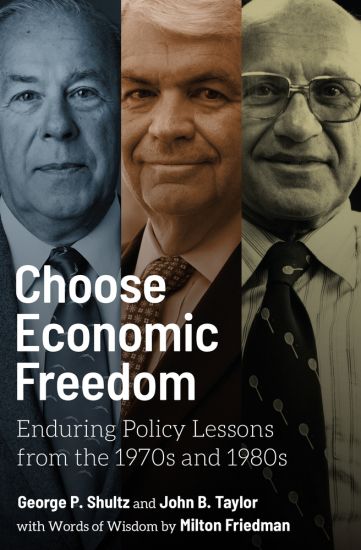
Choose Economic Freedom

Choose Economic Freedom

George P. Shultz; John B. Taylor

Hoover Institution Press,U.S.
2020
sidottu
What are the keys to good economic policy? George P. Shultz and John B. Taylor draw from their several decades of experience at the forefront of national economic policy making to show how market fundamentals beat politically popular government interventions—be they from Democrats or Republicans—as a recipe for success. Choose Economic Freedom reconstructs debates from the 1960s and 1970s about the use of wage and price controls as tools of policy, showing how brilliant economists can hold diametrically opposed views about the wisdom of using government intervention to spur the economy. Speeches and documents from the era include a recently unearthed memo from Arthur Burns, Federal Reserve chair, in 1971, in which he argues in favor of controls. Under Burns's guidance and in the face of stubborn inflation, Nixon introduced wage and price guidelines and freezes. But over the long run, these became a drag on the economy and ultimately failed. It wasn't until the Reagan administration that these controls were reversed, resulting in a vibrant economy. The words of iconic economist Milton Friedman—whose "free to choose" ethos inspired the free-market revolution of the Reagan era—along with lessons Shultz and Taylor learned from the front lines, demonstrate that tried-and-true economic policy works.
Pocket Psychiatry

Pocket Psychiatry

John B. Taylor; Judith Puckett; Scott R. Beach

Wolters Kluwer Health
2019
kierre
Pocket Psychiatry, a new addition to the Pocket Notebook series, is written by residents for residents. A resource for essential information, in a high-yield, easy-to-use format, designed to help students, trainees, and others navigate the initial psychiatric evaluation and management of the most commonly encountered psychiatric conditions. With an emphasis on evidence-based information, Pocket Psychiatry, provides a rare concise and accessible resource, for must-know information on hospital- and clinic-based psychiatric care — from history and physical exam to differential diagnosis testing to therapeutics — in the well known loose leaf pocket size format. Bulleted lists, tables, diagrams, and algorithms make essential facts easy to find and retain. Progress logically from symptoms to differential diagnosis, workup and diagnosis, assessment of risks and benefits of available treatments, to treatment and prognosis. Review of the highest impact trials and literature guiding psychiatric care. Covers all major psychiatric diagnosis, plus management of psychiatric emergencies, the intersection of the legal system and psychiatry, and addition of quick reference for the most commonly used medications in psychiatric management. Written by psychiatry and medicine residents from the Harvard University, and edited by senior faculty. Enrich Your eBook Reading ExperienceRead directly on your preferred device(s), such as computer, tablet, or smartphone. Easily convert to audiobook, powering your content with natural language text-to-speech.
Reform of the International Monetary System
An argument that a rules-based reform of the international monetary system, achieved by applying basic economic theory, would improve economic performance. In this book, the economist John Taylor argues that the apparent correlation of monetary policy decisions among different countries-largely the result of countries' concerns about the exchange rate-causes monetary policy to deviate from effective policies that stabilize inflation and the economy. He argues that a rules-based reform of the international monetary system, achieved by applying basic economic theory, would improve economic performance. Taylor shows that monetary polices in recent years have been deployed either defensively, as central banks counteract forces from abroad that affect the exchange rate, or offensively, as central banks attempt to move the exchange rate to gain a competitive advantage. Focusing on the years from 2005 to 2017, he develops an empirical framework to examine two monetary policy instruments: the policy interest rate (the more conventional of the two) and the size of the balance sheet. He finds that an international contagion in central bank decisions about the policy interest rate has accentuated the deviation from standard interest rate rules that have worked in the past. He finds a similar contagion in decisions about the size of the balance sheet. By considering a counterfactual policy in the estimated model, Taylor is able to estimate by how much the policy of recent years has increased exchange rate volatility. After several rounds of monetary actions and reactions aimed at exchange rates, Taylor finds, the international monetary system is left with roughly the same interest rate configuration, but much larger balance sheets to unwind.
Rules for International Monetary Stability

Rules for International Monetary Stability

Michael D. Bordo; John B. Taylor

Hoover Institution Press,U.S.
2017
sidottu
Since the end of the Great Recession in 2009 the central banks of the advanced countries have taken unprecedented actions to reflate and stimulate their economies. There have been significant differences in the timing and pace of these actions. These independent monetary policy actions have had significant spillover effects on the economies and monetary policy strategies of other advanced countries. In addition the monetary policy actions and interventions of the advanced countries have had a significant impact on the emerging market economies leading to the charge of 'currency wars.' The perceived negative consequences of spillovers from the actions of national central banks has led to calls for international monetary policy coordination. The arguments for coordination based on game theory are the same today as back in the 1980s, which led to accords which required that participant countries follow policies to improve global welfare at the expense of domestic fundamentals. This led to disastrous consequences. An alternative approach to the international spillovers of national monetary policy actions is to view them as deviations from rules based monetary policy. In this view a return to rules based monetary policy and a rolling back of the "" global great deviation"" by each country's central bank would lead to a beneficial policy outcome without the need for explicit policy coordination. In this book we report the results from a recent conference which brought together academics, market participants, and policy makers to focus on these issues. The consensus of much of the conference was on the need for a classic rules based reform of the international monetary system.
Policy Stability and Economic Growth

Policy Stability and Economic Growth

John B. Taylor

Institute of Economic Affairs
2016
nidottu
John Taylor is one of the foremost economists of our generation. His ideas were implemented in central banks across the world during the period of price stability, economic growth and financial stability that followed the 1980s. This period culminated in the financial crisis of 2008 which was followed by a very slow recovery which, seven years on, can hardly be said to be complete. This book presents Taylor's view of the financial crisis and its aftermath. Taylor argues that deviating from strict policy rules, both before and since the crisis, contributed to the events of 2008-13 and, especially, the very slow recovery in national income after the financial crisis. Furthermore, in other areas of government activity, such as regulation and law-making more generally, instability is being created, which is very bad for the economy.
Job with Room and Board

Job with Room and Board

John B. Taylor

Mountain Press
2015
nidottu
In 1907 at the age of eighteen, John B. Taylor took a summer job with the US Forest Service�mapping the wilderness and cruising the timber in the as-yet-unroaded Swan Valley in Montana. The job came with room and board�over a million acres of room and plenty of grouse to supplement the salted pork and hard crackers they brought with them. During the school year in his hometown of Missoula, he studied classics at the university, but after witnessing the brutal exploitation of timber along the Blackfoot River, he decided that �live trees beat dead languages.� He headed to the University of Michigan School of Forestry and obtained degrees in botany and forestry. After a stint in the US Army in World War I, he worked his way up through the Forest Service ranks, serving as ranger, range examiner, timberman, forest supervisor, and assistant regional forester in charge of personnel. His colorful stories portray life during the early days of the Forest Service, when travel was by horse and rangers carried guns. His day-to-day jobs included fighting fires, rounding up wild horses, disposing of moonshine stills on national forest land near Butte during Prohibition, and hiring down-and-out men for the CCC during the Depression. Taylor recorded his memories in the late 1960s, and family friend and author John C. Frohlicher transcribed the tapes and edited the manuscript. Says Frohlicher, �Too many men who spent their lives taming the wilderness are remembered only by a name on a little western creek.� Through these stories, John B. Taylor, 1889�1975, will be remembered for much, much more.
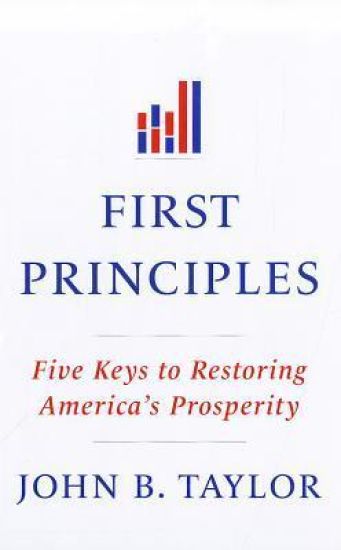
First Principles

First Principles

John B. Taylor

WW Norton Co
2013
nidottu
Mired in a crippling economic slump and hamstrung by partisan political debates, America faces substantial economic challenges, from widespread unemployment to the government’s ballooning debt. These assaults on our prosperity reflect the unintended consequences of more than a decade of government intervention in virtually all areas of the economy. Stanford University economist John B. Taylor proposes a natural and reasonable solution to our economic challenges: return to the country’s founding principles—limited government, rule of law, strong incentives, reliance on markets, a predictable policy framework—and rekindle its economic dynamism.
First Principles

First Principles

John B. Taylor

WW Norton Co
2012
sidottu
America’s economic future is uncertain. Mired in a long crippling economic slump and hamstrung by bitter partisan debate over the growing debt and the role of government, the nation faces substantial challenges, exacerbated by a dearth of vision and common sense among its leaders. Prominent Stanford economist John B. Taylor brings his steady voice of reason to the discussion with a natural solution: start with the country’s founding principles of economic and political freedom—limited government, rule of law, strong incentives, reliance on markets, a predictable policy framework—and reconstruct its economic foundation from these proven principles. Channeling his high-level experience as both a policymaker and researcher, Taylor then zeroes in on current policy issues—the budget, monetary policy, government regulation, tax reform—and lays out in simple terms bold strategies designed to place the country on sound footing in each of these areas.
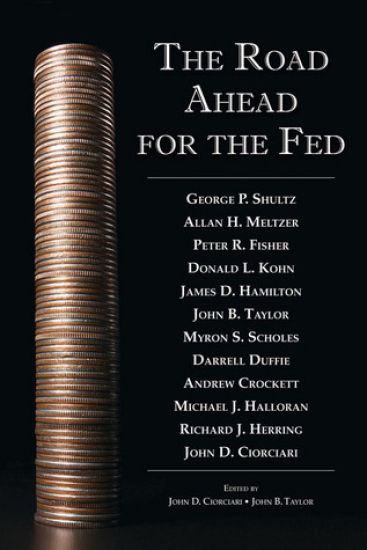
The Road Ahead for the Fed

The Road Ahead for the Fed

John D. Ciorciari; John B. Taylor

Hoover Institution Press,U.S.
2009
sidottu
Expert contributors examine the recent actions of the Federal Reserve and suggest directions for the Fed going forward by drawing on past political, historical, and market principles. They explain how the Fed arrived at its current position, offer ideas on how to exit the situation, and propose new market-based reforms that can help keep the Fed on the road to good monetary policy in the future.
Ezekiel

Ezekiel

John B. Taylor

INTERVARSITY PRESS
2009
nidottu
John Taylor writes, "For most Bible readers Ezekiel is almost a closed book... Their knowledge of him extends little further than his mysterious vision of God's chariot-throne, with its wheels within wheels, and the vision of the valley of dry bones." However, the structure of Ezekiel is simple and orderly, and that makes it easy to analyze for modern readers.
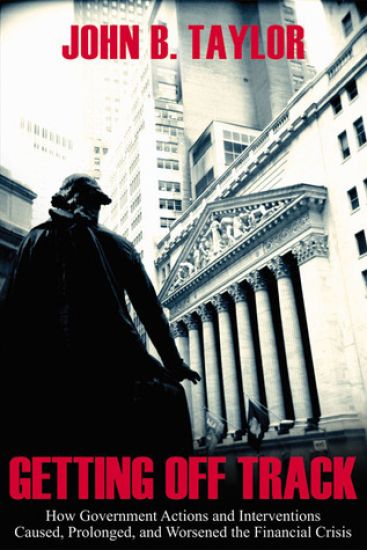
Getting Off Track

Getting Off Track

John B. Taylor

Hoover Institution Press,U.S.
2009
sidottu
Throughout history, financial crises have always been caused by excesses - frequently monetary excesses - which lead to a boom and an inevitable bust. In our current crisis it was a housing boom and bust that in turn led to financial turmoil in the United States and other countries. How did everything deteriorate so suddenly and dramatically? In Getting Off Track: How Government Actions and Interventions Caused, Prolonged, and Worsened the Financial Crisis, Hoover fellow and Stanford economist John B. Taylor offers empirical research to explain what caused the current financial crisis, what prolonged it, and what worsened it dramatically more than a year after it began. The author tells how unusually easy monetary policy helped set the crisis in motion, as interest rates at the Federal Reserve and several other central banks deviated from historical regularities. He explains monetary interaction with the subprime mortgage problem, showing how the use of these mortgages, especially the adjustable-rate variety, led to excessive risk taking. In the United States this was encouraged by government programs designed to promote home ownership, a worthwhile goal but overdone in retrospect. Looking ahead, the author suggests a set of principles to follow to prevent misguided actions and interventions in the future.
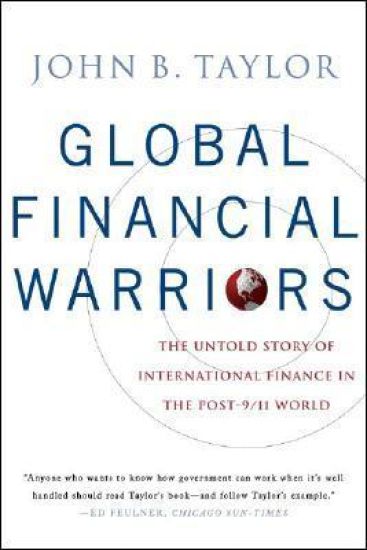
Global Financial Warriors

Global Financial Warriors

John B. Taylor

WW Norton Co
2008
nidottu
Sworn in as head of the U. S. Treasury Department’s international finance division just three months prior to 9/11, John B. Taylor soon found himself at the center of the war on terror. Global Financial Warriors takes you inside the White House Situation Room, to the meetings of the G7 finance ministers, and to cities worldwide as Taylor assembles a coalition to freeze terrorist assets, plans the financial reconstruction in Afghanistan, oversees the development of a new currency in Iraq, and deals with the spread of financial crises. From reforming the IMF and the World Bank to negotiating international agreements to reduce Iraq’s debt by 80 percent and cancel the debt of very poor countries, Taylor’s unparalleled access offers the reader an insider’s account of a pivotal time in international finance.