Kirjojen hintavertailu – 12 903 724 kirjaa ja 27 kauppaa

Kirjailija

John Barrell

Kirjat ja teokset yhdessä paikassa: 18 kirjaa, julkaisuja vuosilta 1991–2025, suosituimpiin kuuluu Trials for Treason and Sedition, 1792-1794, Part I Vol 2. Vertaile teosten hintoja ja tarkista saatavuus suomalaisista kirjakaupoista.

18 kirjaa

Kirjojen julkaisuvuodet: 1991–2025.

English Literature in History

English Literature in History

John Barrell

TAYLOR FRANCIS LTD
2025
sidottu
In eighteenth-century Britain, the study of history was understood first and foremost as the study of how states developed—and lost—their political coherence. But at the same time, writers, preoccupied by contemporary social change, were coming to believe that economic progress was largely dependent on an ever-increasing variety of trades and occupations. Could this highly differentiated society still be understood as ‘unified’, and if so, by whom? Dr Barrell argues that these questions were of central importance not only to historians and social philosophers, but also to poets, novelists, essayists, and even writers of grammar and dictionaries. First published in 1983, English Literature in History examines how, in response to these questions, an economic theory of society was developed out of an earlier political view of society as an area of conflicting interests which could be regulated by disinterested statesmen and gentlemen. It shows how this new economic theory was perceived as a threat to the function and status of the gentleman, whose character had to be redefined if his authority was to be legitimated. Some of the ways in which this was achieved are traced in detailed analysis of the poetry of James Thomson and John Dyer, and in the novels of Tobias Smollett. A central chapter, focusing on Johnson’s Dictionary, demonstrates how notions of ‘correct’ English were used to confirm the status of the gentleman and to reinforce the authority of the ruling class.

Edward Pugh of Ruthin 1763-1813

Edward Pugh of Ruthin 1763-1813

John Barrell

University of Wales Press
2013
nidottu
Edward Pugh (1763-1813) was a Ruthin-born, Welsh-speaking artist and writer who produced compelling landscapes images of Denbighshire in particular and, more widely of North Wales, Monmouthshire and London. He also wrote what is probably the best account of a tour in Wales ever written: it is far superior to Borrow's. This book, the first to consider Pugh's work in detail, shows how his landscapes reveal a wealth of local knowledge, and dramatise some issues of great importance to Wales in his time: the effects of the enclosure of common land; the effects of the war with France on industry and the condition of the poor; the need to develop and modernise the Welsh economy; the power of the great landowners. Apart from Pugh's, almost all the pictures and tours we have of late eighteenth and early nineteenth century North Wales were made by English artists and writers. None of these can tell us about life in North Wales with the same insight as Pugh.
Edward Pugh of Ruthin 1763-1813

Edward Pugh of Ruthin 1763-1813

John Barrell

University of Wales Press
2013
sidottu
Edward Pugh (1763-1813) was a Ruthin-born, Welsh-speaking artist and writer who produced compelling landscapes images of Denbighshire in particular and, more widely of North Wales, Monmouthshire and London. He also wrote what is probably the best account of a tour in Wales ever written: it is far superior to Borrow's. This book, the first to consider Pugh's work in detail, shows how his landscapes reveal a wealth of local knowledge, and dramatise some issues of great importance to Wales in his time: the effects of the enclosure of common land; the effects of the war with France on industry and the condition of the poor; the need to develop and modernise the Welsh economy; the power of the great landowners. Apart from Pugh's, almost all the pictures and tours we have of late eighteenth and early nineteenth century North Wales were made by English artists and writers. None of these can tell us about life in North Wales with the same insight as Pugh.
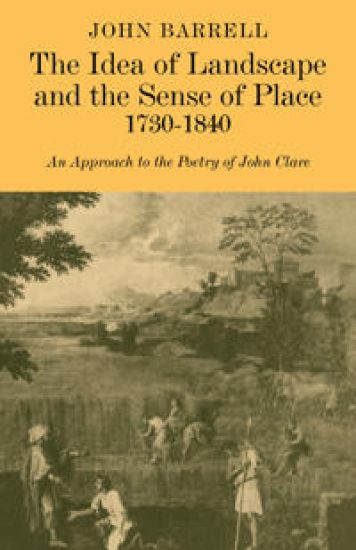
The Idea of Landscape and the Sense of Place 1730–1840

The Idea of Landscape and the Sense of Place 1730–1840

John Barrell

Cambridge University Press
2011
pokkari
It is generally agreed that in the early eighteenth century people began to be interested in landscape as something to have a 'taste' for; that they saw landscape through the eyes of the great painters, and that later pictures, poetry and landscape gardening all reflect that taste. Dr Barrell examines this interest, showing how the taste for landscape affected the poetry in detail. John Clare, who lived most of his life in rural Northamptonshire, whose landscape was being transformed by enclosure, is then taken as the focus of these different attitudes. Clare's truthfulness to the individual locality he wanted to describe would not permit him to use the conventional literary language of his predecessors, and he had instead to find his own language. His success in doing this removed him from mainstream English poetry. This 1972 text brings 'taste' into contact with the social and economic bases of life.
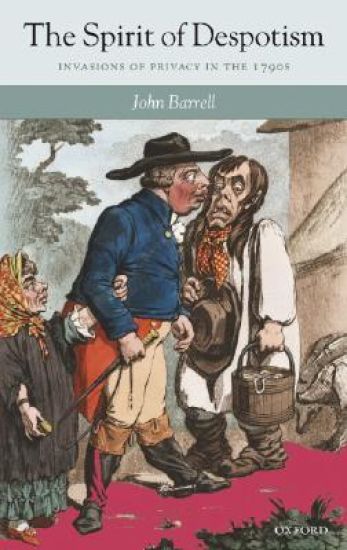
The Spirit of Despotism

The Spirit of Despotism

John Barrell

Oxford University Press
2006
sidottu
How was the social and cultural life of Britain affected by the fear that the French Revolution would spread across the channel? In this brilliant, engagingly written, and profusely illustrated book, John Barrell, well-known for his studies of the history, literature, and art of the period, argues that the conflict between the ancien regime in Britain and the emerging democratic movement was so fundamental that it could not be contained within what had previously been thought of as the 'normal' arena of politics. Activities and spaces which had previously been regarded as 'outside' politics suddenly no longer seemed to be so, and the fear of revolution produced a culture of surveillance and suspicion which penetrated every aspect of private life. Drawing on an unusually wide range of sources, including novels, poems, plays, newspapers, debates in parliament, trials, political pamphlets, and caricatures, The Spirit of Despotism focuses on a number of examples of such invasions of privacy. It shows how the culture of suspicion affected how people spoke and behaved in London coffee-houses; how it influenced attitudes to the king's behaviour in private, especially during his summer holidays in Weymouth; how it infiltrated the country cottage, previously idealized as a protected haven of peace and retirement from political life; and how it influenced the fashion of the period, so that even the way people chose to style their hair came to be seen as a political issue.
Imagining the King's Death

Imagining the King's Death

John Barrell

Oxford University Press
2000
sidottu
It is high treason in British law to 'imagine' the king's death. But after the execution of Louis XVI in 1793, everyone in Britain must have found themselves imagining that the same fate might befall George III. How easy was it to distinguish between fantasising about the death of George and 'imagining' it, in the legal sense of 'intending' or 'designing'? John Barrell examines this question in the context of the political trials of the mid-1790s and the controversies they generated. He shows how the law of treason was adapted in the years following Louis's death to punish what was acknowledged to be a 'modern' form of treason unheard of when the law had been framed. The result, he argues, was the invention of a new, an imaginary, a 'figurative' treason, by which the question of who was imagining the king's death, the supposed traitors or those who charged them with treason, became inescapable.
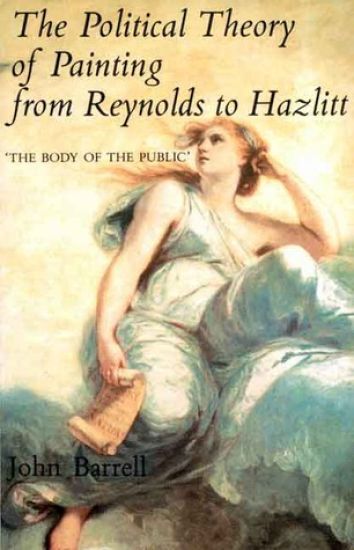
The Political Theory of Painting from Reynolds to Hazlitt
What is the function of painting in a commercial society? John Barrell discusses how British artists and writers of the late eighteenth and early nineteenth centuries, including Sir Joshua Reynolds, William Blake, and James Barry attempted to answer this question. His provocative and illuminating book offers a new perspective on both art criticism and eighteenth-century British culture.
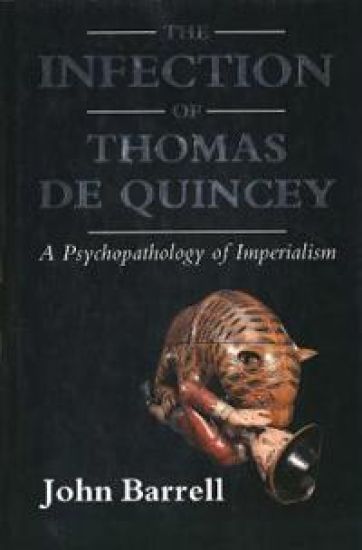
The Infection of Thomas De Quincey

The Infection of Thomas De Quincey

John Barrell

Yale University Press
1991
sidottu
Thomas De Quincey, best known for his book Confessions of an English Opium Eater, was a journalist and propagandist of Empire, of oriental aggression, and of racial paranoia. The greater part of the fourteen volumes of his collected writings concerns the history, the colonial development, and increasingly the threat presented by the Orient in all its manifestations—human, animal, and microbiological. This remarkable book, which is an account of De Quincey’s fears of all things oriental, is also an extraordinary analysis of the psychopathology of mid-Victorian imperialist culture. John Barrell paints a picture of De Quincey as a happy family man, apparently at ease with himself and with the rest of the world, but in fact harboring and expressing the most ferocious and brutal denunciation of Orientals of all kinds and dreaming of exacting from them a terrible retribution. Barrell shows that throughout De Quincey’s writings there is a repeated story of the murder or violation of a female victim—either within or outside De Quincey’s family—by an oriental criminal This story finds its way into almost everything he wrote: the various versions of his autobiography, his novels and short stories, his biographical and critical writings, his essays on politics, history, and science. Barrell attempts to understand this European terror of the East by an approach that is both historical and psychoanalytic. In particular, he explores the relation between childhood anxiety and imperial guilt in a body of writing in which the fear of violence within the family is imaged as a fear of the oriental, and the private and the public, the sexual and the imperial, the feminine and the exotic are endlessly intertwined. This book will be fascinating reading for those interested in Victorian literature, in psychoanalysis and its relation to literature, in the history of imperialism, and in debates about the characteristics and effects of colonial discourse.
Trials for Treason and Sedition, 1792-1794, Part II

Trials for Treason and Sedition, 1792-1794, Part II

John Barrell

Pickering Chatto (Publishers) Ltd
2007
muu
The period 1792-94 witnessed the emergence of the first genuinely popular radical movement in Britain. After the phenomenal success of Thomas Paine's "Rights of Man", the government moved swiftly to prevent French republican ideas taking hold in Britain, beginning with the prosecution of Paine himself in absentia. This book focuses on this period.
Trials for Treason and Sedition, 1792-1794, Part II vol 7
The period 1792-94 witnessed the emergence of the first genuinely popular radical movement in Britain. After the phenomenal success of Thomas Paine's "Rights of Man", the government moved swiftly to prevent French republican ideas taking hold in Britain, beginning with the prosecution of Paine himself in absentia. This book focuses on this period.
Trials for Treason and Sedition, 1792-1794, Part II vol 6
The period 1792-94 witnessed the emergence of the first genuinely popular radical movement in Britain. After the phenomenal success of Thomas Paine's "Rights of Man", the government moved swiftly to prevent French republican ideas taking hold in Britain, beginning with the prosecution of Paine himself in absentia. This book focuses on this period.
Trials for Treason and Sedition, 1792-1794, Part II vol 8
The period 1792-94 witnessed the emergence of the first genuinely popular radical movement in Britain. After the phenomenal success of Thomas Paine's "Rights of Man", the government moved swiftly to prevent French republican ideas taking hold in Britain, beginning with the prosecution of Paine himself in absentia. This book focuses on this period.
Trials for Treason and Sedition, 1792-1794, Part I

Trials for Treason and Sedition, 1792-1794, Part I

John Barrell

Pickering Chatto (Publishers) Ltd
2006
muu
The period 1792–94 witnessed the emergence of the first genuinely popular radical movement in Britain. This collection contains the key trials of London radicalism from 1792–94. It includes a general introduction, but each of the trials is introduced in its own right and supported by endnotes and further reading.