
Kirjailija
John Barry
Kirjat ja teokset yhdessä paikassa: 18 kirjaa, julkaisuja vuosilta 1998–2025, suosituimpiin kuuluu Super Ownership. Vertaile teosten hintoja ja tarkista saatavuus suomalaisista kirjakaupoista.
18 kirjaa
Kirjojen julkaisuvuodet: 1998–2025.


The Interplanetary Laser Jousting Tournament or Relativity Revised
John Barry
Dorrance Publishing Co.
2019
nidottu
It is said that two spaceships going away from each other at very high speeds are able to see light from the other travelling at the proper speed of light because space contracts and time slows down. What would happen if these two spacecrafts passed each other? Would space suddenly invert and time change speed? How would a spaceship travelling between two light sources, such as stars, see light from both going the right speed at the same time? If, on the other hand, light travels at a broad range of speeds and we can detect only that which is going the right speed for us, then where is all the other light hiding? An electron in a cyclotron that is accelerated toward a target at close to the speed of light gains mass. If the target were racing away at a near equal speed, would that extra mass turn out to not be there? This book suggests an alternate theory to special relativity and a few experiments to prove it - or help us to learn something new.
The Interplanetary Laser Jousting Tournament: or Relativity Revised
John Barry
Dorrance Publishing Co.
2019
sidottu
It is said that two spaceships going away from each other at very high speeds are able to see light from the other travelling at the proper speed of light because space contracts and time slows down. What would happen if these two spacecrafts passed each other? Would space suddenly invert and time change speed? How would a spaceship travelling between two light sources, such as stars, see light from both going the right speed at the same time? If, on the other hand, light travels at a broad range of speeds and we can detect only that which is going the right speed for us, then where is all the other light hiding? An electron in a cyclotron that is accelerated toward a target at close to the speed of light gains mass. If the target were racing away at a near equal speed, would that extra mass turn out to not be there? This book suggests an alternate theory to special relativity and a few experiments to prove it - or help us to learn something new.



The Zombie Gardener: Book 1 Beginner Crops
John Barry
Createspace Independent Publishing Platform
2015
nidottu
. . . And now for something completely different. Reaching through time and dimensions from a place no longer with technology, electricity or modern conveniences The Zombie Gardener teaches us some simple down to earth methods on how to create, maintain and preserve a post-apocalyptic garden. The series will take you from seed to harvest using Old World methods on crops that this off-grid world could not survive without. Interwoven with stories from a time yet to come, The Zombie Gardener also includes survival tips, prepping hacks and even recipes from a future that someday could be ours. In book one The Zombie Gardener teaches us how to grow what he feels are some basic crops every garden should have in order to create a sustainable life after the world shuts down. From harvesting the simple potato, to seeding a carrot for future crops, he walks us through with step-by-step instructions to increase our success of having enough food stocks to get through the winter.
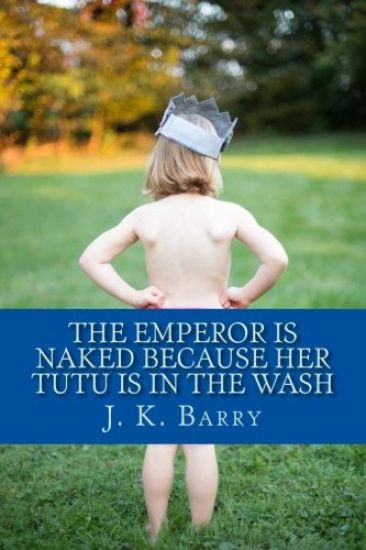
The Emperor is Naked Because Her Tutu is in the Wash
John Barry
Createspace Independent Publishing Platform
2014
nidottu
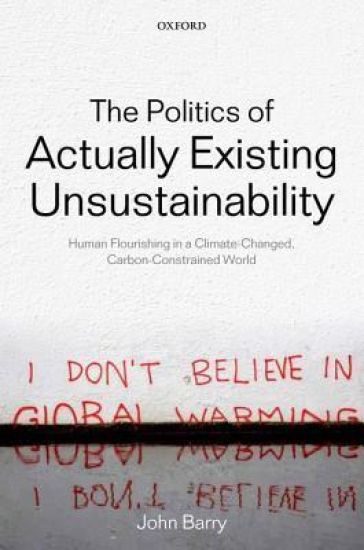
Going against both the naive techno-optimism of 'greening business as usual' and a resurgent 'catastrophism' within green thinking and politics, The Politics of Actually Existing Unsustainability offers an analysis of the causes of unsustainability and diminished human flourishing. It makes a case for seeing that it is profound and deepening unsustainability and growing injustice that characterizes the modern world. The books locates the causes of unsustainability in dominant capitalist modes of production, debt-based consumerism, and the imperative for orthodox economic growth. It suggests that valuable insights into the causes of and alternatives to unsustainability can be found in a critical embracing of human vulnerability and dependency as both constitutive and ineliminable aspects of what it means to be human. Rather than seeing invulnerability as the appropriate response, the book defends resilience, the ability to 'cope with' rather than 'solve' vulnerability, as a more productive strategy. The Politics of Actually Existing Unsustainability offers a trenchant critique of the dominant neoclassical economic groupthink, which the book argues must be seen not as some value-neutral form of 'expert knowledge' but as a thoroughly ideological 'common sense' that has corrupted and limited creative ways of thinking about and through our current predicament. It offers a green political economic alternative which replaces economic growth with economic security, and views economic growth as having done its work in the minority, affluent world, which should now focus on human flourishing and lowering socio-economic inequality and fostering solidarity as part of that new re-orientation of public policy. Complementing this green political economy, the book outlines and develops an account of 'green republicanism', which represents an innovative and original contribution to debates on the political responses to the crises and opportunities of global unsustainability. The Politics of Actually Existing Unsustainability draws widely from a range of disciplines and thinkers to produce a highly relevant, timely, and provocatively original statement on the human predicament in the twenty-first century.
The Transition to Sustainable Living and Practice
Liam Leonard; John Barry
Emerald Publishing Limited
2009
sidottu
"The Transition to Sustainable Living and Practice" provides a series of insights into real alternatives to the current economic malaise, with an examination of key themes such as transition towns, traditional villages, new green financial concepts, the sustainable utopia, co-operative farming, sustainability and activism, ecofeminism, green protectionism, intentional communities and a green philosophy of money.
Written in an engaging and accessible manner by one of the leading scholars in his field, Environment and Social Theory, completed revised and updated with two new chapters, is an indispensable guide to the way in which the environment and social theory relate to one another. This popular text outlines the complex interlinking of the environment, nature and social theory from ancient and pre-modern thinking to contemporary social theorizing. John Barry: examines the ways major religions such as Judaeo-Christianity have and continue to conceptualize the environment analyzes the way the non-human environment features in Western thinking from Marx and Darwin, to Freud and Horkheimer explores the relationship between gender and the environment, postmodernism and risk society schools of thought, and the contemporary ideology of orthodox economic thinking in social theorising about the environment. How humans value, use and think about the environment, is an increasingly central and important aspect of recent social theory. It has become clear that the present generation is faced with a series of unique environmental dilemmas, largely unprecedented in human history. With summary points, illustrative examples, glossary and further reading sections this invaluable resource will benefit anyone with an interest in environmentalism, politics, sociology, geography, development studies and environmental and ecological economics.
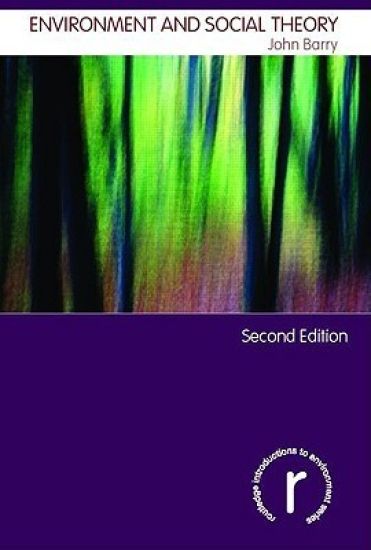
Written in an engaging and accessible manner by one of the leading scholars in his field, Environment and Social Theory, completed revised and updated with two new chapters, is an indispensable guide to the way in which the environment and social theory relate to one another. This popular text outlines the complex interlinking of the environment, nature and social theory from ancient and pre-modern thinking to contemporary social theorizing. John Barry: examines the ways major religions such as Judaeo-Christianity have and continue to conceptualize the environment analyzes the way the non-human environment features in Western thinking from Marx and Darwin, to Freud and Horkheimer explores the relationship between gender and the environment, postmodernism and risk society schools of thought, and the contemporary ideology of orthodox economic thinking in social theorising about the environment. How humans value, use and think about the environment, is an increasingly central and important aspect of recent social theory. It has become clear that the present generation is faced with a series of unique environmental dilemmas, largely unprecedented in human history. With summary points, illustrative examples, glossary and further reading sections this invaluable resource will benefit anyone with an interest in environmentalism, politics, sociology, geography, development studies and environmental and ecological economics.

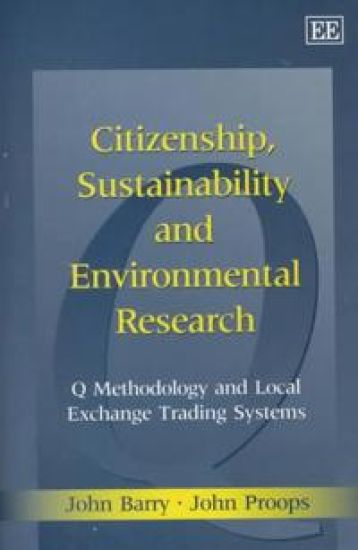
Citizenship, Sustainability and Environmental Research
John Barry; John Proops
Edward Elgar Publishing Ltd
2000
sidottu
This innovative book uses a little-known methodological research tool to study ordinary people doing extraordinary things. Local Exchange Trading Systems (LETS), the subject of the book, is a novel and interesting social phenomenon which seems to constitute a more ecologically rational and socially inclusive form of economic activity. LETS is a system for exchanging goods and services without the use of formal, legal tender. Unlike barter, LETS members buy and sell using their own nominal currency units, but the currency in which trade is conducted is purely a means of exchange, not a commodity in itself or a store of value. The authors of this book examine LETS, and in particular they discuss whether LETS can be viewed as an aspect of the 'greening' of citizenship, with the potential to contribute to the transition to, and maintenance of, a more sustainable society. They describe the part LETS can play in raising environmental awareness; offering more sustainable practices of production and consumption and helping to create in the community the preconditions for sustainability. In their study of LETS, the authors use Q methodology, (a qualitative methodology for the systematic study of subjectivity and shared discourses) and at the same time they evaluate its usefulness for social scientific environmental research. They find that it is a powerful methodological approach which is consistent with many of the core principles, values and aims of ecological economics. They also conclude that Q has the potential to contribute to environmental policy analysis and the creation of a more participative, democratic and effective form of environmental policy making. This book will be of great interest to all social scientists interested in social movements, environment and citizenship, and in particular those wanting to understand the application of Q methodology for social science research.
W. J. M. MacKenzie Prize winner for the best book in Political Science published in 1999 `Of the sixteen books submitted, some of high quality, this one was agreed to be in a class of its own…. The book breaks new ground in `green' political theory, and in an engaging manner, educates those anxious to be good citizens and challenges those responsible for public policy, in a highly topical and globally important discourse.… Barry's immanent critique, his insistence that we build on what there is, his resistance to the easy anti-statist line, his sane and balanced outlook, is intellectually brave in this often rather clamant territory. The analysis of ecological morality, individual stewardship, and collective responsibility provides an original and seminal treatise that advances the discipline as a whole' - Professor Andrew Dunsire
W. J. M. MacKenzie Prize winner for the best book in Political Science published in 1999 `Of the sixteen books submitted, some of high quality, this one was agreed to be in a class of its own…. The book breaks new ground in `green' political theory, and in an engaging manner, educates those anxious to be good citizens and challenges those responsible for public policy, in a highly topical and globally important discourse.… Barry's immanent critique, his insistence that we build on what there is, his resistance to the easy anti-statist line, his sane and balanced outlook, is intellectually brave in this often rather clamant territory. The analysis of ecological morality, individual stewardship, and collective responsibility provides an original and seminal treatise that advances the discipline as a whole' - Professor Andrew Dunsire