Kirjojen hintavertailu – 12 859 819 kirjaa ja 27 kauppaa

Kirjailija

John Beaver

Kirjat ja teokset yhdessä paikassa: 21 kirjaa, julkaisuja vuosilta 2010–2025, suosituimpiin kuuluu The History of the Origine of the French Laws. Vertaile teosten hintoja ja tarkista saatavuus suomalaisista kirjakaupoista.

21 kirjaa

Kirjojen julkaisuvuodet: 2010–2025.

Lo-Fi Photography

Lo-Fi Photography

John Beaver

ROYAL SOCIETY OF CHEMISTRY
2024
sidottu

Halvin toimitettuna 49,10 €

Of all the arts, photography has perhaps the closest association with science and technology: the physics of light and colour combined with chemistry to capture images. Lo-Fi Photography is an ideal introduction to the science that lies behind photography and the array of simple methods that can be used to capture light and create images. From making homemade cameras to accessible techniques, the goal of this book is to provide all readers with access to this interesting form of creative photography via how-to guides, plans and some tips and tricks. In addition to the theory and hands-on guidance, this book also explores Lo-Fi photography as a distinct art form and provides further reading and excellent sources for diving even deeper into the world of experimental photography. Lo-Fi Photography is both a superb introduction to anyone curious about the science of photography and a first-rate guide to the world of experiemental photography for inquisitive photographers.
The Big Picture

The Big Picture

John Beaver

Springer International Publishing AG
2020
nidottu
A brief overview of astronomy and cosmology is presented in five different ways, through the lenses of space, time, evolution, process, and structure. Specific topics are chosen for their contribution to a "big picture" understanding of the interconnectedness of knowledge in astronomy and cosmology. Thus, many topics (stellar astronomy for example) are treated in multiple sections, but from different viewpoints—for example, sizes and distances of stars (space); when stars appeared in the history of the universe (time); stellar evolution (evolution); hydrostatic equilibrium and stellar spectra (process); and stellar structure (structure). Some topics traditional to the introductory astronomy curriculum—eclipses and lunar phases, for example—are omitted altogether as they are inessential for the big-picture goals of the book, and excellent summaries are easily available elsewhere. On the other hand, the book treats some topics not usually covered in an introductory astronomy course, forexample the roles played by equilibrium processes and symmetry in our understanding of the universe. The level is for the beginning undergraduate, with only basic skills in rudimentary algebra assumed. But more advanced students and teachers will also find the book useful as both a set of practical tools and a point of departure for taking stock (in five different ways) of the current state of knowledge in astronomy and cosmology.
The Physics and Art of Photography, Volume 3

The Physics and Art of Photography, Volume 3

John Beaver

Morgan Claypool Publishers
2019
nidottu
This book uses art photography as a point of departure for learning about physics, while also using physics as a point of departure for asking fundamental questions about the nature of photography as an art. Although not a how-to manual, the topics center around hands-on applications, sometimes illustrated by photographic processes that are inexpensive and easily accessible to students (including a versatile new process developed by the author, and first described in print in this series). A central theme is the connection between the physical interaction of light and matter on the one hand, and the artistry of the photographic processes and their results on the other. This is the third volume in this three-part series that uses art photography as a point of departure for learning about physics, while also using physics as a point of departure for asking fundamental questions about the nature of photography as an art. It focuses on the physics and chemistry of photographic light-sensitive materials, as well as the human retina. It also considers the fundamental nature of digital photography and its relationship to the analog photography that preceded it.
The Physics and Art of Photography, Volume 3

The Physics and Art of Photography, Volume 3

John Beaver

Morgan Claypool Publishers
2019
sidottu
This book uses art photography as a point of departure for learning about physics, while also using physics as a point of departure for asking fundamental questions about the nature of photography as an art. Although not a how-to manual, the topics center around hands-on applications, sometimes illustrated by photographic processes that are inexpensive and easily accessible to students (including a versatile new process developed by the author, and first described in print in this series). A central theme is the connection between the physical interaction of light and matter on the one hand, and the artistry of the photographic processes and their results on the other. This is the third volume in this three-part series that uses art photography as a point of departure for learning about physics, while also using physics as a point of departure for asking fundamental questions about the nature of photography as an art. It focuses on the physics and chemistry of photographic light-sensitive materials, as well as the human retina. It also considers the fundamental nature of digital photography and its relationship to the analog photography that preceded it.
The Physics and Art of Photography, Volume 1

The Physics and Art of Photography, Volume 1

John Beaver

Morgan Claypool Publishers
2018
nidottu
This book uses art photography as a point of departure for learning about physics, while also using physics as a point of departure for asking fundamental questions about the nature of photography as an art. Although not a how-to manual, the topics center around hands-on applications, most-often illustrated by photographic processes that are inexpensive and easily accessible to students (including a versatile new process developed by the author, and herein first described in print). A central theme is the connection between the physical interaction of light and matter on the one hand, and the artistry of the photographic processes and their results on the other. Geometry and the Nature of Light focuses on the physics of light and the optics of lenses, but also includes extended discussions of topics less commonly covered in a beginning text, including symmetry in art and physics, different physical processes of the scattering of light, photograms (photographic shadow prints) and the nature of shadows, elements of 2-dimensional design, pinhole photography and the view camera. Although written at a beginning undergraduate level, the topics are chosen for their role in a more general discussion of the relation between science and art that is of interest to readers of all backgrounds and levels of expertise.

The Physics and Art of Photography, Volume 1

The Physics and Art of Photography, Volume 1

John Beaver

Morgan Claypool Publishers
2018
sidottu
This book uses art photography as a point of departure for learning about physics, while also using physics as a point of departure for asking fundamental questions about the nature of photography as an art. Although not a how-to manual, the topics center around hands-on applications, most-often illustrated by photographic processes that are inexpensive and easily accessible to students (including a versatile new process developed by the author, and herein first described in print). A central theme is the connection between the physical interaction of light and matter on the one hand, and the artistry of the photographic processes and their results on the other. Geometry and the Nature of Light focuses on the physics of light and the optics of lenses, but also includes extended discussions of topics less commonly covered in a beginning text, including symmetry in art and physics, different physical processes of the scattering of light, photograms (photographic shadow prints) and the nature of shadows, elements of 2-dimensional design, pinhole photography and the view camera. Although written at a beginning undergraduate level, the topics are chosen for their role in a more general discussion of the relation between science and art that is of interest to readers of all backgrounds and levels of expertise.

The Physics and Art of Photography, Volume 2

The Physics and Art of Photography, Volume 2

John Beaver

Morgan Claypool Publishers
2018
nidottu
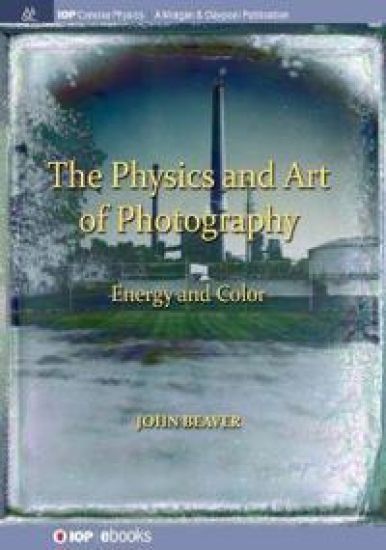
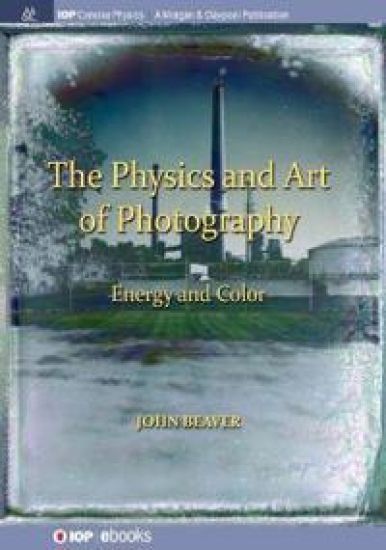
This book uses art photography as a point of departure for learning about physics, while also using physics as a point of departure for asking fundamental questions about the nature of photography as an art. Although not a how-to manual, the topics center around hands-on applications, sometimes illustrated by photographic processes that are inexpensive and easily accessible to students (including a versatile new process developed by the author, and first described in print in this series). A central theme is the connection between the physical interaction of light and matter on the one hand, and the artistry of the photographic processes and their results on the other. One half of Energy and Color focuses on the physics of energy, power, illuminance, and intensity of light, and how these relate to the photographic exposure, including a detailed example that follows the emission of light from the sun all the way through to the formation of the image in the camera. These concepts are described in both their traditional manner, but also using very-low sensitivity photography as an example, which brings the physical concepts to the fore in a visible way, whereas they are often hidden with ordinary high-speed photographic detectors. Energy and Color also considers color in terms of the spectrum of light, how it interacts with the subject, and how the camera's light detector interacts with the image focused upon it. But of equal concern is the only partially-understood and sometimes unexpected ways in which the human eye/brain interprets this spectral stimulus as color. The volume covers basic photographic subjects such as shutter, aperture, ISO, metering and exposure value, but also given their relations to the larger themes of the book less familiar topics such as the Jones-Condit equation, Lambertian versus isotropic reflections, reflection and response curves, and the opponent-process model of color perception. Although written at a beginning undergraduate level, the topics are chosen for their role in a more general discussion of the relation between science and art that is of interest to readers of all backgrounds and levels of expertise.

The Physics and Art of Photography, Volume 2

The Physics and Art of Photography, Volume 2

John Beaver

Morgan Claypool Publishers
2018
sidottu
This book uses art photography as a point of departure for learning about physics, while also using physics as a point of departure for asking fundamental questions about the nature of photography as an art. Although not a how-to manual, the topics center around hands-on applications, sometimes illustrated by photographic processes that are inexpensive and easily accessible to students (including a versatile new process developed by the author, and first described in print in this series). A central theme is the connection between the physical interaction of light and matter on the one hand, and the artistry of the photographic processes and their results on the other. One half of Energy and Color focuses on the physics of energy, power, illuminance, and intensity of light, and how these relate to the photographic exposure, including a detailed example that follows the emission of light from the sun all the way through to the formation of the image in the camera. These concepts are described in both their traditional manner, but also using very-low sensitivity photography as an example, which brings the physical concepts to the fore in a visible way, whereas they are often hidden with ordinary high-speed photographic detectors. Energy and Color also considers color in terms of the spectrum of light, how it interacts with the subject, and how the camera's light detector interacts with the image focused upon it. But of equal concern is the only partially-understood and sometimes unexpected ways in which the human eye/brain interprets this spectral stimulus as color. The volume covers basic photographic subjects such as shutter, aperture, ISO, metering and exposure value, but also given their relations to the larger themes of the book less familiar topics such as the Jones-Condit equation, Lambertian versus isotropic reflections, reflection and response curves, and the opponent-process model of color perception. Although written at a beginning undergraduate level, the topics are chosen for their role in a more general discussion of the relation between science and art that is of interest to readers of all backgrounds and levels of expertise.

The Roman Military Punishments

The Roman Military Punishments

John Beaver

Gale Ecco, Print Editions
2018
sidottu
The 18th century was a wealth of knowledge, exploration and rapidly growing technology and expanding record-keeping made possible by advances in the printing press. In its determination to preserve the century of revolution, Gale initiated a revolution of its own: digitization of epic proportions to preserve these invaluable works in the largest archive of its kind. Now for the first time these high-quality digital copies of original 18th century manuscripts are available in print, making them highly accessible to libraries, undergraduate students, and independent scholars. Rich in titles on English life and social history, this collection spans the world as it was known to eighteenth-century historians and explorers. Titles include a wealth of travel accounts and diaries, histories of nations from throughout the world, and maps and charts of a world that was still being discovered. Students of the War of American Independence will find fascinating accounts from the British side of conflict. ++++The below data was compiled from various identification fields in the bibliographic record of this title. This data is provided as an additional tool in helping to insure edition identification: ++++Harvard University Houghton LibraryN012999Titlepage in red and black. With a half-title. London: from the happy revolution anno, XXXVII 1725] 4], iv, 8],155, 1]p.; 4
The History of the Origine of the French Laws

The History of the Origine of the French Laws

Claude Fleury; John Beaver

Palala Press
2018
pokkari
This work has been selected by scholars as being culturally important, and is part of the knowledge base of civilization as we know it. This work was reproduced from the original artifact, and remains as true to the original work as possible. Therefore, you will see the original copyright references, library stamps (as most of these works have been housed in our most important libraries around the world), and other notations in the work. This work is in the public domain in the United States of America, and possibly other nations. Within the United States, you may freely copy and distribute this work, as no entity (individual or corporate) has a copyright on the body of the work. As a reproduction of a historical artifact, this work may contain missing or blurred pages, poor pictures, errant marks, etc. Scholars believe, and we concur, that this work is important enough to be preserved, reproduced, and made generally available to the public. We appreciate your support of the preservation process, and thank you for being an important part of keeping this knowledge alive and relevant.