Kirjojen hintavertailu – 12 903 735 kirjaa ja 27 kauppaa

Kirjailija

John Buchan

Kirjat ja teokset yhdessä paikassa: 856 kirjaa, julkaisuja vuosilta 1915–2026, suosituimpiin kuuluu The Marquis of Montrose.by John Buchan (ILLUSTRATED). Vertaile teosten hintoja ja tarkista saatavuus suomalaisista kirjakaupoista.

856 kirjaa

Kirjojen julkaisuvuodet: 1915–2026.

Prester John

Prester John

John Buchan

Createspace Independent Publishing Platform
2018
nidottu
Prester John is a 1910 adventure novel by John Buchan. It tells the story of a young Scotsman named David Crawfurd and his adventures in South Africa, where a Zulu uprising is tied to the medieval legend of Prester John. Crawfurd is similar in many ways to Buchan's later character, Richard Hannay.
Mr. Standfast

Mr. Standfast

John Buchan

Createspace Independent Publishing Platform
2018
nidottu
Mr Standfast is the third of five Richard Hannay novels by John Buchan, first published in 1919. It is one of two Hannay novels set during the First World War, the other being Greenmantle; Hannay's first and best-known adventure, The Thirty-Nine Steps, is set in the period immediately before the war started. The title refers to a character in John Bunyan's Pilgrim's Progress, to which there are many other references in the novel; Hannay uses a copy of Pilgrim's Progress to decipher coded messages from his contacts, and letters from his friend Peter Pienaar.
The Thirty-Nine Steps

The Thirty-Nine Steps

John Buchan

Createspace Independent Publishing Platform
2018
nidottu
The Thirty-Nine Steps is an adventure novel by the Scottish author John Buchan. It first appeared as a serial in Blackwood's Magazine in August and September 1915 before being published in book form in October that year by William Blackwood and Sons, Edinburgh. It is the first of five novels featuring Richard Hannay, an all-action hero with a stiff upper lip and a miraculous knack for getting himself out of sticky situations. The novel formed the basis for a number of film adaptations: Alfred Hitchcock's 1935 version; a 1959 colour remake; a 1978 version which is perhaps most faithful to the novel; and a 2008 version for British television. In 2003 the book was listed on the BBC's The Big Read poll of the UK's "best-loved novels." Adventurer Richard Hannay, just returned from South Africa, is thoroughly bored with London life-until he is accosted by a mysterious American, who warns him of an assassination plot that could completely destabalise the fragile political balance of Europe. Initially sceptical, Hannay nonetheless harbours the man-but one dayreturns home to find him murdered... An obvious suspect, Hannay flees to his native Scotland, pursued by both the police and a cunning, ruthless enemy. His life and the security of Britan are in grave peril, and everything rests on the solution to a baffling enigma: what are the 'thirty nine steps'
The Magic Walking Stick

The Magic Walking Stick

John Buchan

Createspace Independent Publishing Platform
2018
nidottu
The Magic Walking Stick is a children's short story by John Buchan. It tells the story of a teenage boy who buys a walking stick from a beggar - a magic walking stick that allows the boy to visit many places at his command
The 39 Steps

The 39 Steps

John Buchan

Fractal Press
2018
pokkari
Europe is close to war and spies are everywhere. Richard Hannay the protagonist and narrator, an expatriate Scot, returns to his new home, a flat in London, after a long stay in Rhodesia, in order to begin a new life. One night he is buttonholed by a stranger, a well-travelled American, who claims to be in fear for his life. The man appears to know of an anarchist plot to destabilise Europe, beginning with a plan to assassinate the Greek Premier, Karolides, during his forthcoming visit to London.
The First World War in Africa 1914-1918
A unique assessment of the Great War in sub-Saharan Africa in all its theatresThe great conflict fought between 1914 and 1918 set Europe ablaze, but, as the definition of 'world war' implies, embraced battlefields where the colonial interests of the protagonist nations inevitably collided. How this occurred on the continent of Africa has always fascinated military history students of the period, not least because these campaigns unconfined by the stagnation of trench warfare, as was the case on the Western Front, were fought over exotic terrains by national, militia and native forces often commanded by able and imaginative officers on both sides. Much focus has been given to the campaigns in East Africa, which features in detail in this book, but also included is the campaign fought in the arid landscape of South-West Africa (now Namibia) and those which took place in Equatorial Togoland (Ghana Volta) and The Cameroons in West Africa. The 'South African Rebellion' is also described. The author of this book, John Buchan, a writer of great talent and economy of phrase, was primarily known for his superlative adventure fiction. However, he was commissioned to write a multi-volume history of the First World War which enabled him to reveal his talent as an historian and from which this single volume edition has been selectively edited. Buchan's text, appearing in this form for the first time in this Leonaur edition, includes many excellent maps and has been further enhanced by photographs and illustrations which were not present in earlier publications of the text. Leonaur editions are newly typeset and are not facsimiles; each title is available in softcover and hardback with dustjacket; our hardbacks are cloth bound and feature gold foil lettering on their spines and fabric head and tail bands.

The First World War in Africa 1914-1918
A unique assessment of the Great War in sub-Saharan Africa in all its theatresThe great conflict fought between 1914 and 1918 set Europe ablaze, but, as the definition of 'world war' implies, embraced battlefields where the colonial interests of the protagonist nations inevitably collided. How this occurred on the continent of Africa has always fascinated military history students of the period, not least because these campaigns unconfined by the stagnation of trench warfare, as was the case on the Western Front, were fought over exotic terrains by national, militia and native forces often commanded by able and imaginative officers on both sides. Much focus has been given to the campaigns in East Africa, which features in detail in this book, but also included is the campaign fought in the arid landscape of South-West Africa (now Namibia) and those which took place in Equatorial Togoland (Ghana Volta) and The Cameroons in West Africa. The 'South African Rebellion' is also described. The author of this book, John Buchan, a writer of great talent and economy of phrase, was primarily known for his superlative adventure fiction. However, he was commissioned to write a multi-volume history of the First World War which enabled him to reveal his talent as an historian and from which this single volume edition has been selectively edited. Buchan's text, appearing in this form for the first time in this Leonaur edition, includes many excellent maps and has been further enhanced by photographs and illustrations which were not present in earlier publications of the text. Leonaur editions are newly typeset and are not facsimiles; each title is available in softcover and hardback with dustjacket; our hardbacks are cloth bound and feature gold foil lettering on their spines and fabric head and tail bands.

1918-Catastrophe to Victory

1918-Catastrophe to Victory

John Buchan

Leonaur Ltd
2018
pokkari
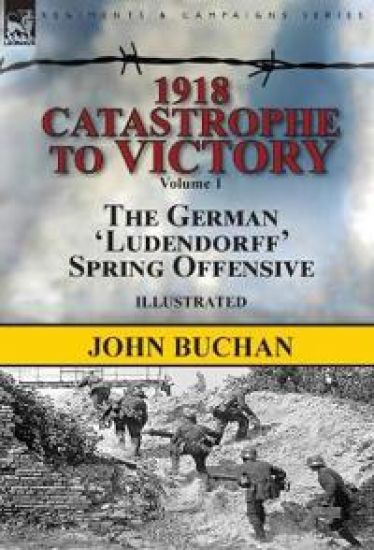
The last German offensive that almost won the war in the westBy the fourth year of the Great War on the Western Front the protagonists knew that established assault tactics could not be depended upon to deliver battlefield victories or, indeed, long endure. Time and attrition was on the side of the Allies, for the German homeland was hard pressed and suffering. The Allied cause was not challenged geographically, in materiel or logistically since the U-Boat menace was being defeated in the Atlantic and decisive military support from the United States America was at hand. The introduction of battle tanks meant an imminent end to the dominance of trenches. To prevail Germany needed to deliver an innovative, swift and encompassing attack solution which would decisively breach the enemy's lines and surge onwards to Paris, thus forcing a cessation of hostilities from a position of strength. In March of 1918 this German assault began and was initially so successful that Allied lines buckled and armies reeled back in disarray, falling back towards positions they had last held in 1914. The Ludendorff Offensive--named for its innovator--in the Spring of 1918, also called the Kaiser's Battle (Kaiserschlacht) was the final initiative for imperial Germany--and one that very nearly succeeded. How it was conceived, implemented, opposed and halted is detailed here, supported by many maps, illustrations and photographs, by John Buchan. A companion volume, '1918--Catastrophe to Victory--the Allied Hundred Days Offensive' by the same author, which describes the battles which concluded the First World War in the West, is also available from Leonaur. Leonaur editions are newly typeset and are not facsimiles; each title is available in softcover and hardback with dustjacket; our hardbacks are cloth bound and feature gold foil lettering on their spines and fabric head and tail bands.

1918-Catastrophe to Victory

1918-Catastrophe to Victory

John Buchan

Leonaur Ltd
2018
sidottu
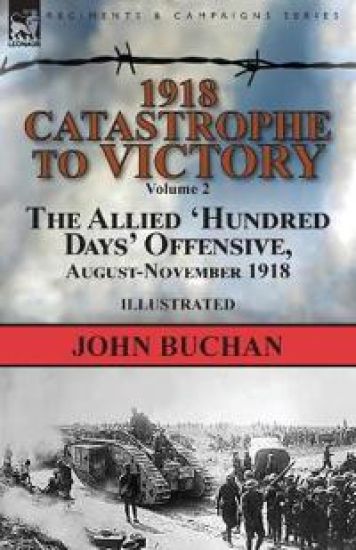
The final battles to Allied victory in the WestThe German Ludendorff Spring Offensive, launched at the Allied lines in Spring 1918, proved to be perilously close the right solution to achieve battlefield victory. Typically for German initiatives it was meticulously planned with coordinated operations working along an established critical timeline. While initially highly successful, the advance took longer than expected and Allied tenacity resulted in ill-conceived remedial actions which stalled the rapid progress upon which ultimate success depended. Allied commanders noted well the most effective components of the German modus operandi and were able to take advantage of its inherent weaknesses, which were exacerbated by Germany's comparatively limited and irreplaceable--in contrast to the Allied situation--resources in men and materiel. As it became clear the German attack had run out of impetus the Allies turned to the offensive and their own attack was launched in early August, 1918. Refined versions of the German grand-tactics were now turned upon them to great effect. This was at last a mobile campaign to be fought over terrain which favoured a rapid advance by all the resources the combined Allied armies could bring to bear. By mid-November the remaining forces of the Central Powers had been defeated, had recoiled towards the frontiers of their homelands and had agreed to an armistice which ended the First World War. How the Allied armies near defeat was so resolutely turned to total triumph in less than four months is the fascinating subject of this book by John Buchan which is supported by many maps, illustrations and photographs. A companion book, '1918--Catastrophe to Victory--the German 'Ludendorff' Spring Offensive' by Buchan, which describes the events which led to the Hundred Days Offensive, is also available from Leonaur. Leonaur editions are newly typeset and are not facsimiles; each title is available in softcover and hardback with dustjacket; our hardbacks are cloth bound and feature gold foil lettering on their spines and fabric head and tail bands.

1918-Catastrophe to Victory

1918-Catastrophe to Victory

John Buchan

Leonaur Ltd
2018
sidottu
The last German offensive that almost won the war in the westBy the fourth year of the Great War on the Western Front the protagonists knew that established assault tactics could not be depended upon to deliver battlefield victories or, indeed, long endure. Time and attrition was on the side of the Allies, for the German homeland was hard pressed and suffering. The Allied cause was not challenged geographically, in materiel or logistically since the U-Boat menace was being defeated in the Atlantic and decisive military support from the United States America was at hand. The introduction of battle tanks meant an imminent end to the dominance of trenches. To prevail Germany needed to deliver an innovative, swift and encompassing attack solution which would decisively breach the enemy's lines and surge onwards to Paris, thus forcing a cessation of hostilities from a position of strength. In March of 1918 this German assault began and was initially so successful that Allied lines buckled and armies reeled back in disarray, falling back towards positions they had last held in 1914. The Ludendorff Offensive--named for its innovator--in the Spring of 1918, also called the Kaiser's Battle (Kaiserschlacht) was the final initiative for imperial Germany--and one that very nearly succeeded. How it was conceived, implemented, opposed and halted is detailed here, supported by many maps, illustrations and photographs, by John Buchan. A companion volume, '1918--Catastrophe to Victory--the Allied Hundred Days Offensive' by the same author, which describes the battles which concluded the First World War in the West, is also available from Leonaur. Leonaur editions are newly typeset and are not facsimiles; each title is available in softcover and hardback with dustjacket; our hardbacks are cloth bound and feature gold foil lettering on their spines and fabric head and tail bands.

1918-Catastrophe to Victory

1918-Catastrophe to Victory

John Buchan

Leonaur Ltd
2018
pokkari
The final battles to Allied victory in the WestThe German Ludendorff Spring Offensive, launched at the Allied lines in Spring 1918, proved to be perilously close the right solution to achieve battlefield victory. Typically for German initiatives it was meticulously planned with coordinated operations working along an established critical timeline. While initially highly successful, the advance took longer than expected and Allied tenacity resulted in ill-conceived remedial actions which stalled the rapid progress upon which ultimate success depended. Allied commanders noted well the most effective components of the German modus operandi and were able to take advantage of its inherent weaknesses, which were exacerbated by Germany's comparatively limited and irreplaceable--in contrast to the Allied situation--resources in men and materiel. As it became clear the German attack had run out of impetus the Allies turned to the offensive and their own attack was launched in early August, 1918. Refined versions of the German grand-tactics were now turned upon them to great effect. This was at last a mobile campaign to be fought over terrain which favoured a rapid advance by all the resources the combined Allied armies could bring to bear. By mid-November the remaining forces of the Central Powers had been defeated, had recoiled towards the frontiers of their homelands and had agreed to an armistice which ended the First World War. How the Allied armies near defeat was so resolutely turned to total triumph in less than four months is the fascinating subject of this book by John Buchan which is supported by many maps, illustrations and photographs. A companion book, '1918--Catastrophe to Victory--the German 'Ludendorff' Spring Offensive' by Buchan, which describes the events which led to the Hundred Days Offensive, is also available from Leonaur. Leonaur editions are newly typeset and are not facsimiles; each title is available in softcover and hardback with dustjacket; our hardbacks are cloth bound and feature gold foil lettering on their spines and fabric head and tail bands.

The Thirty-Nine Steps

The Thirty-Nine Steps

John Buchan

Penguin Classics
2018
pokkari

Halvin toimitettuna 17,90 €

'My guest was lying sprawled on his back. There was a long knife through his heart which skewered him to the floor'Richard Hannay has just returned to England after years in South Africa and is thoroughly bored with his life in London. But then a murder is committed in his flat, just days after a chance encounter with an American who had told him about an assassination plot which could have dire international consequences. An obvious suspect for the police and an easy target for the killers, Hannay goes on the run in his native Scotland where he will need all his courage and ingenuity to stay one step ahead of his pursuers. The Penguin English Library - collectable general readers' editions of the best fiction in English, from the eighteenth century to the end of the Second World War.
Politics and the Mayfly

Politics and the Mayfly

John Buchan

Createspace Independent Publishing Platform
2018
nidottu
Politics and the Mayfly John Buchan We are delighted to publish this classic book as part of our extensive Classic Library collection. Many of the books in our collection have been out of print for decades, and therefore have not been accessible to the general public. The aim of our publishing program is to facilitate rapid access to this vast reservoir of literature, and our view is that this is a significant literary work, which deserves to be brought back into print after many decades. The contents of the vast majority of titles in the Classic Library have been scanned from the original works. To ensure a high quality product, each title has been meticulously hand curated by our staff. Our philosophy has been guided by a desire to provide the reader with a book that is as close as possible to ownership of the original work. We hope that you will enjoy this wonderful classic work, and that for you it becomes an enriching experience.