Kirjojen hintavertailu – 12 859 827 kirjaa ja 27 kauppaa
Kirjailija
John Bunyan
Kirjat ja teokset yhdessä paikassa: 731 kirjaa, julkaisuja vuosilta 1778–2026, suosituimpiin kuuluu The Pilgrim's Progress from This World to That Which Is to Come. Vertaile teosten hintoja ja tarkista saatavuus suomalaisista kirjakaupoista.
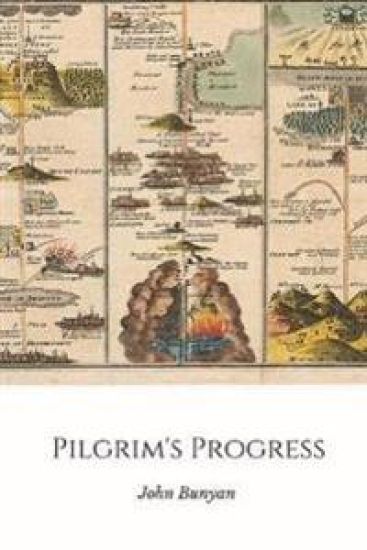
With its vivid characterizations, direct and colorful style, and beauty of language, Pilgrim's Progress has long been one of the most popular books in the English language. The story opens with the author claiming to have had a dream in which he sees the figure of Christian weeping and wondering what to do to avoid the destruction of himself, his family and his town. The rest of the narrative follows Christian on his journey from the City of Destruction via the Slough of Despond, the Hill of Difficulty, the Valley of the Shadow of Death and Vanity Fair over the River of the Water of Life and into the Celestial City.
With its vivid characterizations, direct and colorful style, and beauty of language, Pilgrim's Progress has long been one of the most popular books in the English language. The story opens with the author claiming to have had a dream in which he sees the figure of Christian weeping and wondering what to do to avoid the destruction of himself, his family and his town. The rest of the narrative follows Christian on his journey from the City of Destruction via the Slough of Despond, the Hill of Difficulty, the Valley of the Shadow of Death and Vanity Fair over the River of the Water of Life and into the Celestial City.
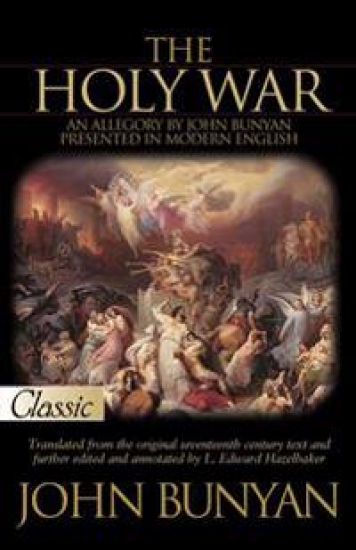
The Holy War, John Bunyan's second-most popular book, has now been translated from the original seventeenth-century text and further edited and annotated by L. Edward Hazelbaker-editor of two other Pure Gold Classics by Bunyan (The Pilgrim's Progress and Grace Abounding to the Chief of Sinners). Hazelbaker's well-crafted works have proven to be bestsellers. This classic allegory illustrates the struggle between good and evil and the ultimate battle for the human soul. When Diabolus occupies the city of Mansoul, King Shaddai and his son, Emmanuel, develop and execute a plan to save and restore the city. Emmanuel says, "You, my Mansoul, and the beloved of my heart, many and great are the privileges that I have bestowed upon you. I have singled you out from others and have chosen you to myself-not because of your worthiness, but for my own sake. I also have redeemed you . . . This I have done because I loved you, and because I have set my heart on you to do good." But Diabolus wants Mansoul for himself. A mighty giant, Diabolus mounts an assault against the famed town of Mansoul-to take it and make it his own habitation. Seeing himself exalted to greatness and honor, he obsesses over "how he might be set up as lord over all and have the sole power under Shaddai." Diabolus and his companions decide to destroy the King's son "so His inheritance might be theirs." Though the battle continues to rage, this book will show the reader what the enemy's intentions are and what God is doing to overcome him.
A TREATISE EVEN MORE RELEVANT NEARLY 350 YEARS LATER The Strait Gate is a treatise written by Puritan author, John Bunyan, author of The Pilgrim's Progress. This treatise was originally published in 1676 with the purpose of the wickedness prevalent among many professing believers in Bunyan's day. One of the issues arose from the general laxity in the preaching the gospel; and near kin to it, was the ease with which someone could make a confession of faith- having no conviction of sin, nor fruit of repentance, and no holiness of living. John Bunyan took the matter to task. Free from his incarceration at the Bedford Jail for two years (after 12 years in prison), Mr. Bunyan exhorted his readers to embrace a pure gospel, a Biblical gospel. Bunyan viewed the Person and work of Jesus Christ the mainspring from which every aspect of acceptable Christianity was produced, be it doctrinal, dutiful or devotional. "Good works must flow from faith, or not at all," wrote John Bunyan in his 1663 treatise, Christian Behaviour (first published in 1674). FROM GEORGE OFFER IN 1862 In his "Editor's Advertisement," prelude to this treatise in The Complete Works of John Bunyan, George Offor wrote, "If any uninspired writer has been entitled to the name of Boanerges, or a son of thunder, it is the author of the following treatise. Here we have a most searching and faithful display of the straitness or exact dimensions of that all-important gate, which will not suffer many professors to pass into the kingdom of heaven, encumbered as they are with fatal errors. Still 'it is no little pinching wicket, but wide enough for all the truly gracious and sincere lovers of Jesus Christ; while it is so strait, that no others can by any means enter in.' This is a subject calculated to rouse and stimulate all genuine professors to solemn inquiry; and it was peculiarly intended to dart at, and fix convictions upon, the multitudes of hypocritical professors who abounded in Bunyan's time, especially under the reigns of the later Stuarts." More than 150 years since Mr. Offor wrote his advertisement, and nearly 350 years since Mr. Bunyan wrote this treatise, error has multiplied and, worse, been magnified to nearly culminate with a mishmash of every error and corruption of the gospel since the birth of the church in the first century. With Mr. Bunyan's treatise, The Strait Gate, the discerning believer will agree that the Bedford tinker-turned-preacher's exhortation to receive knowledge of the Lord Jesus Christ as Savior must come from the scriptures alone, and that this knowledge must be received and understood by the light of the Holy Spirit; and logically presenting the Biblical truths in Mr. Bunyan's unique and indefatigable way, you will be encouraged by this work and rejoice in its purity of propositional truth, revel in its sincerity toward practical application, and resolve to take up a more passionate devotion to Christ's person as God and Savior. SPURGEON ON BUNYAN'S WRITING. Of John Bunyan and his classic story, Charles H. Spurgeon had this to say: "...he cannot give us his Pilgrim's Progress- that sweetest of all prose poems- without continually making us feel and say, 'Why, this man is a living Bible ' Prick him anywhere; his blood is Bibline, the very essence of the Bible flows from him." Although Mr. Spurgeon preached this concerning Bunyan's famous allegory, once you've read this treatise, you'll readily agree, that Bunyan's blood is indeed Bibline in everything he writes. May you benefit greatly from the puritan heart and mind of John Bunyan, forged by God's Word and formed by Christ's Divine Light.
The Life and Death of Mr Badman was published by John Bunyan in 1680, two years after the First Edition of the First Part of The Pilgrim's Progress. In the opening sentence of his preface he tells us it was intended by him as the counterpart or companion picture to the Allegory. But whatever his own intentions may have been, the Public of his own time seem to have declined to accept the book in this capacity. Indeed, another writer, who signs himself T. S., undertook to complete Bunyan's Allegory for him, in a book in size and type closely resembling it, and entitled The Second Part of the Pilgrim's Progress . . . exactly Described under the Similitude of a Dream. In his preface titled "The Author to the Reader," Bunyan announces that Mr Badman is a pseudonym for a real man who is dead. Mr Badman's relatives and offspring continue to populate Earth, which "reels and staggereth to and fro like a Drunkard, the transgression thereof is heavy upon it." In a mock eulogy, Bunyan says Mr Badman did not earn four themes commonly part of a funeral for a great man. First, there is no wrought image that will serve as a memorial, and Bunyan's work will have to suffice. Second, Mr Badman died without Honour, so he earned no badges and scutcheons. Third, his life did not merit a sermon. Fourth, no one will mourn and lament his death. Bunyan then describes the sort of Hell awaiting Mr Badman, citing Scripture. He said he published it to address the wickedness and debauchery that had corrupted England, as was his duty as a Christian, in hopes of delivering himself "from the ruins of them that perish." Bunyan acknowledged the work was influenced by a work by Essex minister Arthur Dent (Puritan) titled The Plaine Man's Pathway to Heaven, which was set up as a dialogue between Theologus and Philagathus. That work also had other characters, including Asunetus and Antilegon. 1] Scholar Frank Wadleigh Chandler described it as a "Puritan romance of roguery," 2] Scholar James Blanton Warey described it as an English precursor to the novel, especially the picaresque novel. John Brown of Bedford came out with a version for Cambridge University Press in 1905 that included Bunyan's The Holy War.
The Pharisee And Publican is a classic Christian novel by John Bunyan. Two men went up into the temple to pray; the one a Pharisee, and the other a Publican. The Pharisee stood and prayed thus with himself; God, I thank thee, that I am not as other men are, extortioners, unjust, adulterers, or even as this Publican. I fast twice in the week, I give tithes of all that I possess. And the Publican, standing afar off would not lift up so much as his eyes unto heaven, but smote upon his breast, saying, God be merciful to me a sinner.-- Luke, xviii. 10-13.
GET JOHN BUNYAN'S CLASSIC PURITAN ALLEGORY TODAY A man dressed in rags, carrying a huge burden upon his back, weeps in the wilderness. The reason for his grief: he's read from the book in his hand that he is doomed and the city in which he lives is destined for destruction. The more he reads, the heavier his burden becomes; and the heavier his burden, the greater his grief. When a man named Evangelist gives him a parchment scroll and provides instruction on how he can remove the burden from his back and flee from the coming wrath, the man in rags begins a pilgrimage with his ultimate goal being Mount Zion and the Celestial City. Before he gets there, however, the man must face many dangers, toils, and snares along the way: deceivers and the deceived; difficult climbs and roaring lions; humiliation and raging dragons; hobgoblins and angry mobs; false witnesses and gloomy giants; flatterers, atheists and rivers of death; and a multitude of situations and circumstances to test his faith in Christ and his love for Christ. In God's providence, and by God's grace, the pilgrim will receive help from Shining Ones, Shepherds, saints, scripture, as well as all the graces and promises God provides every Christian through their sojourn in as they travel through the wilderness of this world. Join Christian through his journey to gain entrance at the Celestial Gate in John Bunyan's classic allegory, The Pilgrim's Progress. This puritan classic is a must read for every Christian believer. The Biblical truths expressed in this timeless tome will inspire your soul, strengthen your faith and increase your understanding in spiritual matters. Of John Bunyan and his classic story, Charles H. Spurgeon had this to say: "...he cannot give us his Pilgrim's Progress- that sweetest of all prose poems- without continually making us feel and say, 'Why, this man is a living Bible ' Prick him anywhere; his blood is Bibline, the very essence of the Bible flows from him." PRAISE FOR PILGRIM'S PROGRESS "Pilgrim's Progress is read with the greatest pleasure."-George Whitefield (1714-1770) "It is a masterpiece of piety and genius; and will, we doubt not, be of standing use to the people of God be so long as the sun and moon endure." -Augustus Toplady (1740-1748) "But as among the stars one excelleth another in glory, so of all our author's writings, there is no one perhaps so universally and deservedly admired as his Pilgrim's Progress, in which he gives a delineation of the Christian life under the idea of a journey or a pilgrimage, from the City of Destruction to the heavenly Jerusalem." -John Newton (1725-1807) "Next to the Bible, the book I value most is John Bunyan's 'Pilgrim's Progress.'" -Charles H. Spurgeon (1834-1892) "That tenderest and most theological of books is pulsating with life in every word." - J. Gresham Machen (1881-1937)
Often disguised as something that would help him, evil accompanies Christian on his journey to the Celestial City. As you walk with him, you'll begin to identify today's many religious pitfalls. These are presented by men such as Pliable, who turns back at the Slough of Despond; and Ignorance, who believes he's a true follower of Christ when he's really only trusting in himself. Each character represented in this allegory is intentionally and profoundly accurate in its depiction of what we see all around us, and unfortunately, what we too often see in ourselves. But while Christian is injured and nearly killed, he eventually prevails to the end. So can you.