Kirjojen hintavertailu – 12 903 725 kirjaa ja 27 kauppaa

Kirjailija

John Capgrave

Kirjat ja teokset yhdessä paikassa: 20 kirjaa, julkaisuja vuosilta 2000–2024, suosituimpiin kuuluu Rome 1450. Capgrave's Jubilee Guide. Vertaile teosten hintoja ja tarkista saatavuus suomalaisista kirjakaupoista.

20 kirjaa

Kirjojen julkaisuvuodet: 2000–2024.

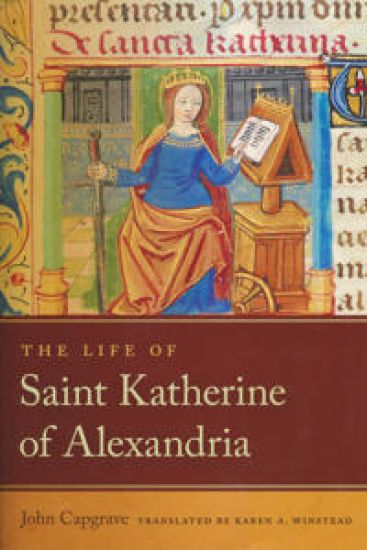
The Life of Saint Katherine of Alexandria

The Life of Saint Katherine of Alexandria

John Capgrave

UNIVERSITY OF NOTRE DAME PRESS
2024
sidottu
The fifteenth-century scholar and Augustinian friar John Capgrave took as his subject the virgin martyr Katherine of Alexandria, who was an anomalous cultural icon, a scholar, and a sovereign whose story unsettled traditional gender stereotypes yet was widely popular throughout Western Europe. Capgrave's Life of Saint Katherine of Alexandria (ca. 1445) stands out among the hundreds of surviving vernacular and Latin narrations about the saint by its intricate plotting, its moral complexity, its obtrusive Chaucerian narrator, and its attention to psychology, history, and theology. The Life of Saint Katherine is a bold literary experiment that transforms the genre of the saint's life by infusing it with conventions and techniques more often associated with chronicles, mystery plays, fabliaux, and romances. In Capgrave's hands, Katherine emerges as a sensitive and studious young woman torn between social responsibilities and personal desires. Her story unfolds in a vividly realized world of political turmoil and religious repression that, as Capgrave's readers were bound to suspect, had everything to do with the England they inhabited and its recent past. Katherine's debate with her lords anticipates arguments for and against female rule that would be made in Tudor England, when the ascensions of Mary I and then Elizabeth I made gynecocracy a political reality, while her debate with the philosophers is a daring exercise in vernacular theology that flouts the censorship then current. Winstead's translation—the first into idiomatic modern English—brings to life Capgrave's sharply drawn characters, compelling plot, and complex, unsettling moral. Its promotion of an informed, intellectualized Christianity during a period known for censorship and repression illuminates the struggle over the definition of orthodoxy that was excited by the perceived threat of Lollard heresy during the fifteenth century. This volume also includes an appendix with passages of Capgrave's original Middle English and literal translations into modern English, providing a valuable tool for teachers and students.

The Book of the Illustrious Henries

The Book of the Illustrious Henries

John Capgrave

Anatiposi Verlag
2023
sidottu
Reprint of the original, first published in 1858. The publishing house Anatiposi publishes historical books as reprints. Due to their age, these books may have missing pages or inferior quality. Our aim is to preserve these books and make them available to the public so that they do not get lost.
The Book of the Illustrious Henries

The Book of the Illustrious Henries

John Capgrave

Anatiposi Verlag
2023
pokkari
Reprint of the original, first published in 1858. The publishing house Anatiposi publishes historical books as reprints. Due to their age, these books may have missing pages or inferior quality. Our aim is to preserve these books and make them available to the public so that they do not get lost.
Liber de Illustribus Henricis

Liber de Illustribus Henricis

John Capgrave

Cambridge University Press
2012
pokkari
John Capgrave (1393–1464) was the Prior of Bishop's Lynn, and the most learned Augustinian friar of his time. Although he was the author of forty-one scholarly works, only twelve survive. This work was dedicated to King Henry VI and chronicles the lives of other great Henries, including six emperors of Germany and six kings of England (including the dedicatee himself). Largely compilations of other sources, his extensive accounts demonstrate the breadth of the scholarship for which he was known. This annotated edition was commissioned as part of the Rolls Series, a project designed, in an early campaign for ease of access to scholarly material, to put more historical sources into print. Edited by F. C. Hingeston and first published in 1858, it includes Capgrave's full Latin text and a glossary, thorough biographical notes, and chapter-by-chapter summaries, offering a useful resource for students of medieval history.
The Chronicle of England

The Chronicle of England

John Capgrave

Cambridge University Press
2012
pokkari
One of the most prolific scholars of his time, John Capgrave (1393–1464) was the author of forty-one historical and theological texts. Today, only twelve survive, and only seven are in English. This work covers the history of the world from the creation of Adam to the year 1417. Beginning with a timeline of Biblical events, including the birth of Cain and the first example of bigamy, he covers Roman myth and history before continuing into accounts of early English monarchs and saints. This scholarly edition, first published in 1858, includes a biography of Capgrave, an introduction to the text and a transcript of The Chronicle. Comprehensive annotations detail points of interest from the manuscript, such as corrections and scribal errors, accompanied by the editor's own marginal notes. Of interest to students of history, this book opens a fascinating window into both early modern and Victorian historiography.
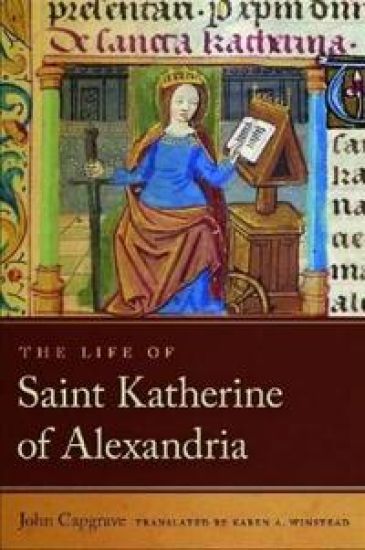
The Life of Saint Katherine of Alexandria

The Life of Saint Katherine of Alexandria

John Capgrave

University of Notre Dame Press
2011
nidottu
The fifteenth-century scholar and Augustinian friar John Capgrave took as his subject the virgin martyr Katherine of Alexandria, who was an anomalous cultural icon, a scholar, and a sovereign whose story unsettled traditional gender stereotypes yet was widely popular throughout Western Europe. Capgrave's Life of Saint Katherine of Alexandria (ca. 1445) stands out among the hundreds of surviving vernacular and Latin narrations about the saint by its intricate plotting, its moral complexity, its obtrusive Chaucerian narrator, and its attention to psychology, history, and theology. The Life of Saint Katherine is a bold literary experiment that transforms the genre of the saint's life by infusing it with conventions and techniques more often associated with chronicles, mystery plays, fabliaux, and romances. In Capgrave's hands, Katherine emerges as a sensitive and studious young woman torn between social responsibilities and personal desires. Her story unfolds in a vividly realized world of political turmoil and religious repression that, as Capgrave's readers were bound to suspect, had everything to do with the England they inhabited and its recent past. Katherine's debate with her lords anticipates arguments for and against female rule that would be made in Tudor England, when the ascensions of Mary I and then Elizabeth I made gynecocracy a political reality, while her debate with the philosophers is a daring exercise in vernacular theology that flouts the censorship then current. Winstead's translation—the first into idiomatic modern English—brings to life Capgrave's sharply drawn characters, compelling plot, and complex, unsettling moral. Its promotion of an informed, intellectualized Christianity during a period known for censorship and repression illuminates the struggle over the definition of orthodoxy that was excited by the perceived threat of Lollard heresy during the fifteenth century. This volume also includes an appendix with passages of Capgrave's original Middle English and literal translations into modern English, providing a valuable tool for teachers and students.

The Life of Saint Katherine

The Life of Saint Katherine

John Capgrave

Medieval Institute Publications
2000
nidottu
John Capgrave's The Life of Saint Katherine, written c. 1463 in Lynn in Norfolk, is, according to the editor, . . . the longest and most intricate Katherine legend written during the Middle Ages, either in Latin or in any vernacular. In telling the story of the life of the virgin martyr, Katherine, Capgrave uses many of the tropes that mark the enormously popular genre of hagiography as it was written throughout the Middle Ages. Given his learning, however, and his evident acquaintance with the works of Chaucer, Lydgate, and Osburn Bokenham, and his knowledge of medieval drama, and the possibility that he knew of The Book of Margery Kempe, this saint's life should be particularly interesting to students of late Middle English culture, especially literature. In the course of his encyclopedic narrative, in which he evidently sought to appeal to a broad audience in sophisticated, if provincial, Norfolk, Capgrave inserts digressions on Greek and Roman history; on just and unjust rule and justifiable vs. unjustifiable rebellion; on child care; on medieval English feasts, jousts, and pageants; and on the role(s) of women.